

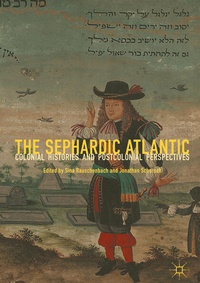
The Sephardic Atlantic
Description
This volume contributes to the growing field of Early Modern Jewish Atlantic History, while stimulating new discussions at the interface between Jewish Studies and Postcolonial Studies. It is a collection of substantive, sophisticated and variegated essays, combining case studies with theoretical reflections, organized into three sections: race and blood, metropoles and colonies, and history and memory. Twelve chapters treat converso slave traders, race and early Afro-Portuguese relations in West Africa, Sephardim and people of color in nineteenth-century Curaçao, Portuguese converso/Sephardic imperialist behavior, Caspar Barlaeus' attitude toward Jews in the Sephardic Atlantic, Jewish-Creole historiography in eighteenth-century Suriname, Savannah's eighteenth-century Sephardic community in an Altantic setting, Freemasonry and Sephardim in the British Empire, the figure of Columbus in popular literature about the Caribbean, key works of Caribbean postcolonial literature on Sephardim, the holocaust, slavery and race, Canadian Jewish identity in the reception history of Esther Brandeau/Jacques La Fargue and Moroccan-Jewish memories of a sixteenth-century Portuguese military defeat.
Reviews / Votes
"These wide-ranging and incisive essays together offer an excellent survey of the vibrancy of the field of Sephardic Studies today, and the vigor of current scholarly engagement between postcolonial studies and Jewish studies, to great mutual benefit. The volume combines theoretical nuance, particularly on questions of race, identity, power and memory, with a set of detailed and often intriguing case studies ranging across all corners of the Atlantic world. It will be essential reading for everybody with a serious interest in the history of cross-cultural interactions in this crucial contact zone, and their legacy for the wider world." (Adam Sutcliffe, King's College, London, UK)
"Ranging from Morocco and West Africa to Savannah, Lisbon and, Surinam, this fascinating collection demonstrates through historical and literary studies that men and women of the Nation , the Sephardic community, although often restricted or disadvantaged, were very much part of the process ofimperial expansion and colonialism, but with their own distinctive millenarian expectations, their own material and spiritual goals, and sometimes with relations with other disadvantaged peoples that challenged imperial projects. This volume makes clear that in the creation of the various "Atlantics" of the Early Modern period, the Sephardi experience and presence cannot be overlooked, and at some times and places cannot be exaggerated." (Stuart B. Schwartz, Yale University, USA)
"This is an important collection of essays. It brings together a dynamic group of scholars who probe the crossovers between subaltern, Sephardic, and Atlantic histories. It is very timely and speaks to a number of fields. It is a book that will provoke important debates as to the nature and limitations of concepts currently employed in Atlantic and Postcolonial studies." (Toby Green, King's College, London, UK)
More details
Other editions
Additional editions
Persons
Sina Rauschenbach is Chair of Religious Studies and Jewish Thought the Universität Potsdam and founder of the Jewish Activism Summer School, Germany.