

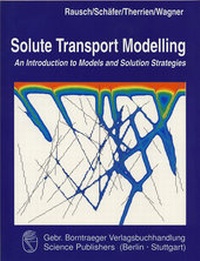
Solute Transport Modelling
An Introduction to Models and Solution Strategies
1st Edition
Published on 22. September 2005
Book
Paperback/Softback
V, 205 pages
978-3-443-01055-3 (ISBN)
Description
Transport models have become an essential tool to investigate groundwater quality problems. This book presents the fundamental hydraulic, hydrochemical and nume rical concepts that are required for the sound and efficient application of solute transport models in groundwater studies. Advection, dispersion and diffusion, which are the main physical transport processes, are first introduced, followed by the derivation of the advection-dispersion equation. A separate chapter is dedicated to multispecies reactive transport modelling, presenting both theory and simulation examples. Special methods used to simulate transport in fractured geological material are also presented. The authors, all of them groundwater modelling professionals, focus on the detailed presentation of numerical methods commonly used in transport models, to provide practitioners with a sound theoretical basis for transport model applications. Grid-based methods are presented, including explicit and implicit finite differences, finite elements and finite volume methods. Particle tracking techniques are also covered, among them the method of characteristics and the random-walk method. This professional text addresses academics, scientists, engineers, hydrologists and hydrogeol ogists interested in the application of transport models in hydrogeology, geoecology, hydrology, geography, environmental engineering, hydraulic engineering and water economics.
More details
Other editions
Additional editions
Randolf Rausch | Wolfgang Schäfer | René Therrien
Solute Transport Modelling
An Introduction to Models and Solution Strategies
E-Book
05/2020
1st Edition
E. Schweizerbart'sche Verlagsbuchhandlung
€39.80
Available for download
Persons
Content
1 Transport processes and equation 1
1.1 Transport model 1
1.2 The transport equation 2
1.3 Transport processes 2
Advection - Molecular diffusion - Dispersion - Reactions
1.4 Derivation of the transport equation 15
1.5 Mathematical nature of the transport equation 19
1.6 Initial and boundary conditions 20
2 Analytical solutions 23
2.1 One-dimensional transport 24
Instantaneous source - Continuous source - Finite-duration source
2.2 Two-dimensional transport 27
Instantaneous source - Continuous source - Steady-state plume - Semi-in nite aquifer
2.3 Other transport solutions 32
3 Grid-based numerical methods 33
3.1 Time discretization 33
The explicit EULER method - The implicit EULER method - The CRANK-NICOLSON method - Higher-order methods
3.2 The nite difference method 36
Mass balance for Finite difference - Matrix equation in one dimension - Criteria for numerical stability - Criteria for numerical precision - Finite difference solution of the 2D transport equation - Mass balance for 2D nite difference - Stability and precision of the 2D solution
3.3 Finite volume method 52
Triangulation and dual grids - Approximation functions and mass balance - Upwind stabilization - Incorporation of boundary conditions
3.4 Finite element method 61
GALERKIN method - Stabilization - Finite element boundary conditions
3.5 Adaptive gridding 66
Example
4 Numerical methods: Particle tracking 71
4.1 The owline and travel time method 71
4.2 Method of characteristics 75
Standard method of characteristics - Modified method of characteristics
4.3 Random-walk method 80
Theoretical basis - Ca-lculation of dispersion - Generation of particle distributions - The random-walk method in two and three dimensions - Computation of concentration distribution - Determination of the ow eld
4.4 Comparison of methods 88
5 Solution of systems of equations 91
5.1 Direct solution 92
5.2 Classical linear iterative methods 94
The JACOBI and GAUSS-SEIDEL methods - Underrelaxed JACOBI method and SOR method - ILU decomposition
5.3 The conjugate gradient method 100
Conjugate gradient method for symmetric matrices - Preconditioned CG method for symmetric matrices - The GMRES method - The BiCGStab method
5.4 Multigrid methods 106
Smoothing - Correction for coarse grids - Prolongation and restriction - Multigrid algorithm - Grid hierarchy - Computational and memory requirements - Algebraic multigrid
5.5 The NEWTON-RAPHSON method 116
The NEWTON method for functions of a single variable - The NEWTON method for systems of equations
6 Transport and reactions 121
6.1 Simple reaction models 121
Retardation - First-order decay
6.2 Dual-porosity model 126
Equations and parameters - Dual-porosity behavior - Application of the dual-porosity model
6.3 Multispecies models 131
Carbonate system equilibrium - Cation exchange - Other equilibrium models - Microbial redox reactions - Overview of existing multispecies models
6.4 Coupling of transport and reactions 145
6.5 Example of a multispecies simulation 147
Hypothetical column - Results - Application of multispecies models
7 Transport in fractured media 159
7.1 Flow and transport in a single fracture 160
7.2 Equivalent Porous Medium approach 164
7.3 Multi-domain approach 164
Dual-domain approach - Dual-porosity approach
7.4 Discrete fracture approach 171
Analytical solutions for discrete fracture transport - Semi-analytical solution for fracture networks - Numerical transport models for fracture networks - Analogy between dual-porosity and discrete fracture model
7.5 Modelling strategies 183
A References 187
B List of symbols 197
C Index 201
1.1 Transport model 1
1.2 The transport equation 2
1.3 Transport processes 2
Advection - Molecular diffusion - Dispersion - Reactions
1.4 Derivation of the transport equation 15
1.5 Mathematical nature of the transport equation 19
1.6 Initial and boundary conditions 20
2 Analytical solutions 23
2.1 One-dimensional transport 24
Instantaneous source - Continuous source - Finite-duration source
2.2 Two-dimensional transport 27
Instantaneous source - Continuous source - Steady-state plume - Semi-in nite aquifer
2.3 Other transport solutions 32
3 Grid-based numerical methods 33
3.1 Time discretization 33
The explicit EULER method - The implicit EULER method - The CRANK-NICOLSON method - Higher-order methods
3.2 The nite difference method 36
Mass balance for Finite difference - Matrix equation in one dimension - Criteria for numerical stability - Criteria for numerical precision - Finite difference solution of the 2D transport equation - Mass balance for 2D nite difference - Stability and precision of the 2D solution
3.3 Finite volume method 52
Triangulation and dual grids - Approximation functions and mass balance - Upwind stabilization - Incorporation of boundary conditions
3.4 Finite element method 61
GALERKIN method - Stabilization - Finite element boundary conditions
3.5 Adaptive gridding 66
Example
4 Numerical methods: Particle tracking 71
4.1 The owline and travel time method 71
4.2 Method of characteristics 75
Standard method of characteristics - Modified method of characteristics
4.3 Random-walk method 80
Theoretical basis - Ca-lculation of dispersion - Generation of particle distributions - The random-walk method in two and three dimensions - Computation of concentration distribution - Determination of the ow eld
4.4 Comparison of methods 88
5 Solution of systems of equations 91
5.1 Direct solution 92
5.2 Classical linear iterative methods 94
The JACOBI and GAUSS-SEIDEL methods - Underrelaxed JACOBI method and SOR method - ILU decomposition
5.3 The conjugate gradient method 100
Conjugate gradient method for symmetric matrices - Preconditioned CG method for symmetric matrices - The GMRES method - The BiCGStab method
5.4 Multigrid methods 106
Smoothing - Correction for coarse grids - Prolongation and restriction - Multigrid algorithm - Grid hierarchy - Computational and memory requirements - Algebraic multigrid
5.5 The NEWTON-RAPHSON method 116
The NEWTON method for functions of a single variable - The NEWTON method for systems of equations
6 Transport and reactions 121
6.1 Simple reaction models 121
Retardation - First-order decay
6.2 Dual-porosity model 126
Equations and parameters - Dual-porosity behavior - Application of the dual-porosity model
6.3 Multispecies models 131
Carbonate system equilibrium - Cation exchange - Other equilibrium models - Microbial redox reactions - Overview of existing multispecies models
6.4 Coupling of transport and reactions 145
6.5 Example of a multispecies simulation 147
Hypothetical column - Results - Application of multispecies models
7 Transport in fractured media 159
7.1 Flow and transport in a single fracture 160
7.2 Equivalent Porous Medium approach 164
7.3 Multi-domain approach 164
Dual-domain approach - Dual-porosity approach
7.4 Discrete fracture approach 171
Analytical solutions for discrete fracture transport - Semi-analytical solution for fracture networks - Numerical transport models for fracture networks - Analogy between dual-porosity and discrete fracture model
7.5 Modelling strategies 183
A References 187
B List of symbols 197
C Index 201