

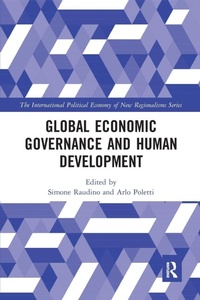
Global Economic Governance and Human Development
1st Edition
Published on 30. June 2021
Book
Paperback/Softback
238 pages
978-1-032-09435-9 (ISBN)
Description
Traditional understandings of economic development in low- and mid-income countries have largely been influenced by the economic narrative of Western Official Development Assistance (ODA). Within this framework, compliance with macroeconomic orthodoxy and early integration in Global Economic Governance (GEG) regimes are presented as enabling conditions to reach enhanced and sustainable levels of economic growth and social betterment. Yet, this narrative often fails to answer fundamental questions surrounding relational dynamics between the economies of ODA beneficiary countries and the GEG regimes they are asked to join.
Bringing together contributions by Government officials, academics and development practitioners, this edited volume explores quantitative and qualitative approaches to socio-economic analysis in low- and mid-income countries, highlighting the conditions under which international economic policies and institutions can foster - or hinder - their socio-economic growth. In particular, contributions address the impact of both West and China-inspired international economic regimes on value-adding capacity, trade, investments, job creation and social development, thus advancing the debate on what policy and legal provisions should low- and mid-income countries adopt in order to maximize the benefits and minimize the costs deriving from joining international economic regimes.
A comprehensive investigation of both sides of the Global Economic Governance and Human Development relationship; this book will interest scholars, practitioners and graduate students working in the areas of international relations, international political economy, global governance, international economics, development studies and human security.
Bringing together contributions by Government officials, academics and development practitioners, this edited volume explores quantitative and qualitative approaches to socio-economic analysis in low- and mid-income countries, highlighting the conditions under which international economic policies and institutions can foster - or hinder - their socio-economic growth. In particular, contributions address the impact of both West and China-inspired international economic regimes on value-adding capacity, trade, investments, job creation and social development, thus advancing the debate on what policy and legal provisions should low- and mid-income countries adopt in order to maximize the benefits and minimize the costs deriving from joining international economic regimes.
A comprehensive investigation of both sides of the Global Economic Governance and Human Development relationship; this book will interest scholars, practitioners and graduate students working in the areas of international relations, international political economy, global governance, international economics, development studies and human security.
More details
Series
Language
English
Place of publication
London
United Kingdom
Publishing group
Taylor & Francis Ltd
Target group
College/higher education
Postgraduate
Illustrations
20 s/w Abbildungen
20 Illustrations, black and white
Dimensions
Height: 234 mm
Width: 156 mm
Thickness: 13 mm
Weight
371 gr
ISBN-13
978-1-032-09435-9 (9781032094359)
Copyright in bibliographic data and cover images is held by Nielsen Book Services Limited or by the publishers or by their respective licensors: all rights reserved.
Schweitzer Classification
Other editions
Additional editions
Simone Raudino | Arlo Poletti
Global Economic Governance and Human Development
Book
11/2018
1st Edition
Routledge
€215.77
Shipment within 10-20 days
Simone Raudino | Arlo Poletti
Global Economic Governance and Human Development
E-Book
11/2018
1st Edition
Routledge
€59.49
Available for download
Simone Raudino | Arlo Poletti
Global Economic Governance and Human Development
E-Book
11/2018
1st Edition
Routledge
€59.49
Available for download
Persons
Simone Raudino is Visiting Professor at the Kiev School of Economics, Ukraine, and the founder of Gap Consultants, a Hong Kong-based business consultancy company exploring alternative measures to promote economic growth in low-income countries.
Arlo Poletti is Associate Professor at the University of Trento, Italy. His research interests focus on the political economy of trade, the politics of international regulatory cooperation and the political economy of international institutions.
Arlo Poletti is Associate Professor at the University of Trento, Italy. His research interests focus on the political economy of trade, the politics of international regulatory cooperation and the political economy of international institutions.
Content
Introduction 1 The Global Economic Governance - Human Development nexus 2 Wealth and the democratization of Global Economic Governance 3 The World Bank in the post-crisis landscape: Stasis and change after the post- Washington Consensus 4 Competing visions of the Western international economic order and the Chinese Belt and Road Initiative 5 Normative trade power Europe? The case of EU trade agreements with Asian countries 6 Is China colonizing Africa? Africa-China relations in a shifting Global Economic Governance system 7 Economic crises and political downturns in South America: Are MERCOSUR's neoliberal roots a constraint on Human Development? 8 Commodity economies and international assistance: Lessons drawn from Ukraine's experience 9 Global Economic Governance, Human Security and socio-economic development in Latin America: The Colombian and Mexican experiences 10 Global Economic Governance and the challenge of economic sustainability in Afghanistan