

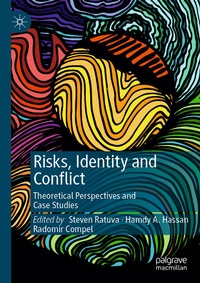
Risks, Identity and Conflict
Description
This volume explores the complex interrelation between risk, identity and conflict
and focuses specifically on ethnicity, culture, religion and gender as modes of
identity that are often associated with conflict in the contemporary world. It
draws on theoretical perspectives as well as pays special attention to analysis of
diverse case studies from Africa, Middle East, Europe, East and Southeast Asia
and Latin America. Using various analytical tools and methodologies, it providesunique narratives of local and regional social risk factors and security complexities.
The relationship between risk and security is multidimensional and perpetually
changing, and lends itself to multiple interpretations. This publication provides a
new ground for theoretical and policy debates to unlock innovative understanding
of risk through analyses of identity as a significant factor in conflict in the world
today.At the same time, it explores ways to address such conflicts in a more
people-centered, empowering and sustainable way.
Reviews / Votes
"This book analyzes, both theoretically and empirically, how diverse social and
political identities such as ethnicity, culture, religion and gender can tackle risks
such as violence, conflicts, and pandemics from the perspective of security. It is
an ambitious and valuable book analyzing how to confront political, social and
international community's risks with norms and institutional reforms within the
framework of neoliberal global competition."(- Professor Kumiko Haba , Aoyama Gakuin University and former
Vice-President of Internationals Studies Association (ISA))"How do our experiences of identity shape our experience of risk in a rapidly
changing, and increasingly insecure world? These are some of the critical
questions that the book provides through exciting and vital insights for a more
sustainable and secure future."
(- Professor Bronwyn Hayward , MNZM, University of Canterbury, New
Zealand, Member of Inter-governmental Panel on Climate Change)
More details
Other editions
Additional editions
Persons
Steven Ratuva is Director and Professor, Macmillan Brown Centre for Pacific Studies at the University of Canterbury, New Zealand.
Hamdy A. Hassan is Professor, College of Humanities and Social Sciences, Zayed University, United Arab Emirates.
Radomir Compel is Associate Professor of Comparative Politics at Nagasaki University, Japan.
Content
Chapter 1: Risk, identity and conflict: A critical overview.- Part I: Ethno-religious Approaches to Risk and Security.- Chapter 2: Risk, Security, and the War on Terror.- Chapter 3: Ethnicity, Insecurity and Geostrategic Transformation in the Horn of Africa.- Chapter 4: Formation of Diaspora Network and Reconstruction of Collective Memory: The Case of Indo-Fijians.- Chapter 5: Ethnicity and Geopolitics of Rohingya Crisis.- Chapter 6: Pious predicaments and pathways for engagement: Ulama and risks in post-conflict milieu.- Part II: Institutional and Policy Approaches to Ethno-religious Risks.- Chapter 7: Ethnic conflicts and peacekeeping.- Chapter 8: Ethnofederal Elections and National Identities: Cross-National Survey Research.- Chapter 9: A Quantitative Text Analysis on Mobilisation of the Electorate by Islamist Parties during the 2018 Iraqi Parliamentary Election.- Chapter 10: Bridging the gap between political ideals and political practices in Afghanistan.- Chapter 11: COVID-19 and the Way to Authoritarian Rule in Ethiopia.- Part III: Gender-based Approaches to Risk and Security.- Chapter 12: Norm Diffusion and Sexual Gender-based violence Survivor Support: A Case Study of Refugee Settlements in Uganda.- Chapter 13: Help-seeking Pathways and Barriers of GBV Survivors in South Sudanese Refugee Settlements in Uganda.- Chapter 14: Negotiating the Gender Based Violence referral pathway: Challenges and opportunities in the refugee hosting areas of Uganda.- Conclusion.- Chapter 15: Risk, Identity and Conflict: Some Concluding Remarks.