

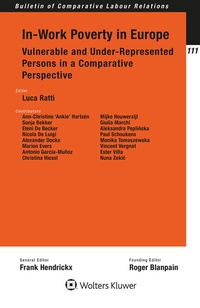
In-Work Poverty in Europe
Vulnerable and Under-Represented Persons in a Comparative Perspective
Published on 6. July 2022
Book
Paperback/Softback
392 pages
978-94-035-4996-5 (ISBN)
Description
In-work poverty is a reality for too many persons in the European Union (EU). Although everyone is in agreement that poverty must be reduced, rarely is there a specific focus on the plight of those who, despite working, are poor. This important book is the first to unreservedly meet the challenge of defining, measuring, and comparing the legal regimes to combat in-work poverty in Europe, fully attending to the strengths and shortcomings of indicators and allowing the assessment of comparative best practices among the Member States.
The distinguished contributors each describe and analyse this complex and multidimensional phenomenon, with its manifold and intertwined causes, in relation to such factors as the following:
- employment-related factors (wage, type of contract, atypical employment);
- worker's socio-demographic characteristics (level of education, gender, age, country of birth);
- size and composition of household;
- household work intensity; and
- institutional factors (childcare, flexible work arrangements, employment protection, housing, technological change).
In a major innovation, the book's methodology approaches the 'working poor' by distinctly defining four groups of vulnerable and under-represented persons (VUPs) with detailed statistical information on in-work poverty in each group.
Following an in-depth introduction focusing on the definition and ramifications of the concept of in-work poverty - including a discussion of legal scholarship and relevant EU instruments - the situations in seven EU Member States (Belgium, Germany, Italy, Luxembourg, the Netherlands, Poland, and Sweden) are compared, revealing important variations. For each of the VUP groups, these chapters explain their composition at the national level and assess the impact of regulation on the incidence of in-work poverty. The last chapter highlights differences and similarities in an attempt to find patterns and identify common regulatory problems and best practices.
The book's comparative perspective greatly assists in understanding in-work poverty determinants, appraising varieties of relevant national policies, and stimulating the development of effective legal measures. With its close analysis of the limitations of existing measurement indicators, the book sheds light on the role of regulation in the prevalence and persistence of the phenomenon and equips policymakers at the EU and national levels with targeted tools to tackle this severe social problem.
The distinguished contributors each describe and analyse this complex and multidimensional phenomenon, with its manifold and intertwined causes, in relation to such factors as the following:
- employment-related factors (wage, type of contract, atypical employment);
- worker's socio-demographic characteristics (level of education, gender, age, country of birth);
- size and composition of household;
- household work intensity; and
- institutional factors (childcare, flexible work arrangements, employment protection, housing, technological change).
In a major innovation, the book's methodology approaches the 'working poor' by distinctly defining four groups of vulnerable and under-represented persons (VUPs) with detailed statistical information on in-work poverty in each group.
Following an in-depth introduction focusing on the definition and ramifications of the concept of in-work poverty - including a discussion of legal scholarship and relevant EU instruments - the situations in seven EU Member States (Belgium, Germany, Italy, Luxembourg, the Netherlands, Poland, and Sweden) are compared, revealing important variations. For each of the VUP groups, these chapters explain their composition at the national level and assess the impact of regulation on the incidence of in-work poverty. The last chapter highlights differences and similarities in an attempt to find patterns and identify common regulatory problems and best practices.
The book's comparative perspective greatly assists in understanding in-work poverty determinants, appraising varieties of relevant national policies, and stimulating the development of effective legal measures. With its close analysis of the limitations of existing measurement indicators, the book sheds light on the role of regulation in the prevalence and persistence of the phenomenon and equips policymakers at the EU and national levels with targeted tools to tackle this severe social problem.
More details
Language
English
Place of publication
Zuidpoolsingel
Netherlands
Product notice
Paperback (trade)
Unsewn / adhesive bound
Dimensions
Height: 234 mm
Width: 156 mm
Thickness: 22 mm
Weight
599 gr
ISBN-13
978-94-035-4996-5 (9789403549965)
Copyright in bibliographic data and cover images is held by Nielsen Book Services Limited or by the publishers or by their respective licensors: all rights reserved.
Schweitzer Classification
Other editions
Additional editions
Luca Ratti
In-Work Poverty in Europe
Vulnerable and Under-Represented Persons in a Comparative Perspective
E-Book
07/2022
Wolters Kluwer
€127.99
Available for download
Luca Ratti
In-Work Poverty in Europe
Vulnerable and Under-Represented Persons in a Comparative Perspective
E-Book
07/2022
Wolters Kluwer
€127.99
Available for download