

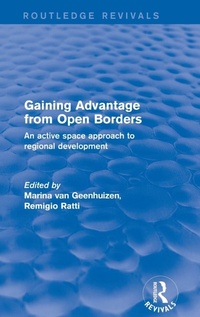
Gaining Advantage from Open Borders
An Active Space Approach to Regional Development
1st Edition
Published on 28. June 2017
Book
Hardback
414 pages
978-1-138-72851-6 (ISBN)
Description
This title was first published in 2001. The contributors to this book examine how changing political borders and disappearing obstacles in transport have led to diverging patterns of interaction between European regions, with different outcomes.trajectories are identified and analyzed.
More details
Series
Language
English
Place of publication
London
United Kingdom
Publishing group
Taylor & Francis Ltd
Target group
College/higher education
Dimensions
Height: 240 mm
Width: 161 mm
Thickness: 27 mm
Weight
787 gr
ISBN-13
978-1-138-72851-6 (9781138728516)
Copyright in bibliographic data and cover images is held by Nielsen Book Services Limited or by the publishers or by their respective licensors: all rights reserved.
Schweitzer Classification
Other editions
Additional editions
Remigio Ratti | Marina van Geenhuizen
Gaining Advantage from Open Borders
An Active Space Approach to Regional Development
Book
01/2019
1st Edition
Routledge
€15.90
Shipment within 10-20 days

Remigio Ratti | Marina van Geenhuizen
Gaining Advantage from Open Borders
An Active Space Approach to Regional Development
E-Book
07/2017
Routledge
€10.49
Available for download

Remigio Ratti | Marina van Geenhuizen
Gaining Advantage from Open Borders
An Active Space Approach to Regional Development
E-Book
07/2017
Routledge
€10.49
Available for download
Persons
Remigio Ratti, Marina van Geenhuizen
Content
Contents: Introduction: An active space approach to regional development, Marina van Geenhuizen and Remigio Ratti;
Regional active space: a regional scientist's paradigmatic answer to the local-global debate, Remigio Ratti;
The importance of being active. A comment on the active space approach from an Austrian perspective, Michael Steiner;
Governance for territorial development: what is it about?, Alberto Bramanti. Reasons For an Active Space Approach: Obstacles to openness of border regions in Europe, Piet Rietveld; Openness: a value in itself? the case of the Dutch-German Ems-Dollart region, Enne de Boer;
The determinants of cross-border economic relations. The case of The Netherlands and Belgium, Henk van Houtum; Cross-border economic dynamics. Threats or opportunities in the Swiss-Italian labour market, Mario A. Maggioni and Alberto Bramanti;
Which role for foreign direct investment? Active space development in Central and Eastern Europe, Marina van Geenhuizen; In search of complementarities. Initiation of interaction with Russian Karelia, Heikki Eskelinen;
Cross-border co-operation in the German-Polish border area, Stefan KrA?tke. Conditions and Policies in Active Space Development: Managing the openness of border regions in the context of European integration, Zdravko Mlinar;
Active cross-border regions: institutional dynamics and institution building, Joachim Blatter; Knowledge as a crucial resource in policy making for mainport Rotterdam, Marina van Geenhuizen and Peter Nijkamp;
Co-operation between local governments: can a holding company be a solution in public-private partnerships?, Remigio Ratti and Christian Vitta;
New technology-based firms and the activation of the Styrian economy, Michael Steiner and Thomas Jud; In search for the best location of a free zone at the Eastern border of Germany, Arndt Siepmann;
European policies for European border regions: an active space approach?, Fabienne Corvers; Reflections on active space development: emerging issues and new research paths, Marina van Geenhuizen and Remigio Ratti.
Regional active space: a regional scientist's paradigmatic answer to the local-global debate, Remigio Ratti;
The importance of being active. A comment on the active space approach from an Austrian perspective, Michael Steiner;
Governance for territorial development: what is it about?, Alberto Bramanti. Reasons For an Active Space Approach: Obstacles to openness of border regions in Europe, Piet Rietveld; Openness: a value in itself? the case of the Dutch-German Ems-Dollart region, Enne de Boer;
The determinants of cross-border economic relations. The case of The Netherlands and Belgium, Henk van Houtum; Cross-border economic dynamics. Threats or opportunities in the Swiss-Italian labour market, Mario A. Maggioni and Alberto Bramanti;
Which role for foreign direct investment? Active space development in Central and Eastern Europe, Marina van Geenhuizen; In search of complementarities. Initiation of interaction with Russian Karelia, Heikki Eskelinen;
Cross-border co-operation in the German-Polish border area, Stefan KrA?tke. Conditions and Policies in Active Space Development: Managing the openness of border regions in the context of European integration, Zdravko Mlinar;
Active cross-border regions: institutional dynamics and institution building, Joachim Blatter; Knowledge as a crucial resource in policy making for mainport Rotterdam, Marina van Geenhuizen and Peter Nijkamp;
Co-operation between local governments: can a holding company be a solution in public-private partnerships?, Remigio Ratti and Christian Vitta;
New technology-based firms and the activation of the Styrian economy, Michael Steiner and Thomas Jud; In search for the best location of a free zone at the Eastern border of Germany, Arndt Siepmann;
European policies for European border regions: an active space approach?, Fabienne Corvers; Reflections on active space development: emerging issues and new research paths, Marina van Geenhuizen and Remigio Ratti.