

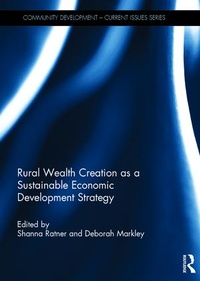
Rural Wealth Creation as a Sustainable Economic Development Strategy
1st Edition
Published on 6. November 2015
Book
Hardback
108 pages
978-1-138-11946-8 (ISBN)
Description
Many rural areas in the United States find themselves struggling to build local assets and create wealth, and, when this wealth is created, they often struggle to hold on it. Previous approaches to community and economic development have been inadequate in attempting to reverse these trends. Shifting to a new way of enabling economic development requires supporting innovative community leaders as they explore new ways of approaching the task at hand. It also requires thinking anew about the role of rural areas, based on valuing multiple forms of wealth - natural, social, and human. There is a real need for an approach that can help stem the potential loss of existing wealth, and attract new investment that will allow rural areas to become valued partners in regional economies.
This book provides an important insight into rural wealth creation as a sustainable economic development strategy. At the same time, a number of compelling issues are raised that merit future research effort and discussion. This book was originally published as a special issue of Community Development.
This book provides an important insight into rural wealth creation as a sustainable economic development strategy. At the same time, a number of compelling issues are raised that merit future research effort and discussion. This book was originally published as a special issue of Community Development.
More details
Series
Language
English
Place of publication
London
United Kingdom
Publishing group
Taylor & Francis Ltd
Target group
College/higher education
Dimensions
Height: 246 mm
Width: 174 mm
Weight
385 gr
ISBN-13
978-1-138-11946-8 (9781138119468)
Copyright in bibliographic data and cover images is held by Nielsen Book Services Limited or by the publishers or by their respective licensors: all rights reserved.
Schweitzer Classification
Other editions
Additional editions
Shanna Ratner | Deborah Markley
Rural Wealth Creation as a Sustainable Economic Development Strategy
Book
01/2018
1st Edition
Routledge
€81.99
Shipment within 10-20 days
Shanna Ratner | Deborah Markley
Rural Wealth Creation as a Sustainable Economic Development Strategy
E-Book
10/2017
1st Edition
Routledge
€69.99
Available for download
Shanna Ratner | Deborah Markley
Rural Wealth Creation as a Sustainable Economic Development Strategy
E-Book
10/2017
1st Edition
Routledge
€69.99
Available for download
Persons
Shanna Ratner is the founder of Yellow Wood Associates, a woman-owned small business, based in St. Alban's City, VT, USA, which specializes in community economic development in rural America.
Deborah Markley is the co-founder of the Center for Rural Entrepreneurship, a national non-profit based in Lincoln, NE, USA, which works with communities across North America to create and implement entrepreneurship development strategies.
Deborah Markley is the co-founder of the Center for Rural Entrepreneurship, a national non-profit based in Lincoln, NE, USA, which works with communities across North America to create and implement entrepreneurship development strategies.
Content
Introduction: Rural wealth creation as a sustainable economic development strategy 1. Facilitating community wealth building: understanding the roles played and capacities needed by coordinating institutions 2. Socioeconomic development in an ultra-peripheral European region: the role of a food regulatory council as a social anchor 3. Community forests as a wealth creation strategy for rural communities 4. Community development and other extra-religious functions of Islamic schools: a contemporary perspective from the voices of stakeholders in two madrassas in Pakistan 5. International amenity migration: implications for integrated community development opportunities 6. A story about storytelling: enhancement of community participation through catalytic storytelling