

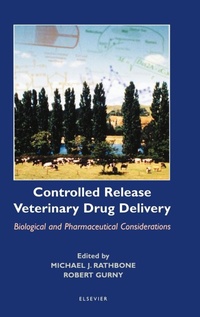
Controlled Release Veterinary Drug Delivery
Biological and Pharmaceutical Considerations
Published on 20. July 2000
Book
Hardback
392 pages
978-0-444-82992-4 (ISBN)
Description
Many controlled release veterinary drug delivery systems (CRVDDS) are presently in use, and recently there has been a host of new CRVDDS within veterinary medicine. The challenges of this area of drug delivery arise from the unique anatomy and physiology of the target animal, the cost constraints associated with the value of the animal being treated and the extended periods of time that delivery must be sustained for (often measured in months).
The purpose of this book is to introduce the reader to the unique opportunities and challenges of the field of CRVDDS and to explain and discuss the basic controlled release principles underlying the development of CRVDDS. Its aim is to provide an overview of many of the areas where CRVVDS have application, and to highlight the opportunities and prospects for controlled release technology in the veterinary field.
Controlled Release Veterinary Drug Delivery comprises chapters that provide workers in the field (and those interested in this area) with information on the design, development and assessment of a variety of CRVDDS. The book contains chapters that describe the relevant animal physiological and anatomical considerations alongside descriptions of current and emerging controlled release delivery systems for a variety of routes for drug delivery, and present overviews on the physical and chemical assessment of veterinary controlled release delivery systems.
The veterinary area is abound with opportunities for the development of controlled release drug delivery technologies. It is an area of medicine that is open to the acceptance of novel drug delivery devices, and which readily encompasses the use of novel routes of administration. It is an area of many unmet needs, most of which offer opportunities and unique challenges for the innovative formulation scientist to provide solutions. This book will provide an insight into the biological, clinical and pharmaceutical challenges that face the formulation scientist in this interesting and diverse area of research.
The purpose of this book is to introduce the reader to the unique opportunities and challenges of the field of CRVDDS and to explain and discuss the basic controlled release principles underlying the development of CRVDDS. Its aim is to provide an overview of many of the areas where CRVVDS have application, and to highlight the opportunities and prospects for controlled release technology in the veterinary field.
Controlled Release Veterinary Drug Delivery comprises chapters that provide workers in the field (and those interested in this area) with information on the design, development and assessment of a variety of CRVDDS. The book contains chapters that describe the relevant animal physiological and anatomical considerations alongside descriptions of current and emerging controlled release delivery systems for a variety of routes for drug delivery, and present overviews on the physical and chemical assessment of veterinary controlled release delivery systems.
The veterinary area is abound with opportunities for the development of controlled release drug delivery technologies. It is an area of medicine that is open to the acceptance of novel drug delivery devices, and which readily encompasses the use of novel routes of administration. It is an area of many unmet needs, most of which offer opportunities and unique challenges for the innovative formulation scientist to provide solutions. This book will provide an insight into the biological, clinical and pharmaceutical challenges that face the formulation scientist in this interesting and diverse area of research.
Reviews / Votes
from:(R. Daniels, Universitaet Braunschweig, Germany)"Although the basics of controlled release drug delivery systems for human and for veterinary use are similar, the details of drug delivery to animals are in fact very different. Thus, it is the purpose of this book to introduce the reader to the unique opportunities and challenges of the field of controlled release veterinary drug delivery systems (CRVDDS).
In summary, the book provides a sound and comprehensive overview of this challenging and exciting field of pharmaceutical research. Those who will go deeper into details will be guided by more than 1200 citations which are provided with the book.
It is recommendable to all workers in the field as well as to everybody who wants to get an insight in this interesting and diverse area of research." --European Journal of Pharmaceutics and Biopharmaceutics Vol. 52/2
More details
Language
English
Place of publication
Oxford
United Kingdom
Publishing group
Elsevier Science & Technology
Target group
Professional and scholarly
Product notice
Laminated cover
Dimensions
Height: 234 mm
Width: 156 mm
Thickness: 24 mm
Weight
726 gr
ISBN-13
978-0-444-82992-4 (9780444829924)
Copyright in bibliographic data and cover images is held by Nielsen Book Services Limited or by the publishers or by their respective licensors: all rights reserved.
Schweitzer Classification
Other editions
Additional editions
M. J. Rathbone | M. J. Rathbone | R. Gurny
Controlled Release Veterinary Drug Delivery
Biological and Pharmaceutical Considerations
E-Book
07/2000
Elsevier
€265.00
Available for download
Persons
Michael J. Rathbone, PhD is Founder and Managing Director of his own company, ULTI Pharmaceuticals, NZ. He is also an associate at University of Technology Sydney, Australia. He has taught at International Medical University, Kuala Lumpur, Malaysia and Griffith University, Australia and he was the Director of Research and General Manager InterAg, New Zealand, where he spearheaded the companies veterinary controlled drug delivery research and directed their national and global collaborative research activities. He is a Fellow of the Controlled Release Society, has served on the Board of Directors of the CRS and has received several prestigious awards for his contribution to the science and technology of controlled release. He has edited 8 books in the area of modified release drug delivery and 10 special theme issues of journals such as Advanced Drug Delivery Reviews (Elsevier) and Journal of Controlled Release (Elsevier).
Content
Preface (M.J. Rathbone). Forward (K. Ellis). Utilization of biopharmaceutical and pharmacokinetic principles in the development of veterinary controlled release drug delivery systems (P. Inskeep). Mechanisms of drug release from controlled release veterinary drug delivery systems (M.J. Rathbone). Intraruminal controlled release products (J. Cardinal). Design parameters for post-ruminal drug delivery systems and rumen-stable products (S. Wu). Design and development of controlled release ocular veterinary drug delivery systems (R. Gurny). Design and development of controlled release intravaginal veterinary drug delivery systems (M.J. Rathbone). Controlled release drug delivery systems for estrous control of domesticated livestock (M.J. Rathbone). Controlled release products for control of ectoparacites of livestock (A.M. Knipling-Bushland). Controlled release products for companion animals (L. Witchey-Lakshmanan). Controlled release vaccines (T. Bowersack). In vitro drug release testing of controlled release veterinary drug products (M.J. Rathbone). Stability testing of veterinary drug products (M.J. Rathbone). USA regulatory aspects pertaining to controlled release veterinary drug delivery systems (D. Lindsey).