

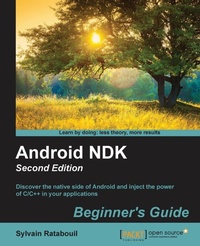
Android NDK Beginner`s Guide -
Discover the native side of Android and inject the power of C/C++ in your applications
2nd Edition
Published on 28. April 2015
Book
Paperback/Softback
494 pages
978-1-78398-964-5 (ISBN)
Description
.
Key Features
Book DescriptionAre you an Android Java programmer who needs more performance? Are you a C/C++ developer who doesn't want to bother with the complexity of Java and its out-of-control garbage collector? Do you want to create fast intensive multimedia applications or games? If you've answered yes to any of these questions then this book is for you. With some general knowledge of C/C++ development, you will be able to dive headfirst into native Android development.What you will learn
Build your first Android native project from scratch
Communicate with Java through Java Native Interfaces
Learn the key design intricacies of creating a native OpenGL ES 2.0 graphics application
Initialize, play, and record sound and music with OpenSL ES
Handle input events and sensors to create different interaction types
Port an existing library on Android by compiling most common C++ frameworks on Android
Interface and optimize the existing code with RenderScript
Combine graphics, sound, input, sensors, and physics in your application
Who this book is for
Key Features
Book DescriptionAre you an Android Java programmer who needs more performance? Are you a C/C++ developer who doesn't want to bother with the complexity of Java and its out-of-control garbage collector? Do you want to create fast intensive multimedia applications or games? If you've answered yes to any of these questions then this book is for you. With some general knowledge of C/C++ development, you will be able to dive headfirst into native Android development.What you will learn
Build your first Android native project from scratch
Communicate with Java through Java Native Interfaces
Learn the key design intricacies of creating a native OpenGL ES 2.0 graphics application
Initialize, play, and record sound and music with OpenSL ES
Handle input events and sensors to create different interaction types
Port an existing library on Android by compiling most common C++ frameworks on Android
Interface and optimize the existing code with RenderScript
Combine graphics, sound, input, sensors, and physics in your application
Who this book is for
More details
Edition
2nd edition
Language
English
Place of publication
Birmingham
United Kingdom
Dimensions
Height: 235 mm
Width: 191 mm
Thickness: 27 mm
Weight
913 gr
ISBN-13
978-1-78398-964-5 (9781783989645)
Copyright in bibliographic data and cover images is held by Nielsen Book Services Limited or by the publishers or by their respective licensors: all rights reserved.
Schweitzer Classification
Other editions
Additional editions
Sylvain Ratabouil
Android NDK Beginner`s Guide - Second Edition
Discover the native side of Android and inject the power of C/C++ in your applications
E-Book
10/2025
Packt Publishing
from
€42.09
Available for download
Person
Sylvain Ratabouil is an IT consultant, experienced in Android, Java, and C/C++. He has contributed to the development of digital and mobile applications for large companies as well as industrial projects for the space and aeronautics industries. As a technology lover, he is passionate about mobile technologies and cannot live without his Android smartphone.
Content
Table of Contents
Setting up your environment
Creating your first Android native project
Interfacing Java and C/C++
Calling Java back from native code
Writing a fully-native application
Rendering Graphics with OpenGL
Playing Sound with OpenSL ES!
Handling Input Devices and Sensors
Porting existing libraries to Android
Intensive computing with RenderScript
Setting up your environment
Creating your first Android native project
Interfacing Java and C/C++
Calling Java back from native code
Writing a fully-native application
Rendering Graphics with OpenGL
Playing Sound with OpenSL ES!
Handling Input Devices and Sensors
Porting existing libraries to Android
Intensive computing with RenderScript