

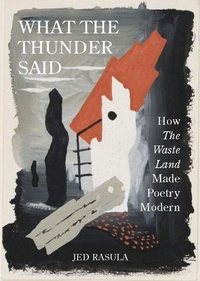
What the Thunder Said
How The Waste Land Made Poetry Modern
Published on 3. December 2024
Book
Paperback/Softback
344 pages
978-0-691-22579-1 (ISBN)
Description
A rich cultural history of the creation, explosive impact, and enduring influence of T. S. Eliot's modernist masterpiece
When T. S. Eliot published The Waste Land in 1922, it put the thirty-four-year-old author on a path to worldwide fame and the Nobel Prize. "But," as Jed Rasula writes, "The Waste Land is not only a poem: it names an event, like a tornado or an earthquake. Its publication was a watershed, marking a before and after. It was a poem that unequivocally declared that the ancient art of poetry had become modern." In What the Thunder Said, Rasula tells the story of how The Waste Land changed poetry forever and how this cultural bombshell served as a harbinger of modernist revolution in all the arts, from abstraction in visual art to atonality in music.
From its famous opening, "April is the cruellest month, breeding / Lilacs out of the dead land," to its closing Sanskrit mantra, "Shantih shantih shantih," The Waste Land combined singular imagery, experimental technique, and dense allusions, boldly fulfilling Ezra Pound's injunction to "make it new." What the Thunder Said traces the origins, reception, and enduring influence of the poem, from its roots in Wagnerism and French Symbolism to the way its strangely beguiling music continues to inspire readers. Along the way, we learn about Eliot's storied circle, including Wyndham Lewis, Virginia Woolf, and Bertrand Russell, and about poets like Mina Loy and Marianne Moore, whose innovations have proven as consequential as those of the "men of 1914."
Filled with fresh insights and unfamiliar anecdotes, What the Thunder Said recovers the explosive force of the twentieth century's most influential poem.
When T. S. Eliot published The Waste Land in 1922, it put the thirty-four-year-old author on a path to worldwide fame and the Nobel Prize. "But," as Jed Rasula writes, "The Waste Land is not only a poem: it names an event, like a tornado or an earthquake. Its publication was a watershed, marking a before and after. It was a poem that unequivocally declared that the ancient art of poetry had become modern." In What the Thunder Said, Rasula tells the story of how The Waste Land changed poetry forever and how this cultural bombshell served as a harbinger of modernist revolution in all the arts, from abstraction in visual art to atonality in music.
From its famous opening, "April is the cruellest month, breeding / Lilacs out of the dead land," to its closing Sanskrit mantra, "Shantih shantih shantih," The Waste Land combined singular imagery, experimental technique, and dense allusions, boldly fulfilling Ezra Pound's injunction to "make it new." What the Thunder Said traces the origins, reception, and enduring influence of the poem, from its roots in Wagnerism and French Symbolism to the way its strangely beguiling music continues to inspire readers. Along the way, we learn about Eliot's storied circle, including Wyndham Lewis, Virginia Woolf, and Bertrand Russell, and about poets like Mina Loy and Marianne Moore, whose innovations have proven as consequential as those of the "men of 1914."
Filled with fresh insights and unfamiliar anecdotes, What the Thunder Said recovers the explosive force of the twentieth century's most influential poem.
Reviews / Votes
"A Choice Outstanding Academic Title of the Year" "Provide[s] valuable context for Eliot's 1922 masterpiece."---Michael Dirda, Washington Post "Stimulating. . . . Rasula's account wonderfully traces the evolution of literary thought, and his syntheses feel fresh and exciting. The result is a refreshing reappraisal of a classic." * Publishers Weekly (starred review) * "[What the Thunder Said is] adding more weight to the headstone that marks Eliot."---James Matthew Wilson, New Criterion "The book demonstrates [Rasula's] uncommon ability to compress highly complicated artistic, cultural, and intellectual histories into accessible and enjoyable prose."---Daniel Kraft, On the Seawall "Filled with fresh insights and unfamiliar anecdotes, What the Thunder Said recovers the explosive force of the twentieth century's most influential poem."---Marshal Zeringue, Campaign for the American Reader "Rasula makes the case for The Waste Land's lasting revolutionary impact in his engaging and insightful, if occasionally discursive, study."---Peter Keough, Arts Fuse "The book is much more than its title suggests, sympathetically conveying a whole complex literary world marked by revolutionary intensity." * Paradigm Explorer * "[What the Thunder Said] confirms Rasula's position as the US's most wide-ranging and aculturally astute historian of modernism." * Choice * "What the Thunder Said is an energetic book bristling with ideas and arguments."---Jason Harding, American Literary HistoryMore details
Language
English
Place of publication
New Jersey
United States
Target group
College/higher education
Professional and scholarly
Product notice
Paperback (trade)
Illustrations
32 b/w illus.
Dimensions
Height: 223 mm
Width: 143 mm
Thickness: 21 mm
Weight
550 gr
ISBN-13
978-0-691-22579-1 (9780691225791)
Copyright in bibliographic data and cover images is held by Nielsen Book Services Limited or by the publishers or by their respective licensors: all rights reserved.
Schweitzer Classification
Other editions
Additional editions
E-Book
08/2022
1st Edition
Princeton University Press
€23.49
Available for download
Person
Jed Rasula is the Helen S. Lanier Distinguished Professor at the University of Georgia. He is the author of nine scholarly books and three poetry collections and the coeditor of two anthologies. His recent books include Destruction Was My Beatrice: Dada and the Unmaking of the Twentieth Century and History of a Shiver: The Sublime Impudence of Modernism.