

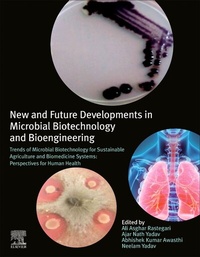
New and Future Developments in Microbial Biotechnology and Bioengineering
Trends of Microbial Biotechnology for Sustainable Agriculture and Biomedicine Systems: Perspectives for Human Health
Published on 16. May 2020
Book
Paperback/Softback
312 pages
978-0-12-820528-0 (ISBN)
Description
New and Future Developments in Microbial Biotechnology and Bioengineering: Trends of Microbial Biotechnology for Sustainable Agriculture and Biomedicine Systems: Perspectives for Human Health discusses how microbial biotechnology helps us understand new strategies to reduce pathogens and drug resistance through microbial biotechnology. The most commonly used probiotic bacteria are Lactobacillus and Bifidobacterium. Therefore, the probiotic strains exhibit powerful anti-inflammatory, antiallergic and other important properties. This new book provides an indispensable reference source for engineers/bioengineers, biochemists, biotechnologists, microbiologists, pharmacologists, and researchers who want to know about the unique properties of this microbe and explore its sustainable biomedicine future applications.
Reviews / Votes
"This book discusses how microbial biotechnology helps us understand new strategies to reduce pathogens and drug resistance through microbial biotechnology. The most commonly used probiotic bacteria are Lactobacillus and Bifidobacterium. Therefore, the probiotic strains exhibit powerful anti-inflammatory, antiallergic, and other important properties. It provides an indispensable reference source for engineers/bioengineers, biochemists, biotechnologists, microbiologists, pharmacologists, and researchers who want to know about the unique properties of this microbe and explore its sustainable biomedicine future applications." --ICPMore details
Language
English
Place of publication
United States
Target group
Professional and scholarly
Researchers-Academia and Professionals
Dimensions
Height: 276 mm
Width: 216 mm
Weight
860 gr
ISBN-13
978-0-12-820528-0 (9780128205280)
Copyright in bibliographic data and cover images is held by Nielsen Book Services Limited or by the publishers or by their respective licensors: all rights reserved.
Schweitzer Classification
Other editions
Additional editions
Ali Asghar Rastegari | M. Sc. Yadav | Neelam Yadav
New and Future Developments in Microbial Biotechnology and Bioengineering
Trends of Microbial Biotechnology for Sustainable Agriculture and Biomedicine Systems: Perspectives for Human Health
E-Book
05/2020
Elsevier
€200.00
Available for download
Persons
Dr. Ali Asghar Rastegari is currently working as an assistant professor in the Faculty of Biological Science, Department of Molecular and Cellular Biochemistry, Falavarjan Branch, Islamic Azad University, Isfahan, I.R. Iran. His areas 09 years of research and 13 years of teaching experiences in the field of Enzyme Biotechnology/ Nanobiotechnology, Biophysical Chemistry, Computational Biology, and Biomedicine. Dr. A.A. Rastegari gained a Ph.D. in Molecular Biophysics in 2009, the University of Science and Research, Tehran Branch, Iran; M.Sc. (Biophysics), in 1994 from Institute of Biochemistry and Biophysics, the University of Tehran, and B.Sc. (Microbiology) in 1990 from the University of Isfahan, Iran. In his honor 39 Publications [21 Research papers, 02 Book, 16 Book chapters] in various supposed international, national journals and publishers. He is editors of 02 books in Elsevier , 02 in CRC press, Taylor & Francis and 06 in Springer, under the process of publication. He has issued 12 abstracts in different conferences/symposiums/workshops. He has presented 02 papers presented at national and international conferences/symposiums. Dr. Rastegari has delivered to organizing 03 conference/workshops. In his validity 01, SUB2459130 of Homo sapiens apolipoprotein C3 (APOC3), mRNA with a single nucleotide variant and accession: SCV000555657.1 in NM_000040.1(APOC3):c.55C>T (p.Arg19Ter) located on NCBI(ClinVar) database at recorded 2019. Dr. Rastegari is a reviewer of different international journals including Journal of Environmental Chemical Engineering (Elsevier), Symbiosis Journal (Springer), Cellulose (Springer), Frontiers in Microbiology, Scientific Report( Springer Nature), Biotechnology Progress(Wiley), Mycosphere, The 2nd International Conference on New Energy and Future Energy System(NEFES2017), The 3nd International Conference on New Energy and Future Energy System(NEFES2018), Nanomedicine Journal, and Iranian Journal of Plant Biology and got 02 Award, Certificate of Reviewing, Awarded Sep., 2017, and In Recognition of the Review made for JECE (Elsevier) and Certificate of Outstanding Contribution in Reviewing, Feb. 2017, In Recognition of the Contributions made to the Quality for JECE (Elsevier). He has a lifetime membership of Iranian Society for Trace Elements Research (ISTER), The Biochemical Society of I.R.IRAN, Member of Society for Bioinformatics in Northern Europe (SocBiN), Membership of Boston Area Molecular Biology Computer Types (BAMBCT), Bioinformatics/ Computational Biology Student Society (BIMATICS Membership), Ensemble genome database and Neuroimaging Informatics Tools and Resources Clearinghouse (NITRC). Dr. Ajar Nath Yadav is an Assistant Professor (Sr. Scale) and Assistant Controller of Examinations at Eternal University, Baru Sahib, Himachal Pradesh, in India. He has eight years of teaching and 12 years of research experience in the field of microbial biotechnology, microbial diversity, and plant-microbe interactions. Dr. Yadav has published three books with Elsevier, five books with Taylor & Francis, one book with Wiley, and 21 books with Springer-Nature. Dr. Yadav has published 123 research communications in different international and national conferences, and obtained 12 Best Paper Presentation Awards, and a Young Scientist Award (NASI-Swarna Jyanti Purskar). He has been serving as an editorial board member and reviewer for 35 different national and international peer-reviewed journals. He has lifetime membership in the Association of Microbiologist in India, and Indian Science Congress Council. Ms. Neelam Yadav PhD is currently working microbial diversity from diverse sources and its applications in agriculture, industry, medicine and related sectors. She obtained her Post graduation degree in Food and Nutrition in 2015 from Gopi Nath P.G. College, Veer Bahadur Singh Purvanchal University, Deoli-Salamatpur, Ghazipur, Uttar Pradesh, India. She has research interest in the area of Probiotics microbes, Human microbiota, and beneficial microbiomes for human health. In her credit 10 Publications in different reputed international, national journals and publishers. She has published 19 abstracts in different conferences/symposiums/workshops. She has presented 9 papers presentation in national and international conferences/symposiums and got 02 best paper presentations Award, and 01 certificates of excellence in reviewing Award. In her credit >1700 microbes (Archaea, bacteria and fungi) isolated from diverse sources and >115 potential and efficient microbes deposited at culture collection. She has deposited 295 nucleotide sequences to NCBI GenBank databases: in public domain. She is Editor/associate editor/reviewer of different international and national journals including. She has the lifetime membership of Association of microbiologist in India, Indian Science Congress Council, India and National Academy of Sciences, India.
Editor
Assistant Professor in the Faculty of Biological Science, Department of Molecular and Cellular Biochemistry, Falavarjan Branch, Islamic Azad University, Isfahan, I.R. Iran;
Assistant Professor, Department of Biotechnology, KSG Akal College of Basic Sciences, Eternal University, Himachal Pradesh, India
Veer Bahadur Singh Purvanchal University, Uttar Pradesh, India
Content
1. Microbe-Mediated Biofortification for Micronutrients: Present status and future challenges
2. Microalgae as Sustainable Food: Functional Food Products of Pharmaceutical Importance
3. Biofloc Systems in Aquaculture: Global Status and Trends
4. Microbially Derived Biosensors for Diagnosis, Monitoring and Epidemiology for Future Biomedicine Systems
5. New Approaches to Antimicrobial Discovery: Current Development and Future Prospects
6. Discovery of Antibiotic-Resistant Bacteria: Microbial and Molecular Approaches
7. Microbial Biofilms in the Human: Diversity and Potential Significance in Health and Disease
8. Genetically Engineered Microbes for Sustainable Therapies
9. Fungal Secondary Metabolites and their Biotechnological Application for Human Health
10. Microbiome Therapies: Role of Microbial Biotechnology to Sustainable Development
11. Probiotics, Prebiotics and Synbiotics: Current Status and Future Uses for Human Health
12. Bacteria in Cancer Therapy: Strategies to Improvement and Future Directions
13. Phage therapy: Current Development and Future Prospects
14. Retrograde Signaling: A Novel Antifungal Drug Target
15. Gut Microbiome: Current Development, Challenges and Perspectives
16. Probiotics for humans: Current Status and Future Prospects
17. Biotechnological Applications of Beneficial Microbiomes for Evergreen Agriculture and Human Health
18. Microbial Biotechnology for Sustainable Biomedicine Systems: Conclusion and Future Visions
2. Microalgae as Sustainable Food: Functional Food Products of Pharmaceutical Importance
3. Biofloc Systems in Aquaculture: Global Status and Trends
4. Microbially Derived Biosensors for Diagnosis, Monitoring and Epidemiology for Future Biomedicine Systems
5. New Approaches to Antimicrobial Discovery: Current Development and Future Prospects
6. Discovery of Antibiotic-Resistant Bacteria: Microbial and Molecular Approaches
7. Microbial Biofilms in the Human: Diversity and Potential Significance in Health and Disease
8. Genetically Engineered Microbes for Sustainable Therapies
9. Fungal Secondary Metabolites and their Biotechnological Application for Human Health
10. Microbiome Therapies: Role of Microbial Biotechnology to Sustainable Development
11. Probiotics, Prebiotics and Synbiotics: Current Status and Future Uses for Human Health
12. Bacteria in Cancer Therapy: Strategies to Improvement and Future Directions
13. Phage therapy: Current Development and Future Prospects
14. Retrograde Signaling: A Novel Antifungal Drug Target
15. Gut Microbiome: Current Development, Challenges and Perspectives
16. Probiotics for humans: Current Status and Future Prospects
17. Biotechnological Applications of Beneficial Microbiomes for Evergreen Agriculture and Human Health
18. Microbial Biotechnology for Sustainable Biomedicine Systems: Conclusion and Future Visions