

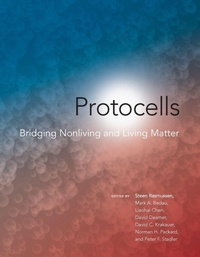
Protocells
Bridging Nonliving and Living Matter
Published on 7. June 2022
Book
Paperback/Softback
712 pages
978-0-262-54588-4 (ISBN)
Description
The first comprehensive general resource on state-of-the-art protocell research, describing current approaches to making new forms of life from scratch in the laboratory.
Protocells offers a comprehensive resource on current attempts to create simple forms of life from scratch in the laboratory. These minimal versions of cells, known as protocells, are entities with lifelike properties created from nonliving materials, and the book provides in-depth investigations of processes at the interface between nonliving and living matter. Chapters by experts in the field put this state-of-the-art research in the context of theory, laboratory work, and computer simulations on the components and properties of protocells. The book also provides perspectives on research in related areas and such broader societal issues as commercial applications and ethical considerations. The book covers all major scientific approaches to creating minimal life, both in the laboratory and in simulation. It emphasizes the bottom-up view of physicists, chemists, and material scientists but also includes the molecular biologists' top-down approach and the origin-of-life perspective. The capacity to engineer living technology could have an enormous socioeconomic impact and could bring both good and ill. Protocells promises to be the essential reference for research on bottom-up assembly of life and living technology for years to come. It is written to be both resource and inspiration for scientists working in this exciting and important field and a definitive text for the interested layman.
Protocells offers a comprehensive resource on current attempts to create simple forms of life from scratch in the laboratory. These minimal versions of cells, known as protocells, are entities with lifelike properties created from nonliving materials, and the book provides in-depth investigations of processes at the interface between nonliving and living matter. Chapters by experts in the field put this state-of-the-art research in the context of theory, laboratory work, and computer simulations on the components and properties of protocells. The book also provides perspectives on research in related areas and such broader societal issues as commercial applications and ethical considerations. The book covers all major scientific approaches to creating minimal life, both in the laboratory and in simulation. It emphasizes the bottom-up view of physicists, chemists, and material scientists but also includes the molecular biologists' top-down approach and the origin-of-life perspective. The capacity to engineer living technology could have an enormous socioeconomic impact and could bring both good and ill. Protocells promises to be the essential reference for research on bottom-up assembly of life and living technology for years to come. It is written to be both resource and inspiration for scientists working in this exciting and important field and a definitive text for the interested layman.
More details
Language
English
Place of publication
Cambridge (Massachusetts)
United States
Publishing group
MIT Press Ltd
Dimensions
Height: 229 mm
Width: 178 mm
Thickness: 46 mm
Weight
1796 gr
ISBN-13
978-0-262-54588-4 (9780262545884)
Copyright in bibliographic data and cover images is held by Nielsen Book Services Limited or by the publishers or by their respective licensors: all rights reserved.
Schweitzer Classification
Persons
edited by Steen Rasmussen, Mark A. Bedau, Liaohai Chen, David Deamer, David C. Krakauer, Norman H. Packard, and Peter F. Stadler