

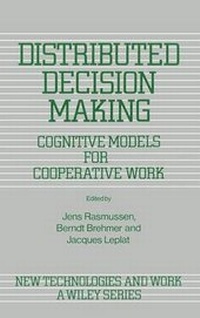
Distributed Decision Making
Cognitive Models for Cooperative Work
1st Edition
Published on 26. December 1990
Book
Hardback
416 pages
978-0-471-92828-7 (ISBN)
Description
Frequently (and often inappropriately) decision making in the work environment has been analyzed and modeled in terms of isolated decisions made by one person. In reality, decision making is a continuous, interpersonal process usually involving several ``decision makers'' aiming at dynamic and cooperative control of the state of affairs at work. Based on original contributions from researchers and research teams, this book provides an urgently needed cognitive approach to models of distributed decision making, exploring the basis for design of decision support systems in various complex, collective, modern work environments. It identifies the state of the art of modeling distributed decision making and the problems imposed by modern high-tech systems. A also formulates promising research avenues.
More details
Series
Language
English
Place of publication
New York
United States
Target group
College/higher education
Professional and scholarly
Dimensions
Height: 239 mm
Width: 165 mm
Thickness: 30 mm
Weight
737 gr
ISBN-13
978-0-471-92828-7 (9780471928287)
Copyright in bibliographic data and cover images is held by Nielsen Book Services Limited or by the publishers or by their respective licensors: all rights reserved.
Schweitzer Classification
Persons
JENS RASMUSSEN was a research professor of cognitive systems engineering at Ris National Laboratory and the Technical University of Copenhagen, following 25 years as the head of the Electronics Department at Ris National Laboratory. Since 1962, he has conducted research in the areas of reliability and risk factors, human reliability, work domain taxonomy, human-machine interaction, and ecological information systems design. A distinguished leader in these fields, he has chaired a number of groups of international experts appointed to assess risk and human-machine interaction in nuclear and other hazardous industries. He is now a consultant in cognitive systems engineering and risk management.
Content
Partial table of contents:
INTRODUCTION: AN OVERVIEW OF THE FIELD.
Distributed Decision Making: Some Notes on the Literature (B.Brehmer).
APPROACHES TO MODELING THE ORGANIZATION OF COOPERATIVE WORK ANDDECISION MAKING.
Cooperative Work: A Conceptual Framework (K. Schmidt).
SPECIAL PROBLEMS IN MODELING DECISION MAKING IN SOCIALSYSTEMS.
Responsibility Allocation in Modern Technology (F. Rapp).
FIELD STUDIES OF COOPERATIVE WORK.
A Method for Tactical Reasoning (MTR) in Emergency Management:Analysis of Individual Acquisition and Collective Implementation(R. Samurcay & J. Rogalski).
EXPERIMENTAL STUDIES IN SIMULATED TASK ENVIRONMENTS.
Dynamic Decision Making: The Effects of Task Complexity andFeedback Delay (B. Brehmer & R. Allard).
SIMULATION OF DECISION PROCESSES.
Decision Models and the Design of Knowledge-Based Systems (M.Lind).
METHODOLOGICAL CONCLUSION.
Use of Simulation in the Study of Complex Decision Making (B.Brehmer, et al.).
Author Index.
Subject Index.
INTRODUCTION: AN OVERVIEW OF THE FIELD.
Distributed Decision Making: Some Notes on the Literature (B.Brehmer).
APPROACHES TO MODELING THE ORGANIZATION OF COOPERATIVE WORK ANDDECISION MAKING.
Cooperative Work: A Conceptual Framework (K. Schmidt).
SPECIAL PROBLEMS IN MODELING DECISION MAKING IN SOCIALSYSTEMS.
Responsibility Allocation in Modern Technology (F. Rapp).
FIELD STUDIES OF COOPERATIVE WORK.
A Method for Tactical Reasoning (MTR) in Emergency Management:Analysis of Individual Acquisition and Collective Implementation(R. Samurcay & J. Rogalski).
EXPERIMENTAL STUDIES IN SIMULATED TASK ENVIRONMENTS.
Dynamic Decision Making: The Effects of Task Complexity andFeedback Delay (B. Brehmer & R. Allard).
SIMULATION OF DECISION PROCESSES.
Decision Models and the Design of Knowledge-Based Systems (M.Lind).
METHODOLOGICAL CONCLUSION.
Use of Simulation in the Study of Complex Decision Making (B.Brehmer, et al.).
Author Index.
Subject Index.