

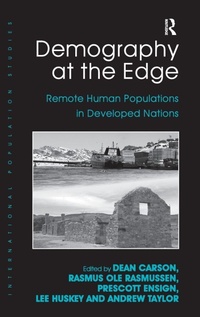
Demography at the Edge
Remote Human Populations in Developed Nations
1st Edition
Published on 1. April 2011
Book
Hardback
372 pages
978-0-7546-7962-2 (ISBN)
Description
Addressing the methodological and topical challenges facing demographers working in remote regions, this book compares and contrasts the research, methods and models, and policy applications from peripheral regions in developed nations. With the emphasis on human populations as dynamic, adaptive, evolving systems, it explores how populations respond in different ways to changing environmental, cultural and economic conditions and how effectively they manage these change processes. Theoretical understandings and policy issues arising from demographic modelling are tackled including: competition for skilled workers; urbanisation and ruralisation; population ageing; the impacts of climate change; the life outcomes of Indigenous peoples; globalisation and international migration. Based on a strong theoretical framework around issues of heterogeneity, generational change, temporariness and the relative strength of internal and external ties, Demography at the Edge provides a common set of approaches and issues that benefit both researchers and practitioners.
Reviews / Votes
'Overall, the editors and other contributors to Demography at the Edge provide an accessible and informative introduction to the social demography of remote areas in developed countries. By reviewing a broad set of methodological and substantive topics, and complementing them with numerous case studies, they give readers a necessary baseline of knowledge about remote area demography. Their book contains important lessons for academics, policymakers, and local stakeholders...' Journal of Regional ScienceMore details
Language
English
Place of publication
London
United Kingdom
Publishing group
Taylor & Francis Ltd
Target group
College/higher education
Dimensions
Height: 240 mm
Width: 161 mm
Thickness: 25 mm
Weight
722 gr
ISBN-13
978-0-7546-7962-2 (9780754679622)
Copyright in bibliographic data and cover images is held by Nielsen Book Services Limited or by the publishers or by their respective licensors: all rights reserved.
Schweitzer Classification
Other editions
Additional editions
Rasmus Ole Rasmussen | Prescott Ensign | Lee Huskey
Demography at the Edge
Remote Human Populations in Developed Nations
Book
11/2016
1st Edition
Routledge
€79.40
Shipment within 10-20 days
Rasmus Ole Rasmussen | Prescott Ensign | Lee Huskey
Demography at the Edge
Remote Human Populations in Developed Nations
E-Book
05/2016
Routledge
€72.49
Available for download
Rasmus Ole Rasmussen | Prescott Ensign | Lee Huskey
Demography at the Edge
Remote Human Populations in Developed Nations
E-Book
05/2016
Routledge
€72.49
Available for download
Persons
Associate Professor Dean Carson is the Head of Population Studies at The Northern Institute, Charles Darwin University in Australia's Northern Territory; Associate Professor Rasmus Ole Rasmussen is attached to the Department of Geography and International Studies at the University of Roskilde in Denmark and works as a Senior Research Fellow with the Nordic Centre for Spatial Development (NORDREGIO) in Sweden; Dr Prescott Ensign is an assistant professor with the Telfer School of Management at the University of Ottawa in Canada; Lee Huskey is the Professor of Economics at the University of Alaska Anchorage and Andrew Taylor is a Population Researcher with The Northern Institute at Charles Darwin University, Australia
Content
I: Methods, Models and Data; 1: Perspectives on 'Demography at the Edge'; 2: The Challenge of Enumeration and Population Estimation in Remote Areas; 3: The Forecasting of Remote Area Populations: Numbers Aren't Everything; 4: International Immigration Trends and Data; 5: Indigenous Vitals: Trends and Measurement; II: The Dynamics of Populations at the Edge; 6: Bubbles and Craters: Analysing Ageing Patterns of Remote Area Populations; 7: Transnational Links at the Edge; 8: Indigenous Demography: Convergence, Divergence, or Something Else?; 9: The 'Problem' of Indigenous Migration in the Globalised State; 10: Labour Migration: 'What goes around comes around'; 11: Fly-in/Fly-out Resource Developments: Implications for Community and Regional Development; 12: Why the Other Half Leave: Gender Aspects of Northern Sparsely Populated Areas; 13: Education, Remoteness and Population Dynamics; 14: Tourist Populations and Local Capital; 15: The Challenge of Housing in Remote Areas; 16: Weather Hazards, Place and Resilience in the Remote Norths; 17: Population Policies at the Edge: The Demographic Ambitions of Frontiers