

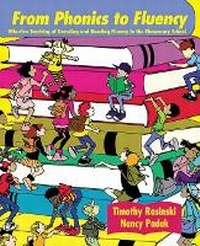
From Phonics to Fluency
Effective Teaching of Decoding and Reading Fluency in the Elementary School
Published on 12. March 2002
Book
Paperback/Softback
256 pages
978-0-321-04903-2 (ISBN)
Description
The past decade has seen renewed emphasis on "decoding"-learning to read by breaking down words into parts. From Phonics to Fluency provides a wealth of methods, strategies, and activities for moving from this early stage of reading to fluency.
More details
Language
English
Place of publication
United States
Publishing group
Pearson Education (US)
Target group
Professional and scholarly
Dimensions
Height: 235 mm
Width: 191 mm
Weight
431 gr
ISBN-13
978-0-321-04903-2 (9780321049032)
Copyright in bibliographic data and cover images is held by Nielsen Book Services Limited or by the publishers or by their respective licensors: all rights reserved.
Schweitzer Classification
Other editions
New editions
Timothy V. Rasinski | Nancy D. Padak
From Phonics to Fluency
Effective Teaching of Decoding and Reading Fluency in the Elementary School
Book
02/2008
2nd Edition
Pearson
€33.12
Article exhausted; check for reprint
Content
1. Word Study and Fluency.
2. Basic Concepts and Terminology.
3. Using Authentic Texts to Learn New Words and Develop Fluency.
4. Teaching Phonemic Awareness.
5. Onsets, Rimes and Basic Phonic Patterns.
6. Teaching Advanced Word Patterns.
7. Word Walls.
8. Making and Writing Words.
9. Word Banks and Word Sorts.
10. Contextual Word Recognition.
11. The Language Experience Approach and Word Learning.
12. Word Games.
13. Spelling and Word Learning.
14. Beyond Word Study: Reading Fluency.
15. Instructional Routines for Word Study and Fluency.
16. Assessing Word Recognition and Reading Fluency.
17. Involving Parents in Word Study and Reading Fluency Instruction.
APPENDICES.
Common Rimes.
Instant Words.
Prefixes.
Suffixes.
Greek and Latin Word Patterns.
Web Sites for Word Study.
Author Index.
Subject Index.
2. Basic Concepts and Terminology.
3. Using Authentic Texts to Learn New Words and Develop Fluency.
4. Teaching Phonemic Awareness.
5. Onsets, Rimes and Basic Phonic Patterns.
6. Teaching Advanced Word Patterns.
7. Word Walls.
8. Making and Writing Words.
9. Word Banks and Word Sorts.
10. Contextual Word Recognition.
11. The Language Experience Approach and Word Learning.
12. Word Games.
13. Spelling and Word Learning.
14. Beyond Word Study: Reading Fluency.
15. Instructional Routines for Word Study and Fluency.
16. Assessing Word Recognition and Reading Fluency.
17. Involving Parents in Word Study and Reading Fluency Instruction.
APPENDICES.
Common Rimes.
Instant Words.
Prefixes.
Suffixes.
Greek and Latin Word Patterns.
Web Sites for Word Study.
Author Index.
Subject Index.