

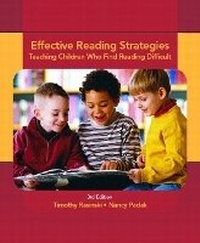
Effective Reading Strategies
Teaching Children Who Find Reading Difficult
3rd Edition
Published on 23. December 2003
Book
Paperback/Softback
400 pages
978-0-13-112186-7 (ISBN)
Description
Effective Reading Strategies: Teaching Children Who Find Reading Difficult, Third Edition, offers the teaching community a wealth of instructional strategies and activities. This book is aimed at strengthening and developing the reading skills of children who find the subject hard to grasp, including those for whom English is a second language. The broad-based remedial and corrective reading instruction focuses on several areas: phonemic awareness, decoding, fluency, vocabulary, and comprehension. Teachers can combine and modify the various reading strategies and activities to fit their current curricula.
Other features of this book:
A clear focus on scientifically based research, including summaries of the National Reading Panel's findings and compliance strategies for the Elementary and Secondary Education Act ("No Child Left Behind").
Professional commentary-Real teachers' opinions and classroom experiences interwoven with the strategies and activities illustrating their application in today's classrooms.
High-Frequency Words-Appendix O provides a listing of common words for instructional focus.
Other features of this book:
A clear focus on scientifically based research, including summaries of the National Reading Panel's findings and compliance strategies for the Elementary and Secondary Education Act ("No Child Left Behind").
Professional commentary-Real teachers' opinions and classroom experiences interwoven with the strategies and activities illustrating their application in today's classrooms.
High-Frequency Words-Appendix O provides a listing of common words for instructional focus.
Reviews / Votes
"The chapters that describe strategies for discrete reading behaviors (e.g., words, fluency, comprehension) provide ...a wealth of instructional support through an excellent collection of activities." - Evangeline Newton, University of Akron"A strength of the book is its practicality-teachers could use these strategies immediately and fit them into their existing curriculum." - Elizabeth Sturtevant, George Mason University
More details
Edition
3rd edition
Language
English
Place of publication
United States
Publishing group
Pearson Education (US)
Target group
Professional and scholarly
Dimensions
Height: 233 mm
Width: 194 mm
Thickness: 19 mm
Weight
667 gr
ISBN-13
978-0-13-112186-7 (9780131121867)
Copyright in bibliographic data and cover images is held by Nielsen Book Services Limited or by the publishers or by their respective licensors: all rights reserved.
Schweitzer Classification
Other editions
New editions
Timothy Rasinski | Nancy Padak | Gay Fawcett
Teaching Children Who Find Reading Difficult
Book
03/2009
4th Edition
Pearson
€83.69
Shipment within 15-20 days
Previous edition

Timothy V. Rasinski | Nancy D. Padak
Effective Reading Strategies
Teaching Children Who Find Reading Difficult
Book
11/1999
2nd Edition
Pearson
€23.55
Article exhausted; check for reprint
Persons
Timothy Rasinksi and Nancy Padak are Professors of Curriculum and Instruction at Kent State University, where they teach courses in literacy education. They also served as editors of The Reading Teacher, the most widely read professional journal in reading education, and currently edit the Journal of Literacy Research.
Previously a classroom and Title I teacher in Nebraska, Tim Rasinski received his Ph.D. from The Ohio State University and has taught at the University of Georgia. He has written and edited several books on literacy education. Tim has also conducted research and written many articles on reading and writing educatioin published in Reading Research Quarterly, Reading Psychology, and Education Forum.
Nancy Padak received her Ed.D. from Northern Illinois University, and has worked as a classroom teacher, Title I administrator, and a school district reading and language arts curriculum director in Illinois. She is Director of the University Reading and Writing Center at Kent State and Principal Investigator at the Ohio Literacy Resource Center. Nancy was recently named Distinguished Professor by Kent State University.
Tim and Nancy have worked extensively with children in public schools and in university reading clinics who have experienced difficulty in learning to read. The reading clinical program that they direct won an Ohio's Best Award for its innovative practices in helping children learn to read.
Previously a classroom and Title I teacher in Nebraska, Tim Rasinski received his Ph.D. from The Ohio State University and has taught at the University of Georgia. He has written and edited several books on literacy education. Tim has also conducted research and written many articles on reading and writing educatioin published in Reading Research Quarterly, Reading Psychology, and Education Forum.
Nancy Padak received her Ed.D. from Northern Illinois University, and has worked as a classroom teacher, Title I administrator, and a school district reading and language arts curriculum director in Illinois. She is Director of the University Reading and Writing Center at Kent State and Principal Investigator at the Ohio Literacy Resource Center. Nancy was recently named Distinguished Professor by Kent State University.
Tim and Nancy have worked extensively with children in public schools and in university reading clinics who have experienced difficulty in learning to read. The reading clinical program that they direct won an Ohio's Best Award for its innovative practices in helping children learn to read.
Content
1. New Perspectives on Helping Students Become Literate.
2. The Instructional Framework.
3. Developing Positive Attitudes about and Ambiance for Reading.
4. Early Intervention.
5. Word Recognition.
6. Nurturing Fluent Reading.
7. Building Vocabulary.
8. Comprehension Development with Narrative Text.
9. Comprehension Development with Nonfiction Text.
10. Writing Development.
11. Putting It All Together: Instructional Routines that Work.
12. Involving Parents in Children's Reading.
13. Determining Instructional Needs: Assessing Readers in Action.
Appendix A: Award-Winning Books.
Appendix B: Poetry and Rhymes for Reading.
Appendix C: Classic Predictable Pattern Books.
Appendix D: Series Books.
Appendix E: Alphabet, Number, and Other Concept Books.
Appendix F: Common Word Families.
Appendix G: Maze and Cloze Activities.
Appendix H: Internet Sites.
Appendix I: Sources of Information on Word Histories and Word Play.
Appendix J: Meaningful Prefixes, Suffixes, and Word Parts.
Appendix K: Magazines for Children.
Appendix L: Bookmaking Ideas.
Appendix M: Sample Letter to Parents.
Appendix N: Professional Resources.
Appendix O: The Essential Primary Grade Sight Word List.
References.
Author Index.
Subject Index.
About the Authors.
2. The Instructional Framework.
3. Developing Positive Attitudes about and Ambiance for Reading.
4. Early Intervention.
5. Word Recognition.
6. Nurturing Fluent Reading.
7. Building Vocabulary.
8. Comprehension Development with Narrative Text.
9. Comprehension Development with Nonfiction Text.
10. Writing Development.
11. Putting It All Together: Instructional Routines that Work.
12. Involving Parents in Children's Reading.
13. Determining Instructional Needs: Assessing Readers in Action.
Appendix A: Award-Winning Books.
Appendix B: Poetry and Rhymes for Reading.
Appendix C: Classic Predictable Pattern Books.
Appendix D: Series Books.
Appendix E: Alphabet, Number, and Other Concept Books.
Appendix F: Common Word Families.
Appendix G: Maze and Cloze Activities.
Appendix H: Internet Sites.
Appendix I: Sources of Information on Word Histories and Word Play.
Appendix J: Meaningful Prefixes, Suffixes, and Word Parts.
Appendix K: Magazines for Children.
Appendix L: Bookmaking Ideas.
Appendix M: Sample Letter to Parents.
Appendix N: Professional Resources.
Appendix O: The Essential Primary Grade Sight Word List.
References.
Author Index.
Subject Index.
About the Authors.