

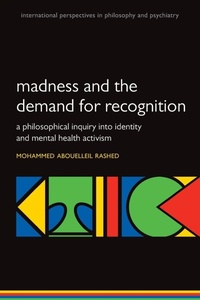
Madness and the demand for recognition
A philosophical inquiry into identity and mental health activism
Published on 7. February 2019
Book
Paperback/Softback
292 pages
978-0-19-878686-3 (ISBN)
Description
Madness is a complex and contested term. Through time and across cultures it has acquired many formulations: for some, madness is synonymous with unreason and violence, for others with creativity and subversion, elsewhere it is associated with spirits and spirituality. Among the different formulations, there is one in particular that has taken hold so deeply and systematically that it has become the default view in many communities around the world: the idea that madness is a disorder of the mind.
Contemporary developments in mental health activism pose a radical challenge to psychiatric and societal understandings of madness. Mad Pride and mad-positive activism reject the language of mental 'illness' and 'disorder', reclaim the term 'mad', and reverse its negative connotations. Activists seek cultural change in the way madness is viewed, and demand recognition of madness as grounds for identity. But can madness constitute such grounds? Is it possible to reconcile delusions, passivity phenomena, and the discontinuity of self often seen in mental health conditions with the requirements for identity formation presupposed by the theory of recognition? How should society respond?
Guided by these questions, this book is the first comprehensive philosophical examination of the claims and demands of Mad activism. Locating itself in the philosophy of psychiatry, Mad studies, and activist literatures, the book develops a rich theoretical framework for understanding, justifying, and responding to Mad activism's demand for recognition.
Contemporary developments in mental health activism pose a radical challenge to psychiatric and societal understandings of madness. Mad Pride and mad-positive activism reject the language of mental 'illness' and 'disorder', reclaim the term 'mad', and reverse its negative connotations. Activists seek cultural change in the way madness is viewed, and demand recognition of madness as grounds for identity. But can madness constitute such grounds? Is it possible to reconcile delusions, passivity phenomena, and the discontinuity of self often seen in mental health conditions with the requirements for identity formation presupposed by the theory of recognition? How should society respond?
Guided by these questions, this book is the first comprehensive philosophical examination of the claims and demands of Mad activism. Locating itself in the philosophy of psychiatry, Mad studies, and activist literatures, the book develops a rich theoretical framework for understanding, justifying, and responding to Mad activism's demand for recognition.
Reviews / Votes
Madness and the demand for recognition amplifies the value of Mad Movement efforts to bring about societal transformation, and may offer us some theoretical anchors, emerging from our own descriptions of our work, to bolster our activities. * Alise de Bie, Disability & Society * Rashed's Madness and the Demand for Recognition is the first book that, in terms of the theory of recognition, is devoted to the central question of social psychiatry: how - outside of a medical-psychiatric framework - can we deal with demands for social and cultural recognition by people with psychiatric experience ... The book is written clearly and precisely and, despite its academic character, is very easy to read. * Lukas Iwer, Sozialpsychiatrische Informationen *More details
Series
Language
English
Place of publication
Oxford
United Kingdom
Target group
College/higher education
Dimensions
Height: 234 mm
Width: 156 mm
Thickness: 16 mm
Weight
447 gr
ISBN-13
978-0-19-878686-3 (9780198786863)
Copyright in bibliographic data and cover images is held by Nielsen Book Services Limited or by the publishers or by their respective licensors: all rights reserved.
Schweitzer Classification
Other editions
Additional editions
Mohammed Abouelleil Rashed
Madness and the demand for recognition
A philosophical inquiry into identity and mental health activism
E-Book
01/2019
1st Edition
OUP eBook
€37.99
Available for download
Mohammed Abouelleil Rashed
Madness and the demand for recognition
A philosophical inquiry into identity and mental health activism
E-Book
01/2019
1st Edition
OUP eBook
€37.99
Available for download
Person
Mohammed Abouelleil Rashed is Wellcome Trust ISSF Research Fellow at the Department of Philosophy, Birkbeck College, University of London, and Visiting Lecturer at the Department of Philosophy, King's College London. Before moving on to full-time research in 2007, Mohammed studied medicine at Cairo University Medical School and trained in psychiatry in London on the Guy's, King's College, and St. Thomas' Hospitals training scheme. He is the author of several papers and chapters in philosophy and psychiatry on the concept of mental disorder, the concept of culture, the nature of the diagnostic process, madness and disability, empathy and understanding in mental health, and psychiatric ethics.
Content
Part 1: Madness
1: Mental health activism and the demand for recognition
2: The problem of distress and disability
Part 2: Recognition
3: The concept of recognition and the problem of freedom
4: Identity and the psychological consequences of recognition
5: Misrecognition: Political reform or reconciliation?
Part 3: Routes to recognition
6: Mad culture
7: Mad identity I: Controversial and failed identities
8: Mad identity II: Unity and continuity of self
9: Madness and the limits of recognition
Part 4: Approaches to Mad Activism
10: Responding to the demand for recognition of Mad identity
11: Conclusion: Pathways to reconciliation
1: Mental health activism and the demand for recognition
2: The problem of distress and disability
Part 2: Recognition
3: The concept of recognition and the problem of freedom
4: Identity and the psychological consequences of recognition
5: Misrecognition: Political reform or reconciliation?
Part 3: Routes to recognition
6: Mad culture
7: Mad identity I: Controversial and failed identities
8: Mad identity II: Unity and continuity of self
9: Madness and the limits of recognition
Part 4: Approaches to Mad Activism
10: Responding to the demand for recognition of Mad identity
11: Conclusion: Pathways to reconciliation