

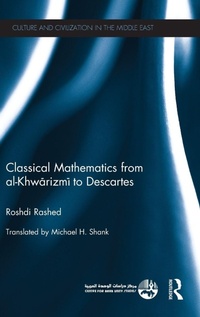
Classical Mathematics from Al-Khwarizmi to Descartes
1st Edition
Published on 11. August 2014
Book
Hardback
758 pages
978-0-415-83388-2 (ISBN)
Description
This book follows the development of classical mathematics and the relation between work done in the Arab and Islamic worlds and that undertaken by the likes of Descartes and Fermat.
'Early modern,' mathematics is a term widely used to refer to the mathematics which developed in the West during the sixteenth and seventeenth century. For many historians and philosophers this is the watershed which marks a radical departure from 'classical mathematics,' to more modern mathematics; heralding the arrival of algebra, geometrical algebra, and the mathematics of the continuous. In this book, Roshdi Rashed demonstrates that 'early modern,' mathematics is actually far more composite than previously assumed, with each branch having different traceable origins which span the millennium. Going back to the beginning of these parts, the aim of this book is to identify the concepts and practices of key figures in their development, thereby presenting a fuller reality of these mathematics.
This book will be of interest to students and scholars specialising in Islamic science and mathematics, as well as to those with an interest in the more general history of science and mathematics and the transmission of ideas and culture.
'Early modern,' mathematics is a term widely used to refer to the mathematics which developed in the West during the sixteenth and seventeenth century. For many historians and philosophers this is the watershed which marks a radical departure from 'classical mathematics,' to more modern mathematics; heralding the arrival of algebra, geometrical algebra, and the mathematics of the continuous. In this book, Roshdi Rashed demonstrates that 'early modern,' mathematics is actually far more composite than previously assumed, with each branch having different traceable origins which span the millennium. Going back to the beginning of these parts, the aim of this book is to identify the concepts and practices of key figures in their development, thereby presenting a fuller reality of these mathematics.
This book will be of interest to students and scholars specialising in Islamic science and mathematics, as well as to those with an interest in the more general history of science and mathematics and the transmission of ideas and culture.
Reviews / Votes
This comprehensive history of mathematics from the 8th to the 17th centuries is organized by fields. The most interesting part is "Algebra" because of its unifying role. - M. Bona, University of FloridaMore details
Series
Language
English
Place of publication
London
United Kingdom
Publishing group
Taylor & Francis Ltd
Target group
College/higher education
Dimensions
Height: 240 mm
Width: 161 mm
Thickness: 45 mm
Weight
1303 gr
ISBN-13
978-0-415-83388-2 (9780415833882)
Copyright in bibliographic data and cover images is held by Nielsen Book Services Limited or by the publishers or by their respective licensors: all rights reserved.
Schweitzer Classification
Other editions
Additional editions
Roshdi Rashed
Classical Mathematics from Al-Khwarizmi to Descartes
Book
12/2019
1st Edition
Routledge
€69.00
Shipment within 15-20 days
Roshdi Rashed
Classical Mathematics from Al-Khwarizmi to Descartes
E-Book
08/2014
1st Edition
Routledge
€59.49
Available for download
Roshdi Rashed
Classical Mathematics from Al-Khwarizmi to Descartes
E-Book
08/2014
1st Edition
Routledge
€59.49
Available for download
Person
Roshdi Rashed is one of the most eminent authorities on Arabic mathematics and the exact sciences. A historian and philosopher of mathematics and science and a highly celebrated epistemologist, he is currently Emeritus Research Director (distinguished class) at the Centre National de la Recherche Scientifique (CNRS) in Paris, and is the former Director of the Centre for History of Medieval Science and Philosophy at the University of Paris (Denis Diderot, Paris VII). He also holds an Honorary Professorship at the University of Tokyo and an Emeritus Professorship at the University of Mansourah in Egypt.
Michael H. Shank is professor of the History of Science at the University of Wisconsin-Madison, were he teaches surveys of the history of science from antiquity to Newton. His research interests focus on, and often stray beyond, the late-medieval Viennese astronomical and natural philosophical traditions.
Michael H. Shank is professor of the History of Science at the University of Wisconsin-Madison, were he teaches surveys of the history of science from antiquity to Newton. His research interests focus on, and often stray beyond, the late-medieval Viennese astronomical and natural philosophical traditions.
Content
Introduction Part I: Algebra and Arithmetic 1 Algebra and its unifying role 2 Algebra and Linguistics 3 The First Classification of Curves 4 Descartes Geometry and the distinction between geometrical and mechanical curves 5 The Ovals of Descartes 6 Descartes and the Infinitely Small 7 Fermat and Algebraic Geometry 8 Euclidean Arithmetic 9 Algorithmic Methods 10 Ibn Qurra and Amicable Numbers 11 Fibonacci and Arabic Mathematics 12 Fibonacci and the Latin Extension of Arabic Mathematics 13 Al-Yazdi 14 Fermat and the Origins of Modern Diophantine Analysis Part II: Geometry 15 The Archemedians and the Problems of Infinity 16 Conics and traditions of the early research projections 17 The Continuous Drawing of Conic Curves and the Classification of Curves 18 The Fifth Postulate of Euclid Part III: The Application of Mathematics - Astronomy and Optics 19 The Celestial Cinematics of Ibn Al-Haytham 20 Mirrors