

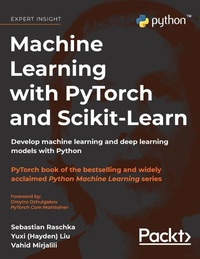
Machine Learning with PyTorch and Scikit-Learn
Develop machine learning and deep learning models with Python
Published on 25. February 2022
Book
Hardback
774 pages
978-1-83702-195-6 (ISBN)
Description
This book of the bestselling and widely acclaimed Python Machine Learning series is a comprehensive guide to machine and deep learning using PyTorch's simple to code framework.
Purchase of the print or Kindle book includes a free eBook in PDF format.Key FeaturesLearn applied machine learning with a solid foundation in theory
Clear, intuitive explanations take you deep into the theory and practice of Python machine learning
Fully updated and expanded to cover PyTorch, transformers, XGBoost, graph neural networks, and best practices
Book Description
Machine Learning with PyTorch and Scikit-Learn is a comprehensive guide to machine learning and deep learning with PyTorch. It acts as both a step-by-step tutorial and a reference you'll keep coming back to as you build your machine learning systems.
Packed with clear explanations, visualizations, and examples, the book covers all the essential machine learning techniques in depth. While some books teach you only to follow instructions, with this machine learning book, we teach the principles allowing you to build models and applications for yourself.
Why PyTorch?
PyTorch is the Pythonic way to learn machine learning, making it easier to learn and simpler to code with. This book explains the essential parts of PyTorch and how to create models using popular libraries, such as PyTorch Lightning and PyTorch Geometric.
You will also learn about generative adversarial networks (GANs) for generating new data and training intelligent agents with reinforcement learning. Finally, this new edition is expanded to cover the latest trends in deep learning, including graph neural networks and large-scale transformers used for natural language processing (NLP).
This PyTorch book is your companion to machine learning with Python, whether you're a Python developer new to machine learning or want to deepen your knowledge of the latest developments.What you will learnExplore frameworks, models, and techniques for machines to 'learn' from data
Use scikit-learn for machine learning and PyTorch for deep learning
Train machine learning classifiers on images, text, and more
Build and train neural networks, transformers, and boosting algorithms
Discover best practices for evaluating and tuning models
Predict continuous target outcomes using regression analysis
Dig deeper into textual and social media data using sentiment analysis
Who this book is for
If you have a good grasp of Python basics and want to start learning about machine learning and deep learning, then this is the book for you. This is an essential resource written for developers and data scientists who want to create practical machine learning and deep learning applications using scikit-learn and PyTorch.
Before you get started with this book, you'll need a good understanding of calculus, as well as linear algebra.Table of ContentsGiving Computers the Ability to Learn from Data
Training Simple Machine Learning Algorithms for Classification
A Tour of Machine Learning Classifiers Using Scikit-Learn
Building Good Training Datasets - Data Preprocessing
Compressing Data via Dimensionality Reduction
Learning Best Practices for Model Evaluation and Hyperparameter Tuning
Combining Different Models for Ensemble Learning
Applying Machine Learning to Sentiment Analysis
Predicting Continuous Target Variables with Regression Analysis
Working with Unlabeled Data - Clustering Analysis
Implementing a Multilayer Artificial Neural Network from Scratch
(N.B. Please use the Look Inside option to see further chapters)
More details
Language
English
Place of publication
Birmingham
United Kingdom
Product notice
sewn/stitched
Cloth over boards
Dimensions
Height: 241 mm
Width: 196 mm
Thickness: 46 mm
Weight
1612 gr
ISBN-13
978-1-83702-195-6 (9781837021956)
Copyright in bibliographic data and cover images is held by Nielsen Book Services Limited or by the publishers or by their respective licensors: all rights reserved.
Schweitzer Classification
Persons
Sebastian Raschka, author of the bestselling book, Python Machine Learning, has many years of experience with coding in Python, and he has given several seminars on the practical applications of data science, machine learning, and deep learning, including a machine learning tutorial at SciPy - the leading conference for scientific computing in Python.While Sebastian's academic research projects are mainly centered around problem-solving in computational biology, he loves to write and talk about data science, machine learning, and Python in general, and he is motivated to help people develop data-driven solutions without necessarily requiring a machine learning background.His work and contributions have recently been recognized by the departmental outstanding graduate student award 2016-2017, as well as the ACM Computing Reviews' Best of 2016 award. In his free time, Sebastian loves to contribute to open source projects, and the methods that he has implemented are now successfully used in machine learning competitions, such as Kaggle.Vahid Mirjalili obtained his PhD in mechanical engineering working on novel methods for large-scale, computational simulations of molecular structures. Currently, he is focusing his research efforts on applications of machine learning in various computer vision projects at the Department of Computer Science and Engineering at Michigan State University.Vahid picked Python as his number-one choice of programming language, and throughout his academic and research career he has gained tremendous experience with coding in Python. He taught Python programming to the engineering class at Michigan State University, which gave him a chance to help students understand different data structures and develop efficient code in Python.While Vahid's broad research interests focus on deep learning and computer vision applications, he is especially interested in leveraging deep learning techniques to extend privacy in biometric data such as face images so that information is not revealed beyond what users intend to reveal. Furthermore, he also collaborates with a team of engineers working on self-driving cars, where he designs neural network models for the fusion of multispectral images for pedestrian detection.