

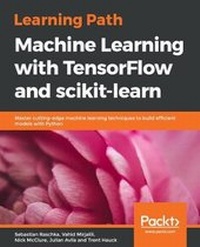
Learning Path - Machine Learning with TensorFlow and scikit-learn
Master cutting-edge machine learning techniques to build efficient models with Python
Published on 31. December 2018
Book
Paperback/Softback
805 pages
978-1-78995-619-1 (ISBN)
Description
Unlock powerful machine learning techniques and solve any machine learning problem you come across with Python
About This Book
* Understand the key frameworks in data science, machine learning, and deep learning
*Leverage scikit-learn and TensorFlow to fully explore the machine learning ecosystem
*Apply machine learning and deep learning algorithms to challenging real-world datasets
Who This Book Is For
Machine Learning with TensorFlow and scikit-learn is for developers, data scientists, and machine learning enthusiasts who want to learn the principles of machine learning and effectively use it with TensorFlow and scikit-learn in their everyday lives. Prior knowledge of Python is assumed. Basic knowledge of high school math and statistics will be beneficial.
What You Will Learn
* Create a deep neural network using TensorFlow
*Uncover hidden patterns and structures in data with clustering
*Get to grips with the linear regression techniques with TensorFlow
*Implement neural networks and improve predictions
*Apply NLP and sentiment analysis to your data
*Use distance metrics to predict clustering
*Create your own estimator with the simple syntax of scikit-learn
*Explore the feed-forward neural networks available in scikit-learn
In Detail
Machine learning is becoming more and more transformational to businesses every passing day. Machine Learning with TensorFlow and scikit-learn offers you the practical knowledge and techniques you need to create and contribute to machine learning, deep learning, and modern data analysis using the latest cutting-edge tools.
You'll begin this Learning Path by working on techniques that you need to create and contribute to the field of machine learning. Coverage of the TensorFlow deep learning library and the scikit-learn code are included, as they are two of the most popular frameworks used in machine learning.
This Learning Path is loaded with several examples that show you how to leverage the open source Python libraries to create machine learning models that easily solve your everyday tasks and problems. You'll learn how to use complex Scikit-learn features and the TensorFlow computing library for intensive computation, digging deeper to gain more insights into your data than ever before. You will explore topics right from mathematical operations to implementing various supervised, unsupervised, and deep learning algorithms with scikit-learn.
By the end of this Learning Path, you'll be equipped with tools that will help you maximize the potential of machine learning.
This Learning Path includes content from the following Packt products:
* Python Machine Learning, Second Edition by Sebastian Raschka, Vahid Mirjalili
*TensorFlow Machine Learning Cookbook, Second Edition by Nick McClure
*Scikit-learn Cookbook, Second Edition by Julian Avila, Trent Hauck
About This Book
* Understand the key frameworks in data science, machine learning, and deep learning
*Leverage scikit-learn and TensorFlow to fully explore the machine learning ecosystem
*Apply machine learning and deep learning algorithms to challenging real-world datasets
Who This Book Is For
Machine Learning with TensorFlow and scikit-learn is for developers, data scientists, and machine learning enthusiasts who want to learn the principles of machine learning and effectively use it with TensorFlow and scikit-learn in their everyday lives. Prior knowledge of Python is assumed. Basic knowledge of high school math and statistics will be beneficial.
What You Will Learn
* Create a deep neural network using TensorFlow
*Uncover hidden patterns and structures in data with clustering
*Get to grips with the linear regression techniques with TensorFlow
*Implement neural networks and improve predictions
*Apply NLP and sentiment analysis to your data
*Use distance metrics to predict clustering
*Create your own estimator with the simple syntax of scikit-learn
*Explore the feed-forward neural networks available in scikit-learn
In Detail
Machine learning is becoming more and more transformational to businesses every passing day. Machine Learning with TensorFlow and scikit-learn offers you the practical knowledge and techniques you need to create and contribute to machine learning, deep learning, and modern data analysis using the latest cutting-edge tools.
You'll begin this Learning Path by working on techniques that you need to create and contribute to the field of machine learning. Coverage of the TensorFlow deep learning library and the scikit-learn code are included, as they are two of the most popular frameworks used in machine learning.
This Learning Path is loaded with several examples that show you how to leverage the open source Python libraries to create machine learning models that easily solve your everyday tasks and problems. You'll learn how to use complex Scikit-learn features and the TensorFlow computing library for intensive computation, digging deeper to gain more insights into your data than ever before. You will explore topics right from mathematical operations to implementing various supervised, unsupervised, and deep learning algorithms with scikit-learn.
By the end of this Learning Path, you'll be equipped with tools that will help you maximize the potential of machine learning.
This Learning Path includes content from the following Packt products:
* Python Machine Learning, Second Edition by Sebastian Raschka, Vahid Mirjalili
*TensorFlow Machine Learning Cookbook, Second Edition by Nick McClure
*Scikit-learn Cookbook, Second Edition by Julian Avila, Trent Hauck
More details
Language
English
Place of publication
Birmingham
United Kingdom
Target group
Professional and scholarly
Dimensions
Height: 235 mm
Width: 191 mm
ISBN-13
978-1-78995-619-1 (9781789956191)
Copyright in bibliographic data and cover images is held by Nielsen Book Services Limited or by the publishers or by their respective licensors: all rights reserved.
Schweitzer Classification
Persons
Sebastian Raschka, author of the bestselling book, Python Machine Learning, has many years of experience with coding in Python, and he has given several seminars on the practical applications of data science, machine learning, and deep learning, including a machine learning tutorial at SciPy - the leading conference for scientific computing in Python.
While Sebastian's academic research projects are mainly centered around problem-solving in computational biology, he loves to write and talk about data science, machine learning, and Python in general, and he is motivated to help people develop data-driven solutions without necessarily requiring a machine learning background.
His work and contributions have recently been recognized by the departmental outstanding graduate student award 2016-2017, as well as the ACM Computing Reviews' Best of 2016 award. In his free time, Sebastian loves to contribute to open source projects, and the methods that he has implemented are now successfully used in machine learning competitions, such as Kaggle. Vahid Mirjalili obtained his PhD in mechanical engineering working on novel methods for large-scale, computational simulations of molecular structures. Currently, he is focusing his research efforts on applications of machine learning in various computer vision projects at the Department of Computer Science and Engineering at Michigan State University.
Vahid picked Python as his number-one choice of programming language, and throughout his academic and research career he has gained tremendous experience with coding in Python. He taught Python programming to the engineering class at Michigan State University, which gave him a chance to help students understand different data structures and develop efficient code in Python.
While Vahid's broad research interests focus on deep learning and computer vision applications, he is especially interested in leveraging deep learning techniques to extend privacy in biometric data such as face images so that information is not revealed beyond what users intend to reveal. Furthermore, he also collaborates with a team of engineers working on self-driving cars, where he designs neural network models for the fusion of multispectral images for pedestrian detection. Nick McClure is currently a senior data scientist at PayScale, Inc. in Seattle, WA. Prior to this, he has worked at Zillow Group and Caesar's Entertainment Corporation. He got his degrees in Applied Mathematics from The University of Montana and the College of Saint Benedict and Saint John's University.
He has a passion for learning and advocating for analytics, machine learning, and artificial intelligence. Nick occasionally puts his thoughts and musings on his blog or through his Twitter account, @nfmcclure. Julian Avila is a programmer and data scientist in finance and computer vision. He graduated from the Massachusetts Institute of Technology (MIT) in mathematics, where he researched quantum mechanical computation, a field involving physics, math, and computer science. While at MIT, Julian first picked up classical and flamenco guitars, Machine Learning, and artificial intelligence through discussions with friends in the CSAIL lab.
He started programming in middle school, including games and geometrically artistic animations. He competed successfully in math and programming and worked for several groups at MIT. Julian has written complete software projects in elegant Python with just-in-time compilation. Some memorable projects of his include a large-scale facial recognition system for videos with neural networks on GPUs, recognizing parts of neurons within pictures, and stock-market trading programs. Trent Hauck is a data scientist living and working in the Seattle area. He grew up in Wichita, Kansas and received his undergraduate and graduate degrees from the University of Kansas. He is the author of the book Instant Data Intensive Apps with pandas How-to, Packt Publishing-a book that can get you up to speed quickly with pandas and other associated technologies.
While Sebastian's academic research projects are mainly centered around problem-solving in computational biology, he loves to write and talk about data science, machine learning, and Python in general, and he is motivated to help people develop data-driven solutions without necessarily requiring a machine learning background.
His work and contributions have recently been recognized by the departmental outstanding graduate student award 2016-2017, as well as the ACM Computing Reviews' Best of 2016 award. In his free time, Sebastian loves to contribute to open source projects, and the methods that he has implemented are now successfully used in machine learning competitions, such as Kaggle. Vahid Mirjalili obtained his PhD in mechanical engineering working on novel methods for large-scale, computational simulations of molecular structures. Currently, he is focusing his research efforts on applications of machine learning in various computer vision projects at the Department of Computer Science and Engineering at Michigan State University.
Vahid picked Python as his number-one choice of programming language, and throughout his academic and research career he has gained tremendous experience with coding in Python. He taught Python programming to the engineering class at Michigan State University, which gave him a chance to help students understand different data structures and develop efficient code in Python.
While Vahid's broad research interests focus on deep learning and computer vision applications, he is especially interested in leveraging deep learning techniques to extend privacy in biometric data such as face images so that information is not revealed beyond what users intend to reveal. Furthermore, he also collaborates with a team of engineers working on self-driving cars, where he designs neural network models for the fusion of multispectral images for pedestrian detection. Nick McClure is currently a senior data scientist at PayScale, Inc. in Seattle, WA. Prior to this, he has worked at Zillow Group and Caesar's Entertainment Corporation. He got his degrees in Applied Mathematics from The University of Montana and the College of Saint Benedict and Saint John's University.
He has a passion for learning and advocating for analytics, machine learning, and artificial intelligence. Nick occasionally puts his thoughts and musings on his blog or through his Twitter account, @nfmcclure. Julian Avila is a programmer and data scientist in finance and computer vision. He graduated from the Massachusetts Institute of Technology (MIT) in mathematics, where he researched quantum mechanical computation, a field involving physics, math, and computer science. While at MIT, Julian first picked up classical and flamenco guitars, Machine Learning, and artificial intelligence through discussions with friends in the CSAIL lab.
He started programming in middle school, including games and geometrically artistic animations. He competed successfully in math and programming and worked for several groups at MIT. Julian has written complete software projects in elegant Python with just-in-time compilation. Some memorable projects of his include a large-scale facial recognition system for videos with neural networks on GPUs, recognizing parts of neurons within pictures, and stock-market trading programs. Trent Hauck is a data scientist living and working in the Seattle area. He grew up in Wichita, Kansas and received his undergraduate and graduate degrees from the University of Kansas. He is the author of the book Instant Data Intensive Apps with pandas How-to, Packt Publishing-a book that can get you up to speed quickly with pandas and other associated technologies.