

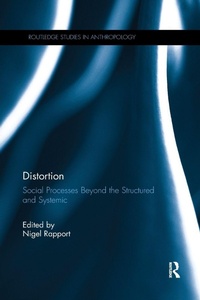
Distortion
Social Processes Beyond the Structured and Systemic
1st Edition
Published on 14. August 2020
Book
Paperback/Softback
176 pages
978-0-367-59476-3 (ISBN)
Description
Distortion occurs between the intentions of actions and their outcomes. It can also occur between thoughts and actions; between words and how they are interpreted; between a statement of law and its enactment; between a vision and its artistic representation; and between a cultural tradition or habitus and its animation in contemporary contexts. Escaping the bounds of relationality, of structuration and of systemics, distortion is a form of complex connectedness that has seldom been addressed in the social sciences as a phenomenon in its own right.
This volume argues for the key importance of distortion as a concept in the social sciences, and attempts to refine it as a concept. Each chapter examines distortion in the context of an ethnographic case study, examining how its conceptualization can further comprehension of a particular ethnographic situation. It is contended that distortion is an account of the emergent or revolutionary nature of human life, an emergence that can be attached to particular antecedent conditions in a processual or temporal way yet is a transformation of the essential nature of those conditions.
Coming to terms with distortion adds significantly to the social-scientific appreciation of human activity and creativity, of conscious experience, of the nature of social interaction and exchange, and of the complexity of social milieu. Distortion should be essential reading on advanced undergraduate and postgraduate modules on social theory, contemporary issues and methodologies, communication, sociality, materiality, and intersectionality.
This volume argues for the key importance of distortion as a concept in the social sciences, and attempts to refine it as a concept. Each chapter examines distortion in the context of an ethnographic case study, examining how its conceptualization can further comprehension of a particular ethnographic situation. It is contended that distortion is an account of the emergent or revolutionary nature of human life, an emergence that can be attached to particular antecedent conditions in a processual or temporal way yet is a transformation of the essential nature of those conditions.
Coming to terms with distortion adds significantly to the social-scientific appreciation of human activity and creativity, of conscious experience, of the nature of social interaction and exchange, and of the complexity of social milieu. Distortion should be essential reading on advanced undergraduate and postgraduate modules on social theory, contemporary issues and methodologies, communication, sociality, materiality, and intersectionality.
More details
Series
Language
English
Place of publication
London
United Kingdom
Publishing group
Taylor & Francis Ltd
Target group
College/higher education
Postgraduate
Dimensions
Height: 234 mm
Width: 156 mm
Thickness: 11 mm
Weight
307 gr
ISBN-13
978-0-367-59476-3 (9780367594763)
Copyright in bibliographic data and cover images is held by Nielsen Book Services Limited or by the publishers or by their respective licensors: all rights reserved.
Schweitzer Classification
Other editions
Additional editions
Book
08/2017
1st Edition
Routledge
€215.41
Shipment within 10-20 days
E-Book
08/2017
Routledge
€60.49
Available for download
E-Book
08/2017
Routledge
€60.49
Available for download
Person
Nigel Rapport is Professor of Anthropological and Philosophical Studies in the Department of Social Anthropology at the University of St Andrews, UK.
Content
1. Introduction: Conceptualizing the 'distortion of human social life' 2. Contorted environments and distorted being 3. A blind man's problem: Distortion and non-responsiveness; or, the construction of non-futures in Danish bureaucracy 4. Distortion and Stanley Spencer's life in art 5. The politics of paradox: Kierkegaardian theology and national conservatism in Denmark 6. 'Into the crack': Scottish agricultural revolutions and the art of moaning 7. Chains of distortion: Awkward relations and productive resistance in a Danish consulting company 8. 'Hello, can you hear me better now?' Mediatized acoustemologies and distortion on the radio 9. Epi-pro-logue: An anthropological theory of distortion