

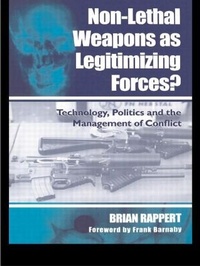
Non-lethal Weapons as Legitimising Forces?
Technology, Politics and the Management of Conflict
1st Edition
Published on 1. May 2003
Book
Paperback/Softback
312 pages
978-0-7146-8360-7 (ISBN)
Description
As mankind finds ever more impious ways to kill and maim, some look to non-lethal weapons as a fix. Brian Rappert discusses the technologies involved and the ethics of, for example blinding someone with a laser, leaving them blind forever, versus killing them outright.
Reviews / Votes
' ... excellent book ...' - SurvivalMore details
Language
English
Place of publication
London
United Kingdom
Publishing group
Taylor & Francis Ltd
Target group
College/higher education
Professional and scholarly
Dimensions
Height: 229 mm
Width: 152 mm
Weight
580 gr
ISBN-13
978-0-7146-8360-7 (9780714683607)
Copyright in bibliographic data and cover images is held by Nielsen Book Services Limited or by the publishers or by their respective licensors: all rights reserved.
Schweitzer Classification
Other editions
Additional editions
Brian Rappert
Non-lethal Weapons as Legitimising Forces?
Technology, Politics and the Management of Conflict
E-Book
11/2004
Routledge
€69.99
Available for download
Brian Rappert
Non-lethal Weapons as Legitimising Forces?
Technology, Politics and the Management of Conflict
E-Book
11/2004
Routledge
€69.99
Available for download
Brian Rappert
Non-lethal Weapons as Legitimising Forces?
Technology, Politics and the Management of Conflict
Book
05/2003
1st Edition
Routledge
€252.97
Shipment within 10-20 days
Person
Brian Rappert is a Research Fellow in the School of Sociology and Social Policy at the University of Nottingham. He is author of numerous reports and articles on the assessments of risky technology.
Content
Part 1 Claims and expectations: what's in a name?; tools of the trade; threats and promises. Part 2 Technologies, contexts and controls: weapons of minimal harm? assessing effects; on to the streets - examining major deployments of non-lethals; controlling evaluations - the prospects for prohibitions. Part 3 Case studies: CS sprays in Britain; gauging electroshock weapons; humanitarian interventions, humanitarian tools?. Conclusions and recommendations.