

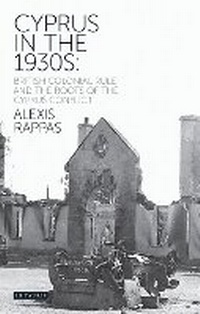
Cyprus in the 1930s
British Colonial Rule and the Roots of the Cyprus Conflict
Published on 2. June 2014
Book
Hardback
272 pages
978-1-78076-438-2 (ISBN)
Description
Why has the unification of Cyprus proved impossible? The existing literature looks to the 1950s, and the formation of EOKA under George Grivas. Here, Alexis Rappas challenges the dominance of that starting point in the current histories of the island, showing that the key to the conflict between the British Empire and Greek Cypriots lies in the disputes of the 1930s. Cyprus in the 1930s charts the history of the island in this period, and details British attempts to impose a homogeneous 'Cypriot' culture onto a diverse and divided population. Community leaders and the hierarchy of the Church, who had functioned as bridges between local interests, were marginalised as Britain attempted to engineer unification through education and social policy. The result was a radicalisation of both Turkish-Cypriot and Greek-Cypriot identity. Based on new primary source material from Britain, Cyprus and Greece. Rappas analyses British state-building and the role of Cypriot ethnicities in the formation of modern Cyprus.
Reviews / Votes
The authoritarian government of Sir Herbert Palmer (1933-1939) was intended to be the most consistent answer provided by an imperial and colonial state in order to control the island of Cyprus after the anti-colonial revolt of 1931. In his path-breaking first monograph Alexis Rappas provides an analytical and in-depth study of that moment, calling attention to the influence of fascist methods developed during the same period and simultaneously contributes to the more general process of rethinking the history of the British colonial state. Diogo Ramada Curto, Universidade Nova de Lisboa Interweaving archival material and theoretical problems into a brisk and engaging narrative, Cyprus in the 1930s captures a peculiar moment in European imperial history, marked by ambitious colonial projects for social reform and nationalist or left-wing anti-colonial movements. George B. Dertilis, Directeur d'estudes, E.H.E.S.S, Paris Focusing on a period which so far has received only scant treatment in the literature, Cyprus in the 1930s is a fine and highly convincing study on politics in Cyprus undr British rule. Alternating scales of analysis and drawing on a variety of theoretical approaches, it makes important contributions to the history of Cyprus, British imperial history, and on a more general level to the problematic of the colonial state. Sebastian Conrad, Professor of History, Freie Universitat, BerlinMore details
Language
English
Place of publication
United Kingdom
Publishing group
Bloomsbury Publishing PLC
Target group
College/higher education
Professional and scholarly
Dimensions
Height: 216 mm
Width: 138 mm
Thickness: 28 mm
Weight
463 gr
ISBN-13
978-1-78076-438-2 (9781780764382)
Copyright in bibliographic data and cover images is held by Nielsen Book Services Limited or by the publishers or by their respective licensors: all rights reserved.
Schweitzer Classification
Person
Alexis Rappas is Lecturer in Modern History at the Institut d'Etudes Politiques in Paris. He has been a visiting scholar at Brown, Princeton and Northeastern Universities and gained his PhD in History at the University of Florence, Italy.
Content
List of tables 4
Acknowledgments 5
Foreword 6
Chapter 1: Introduction: A Revolt and the Consolidation of Authoritarian Rule 8
Chapter 2: The Three Pillars of Arcadian Cyprus: Experiments in Social Engineering 31
Chapter 3: Rituals of Bureaucratic Governance 61
Chapter 4: The Constitutionalist Movement and the Avenues of Mass Politicization 93
Chapter 5: The Orthodox Church and the Displacement of the Public Sphere 128
Chapter 6: The Labour Question: Political Stakes in a Battle of Denominations 156
Conclusion: The Expanding Boundaries of a Faceless State 184
Sources and Bibliography 190
Index 210
Acknowledgments 5
Foreword 6
Chapter 1: Introduction: A Revolt and the Consolidation of Authoritarian Rule 8
Chapter 2: The Three Pillars of Arcadian Cyprus: Experiments in Social Engineering 31
Chapter 3: Rituals of Bureaucratic Governance 61
Chapter 4: The Constitutionalist Movement and the Avenues of Mass Politicization 93
Chapter 5: The Orthodox Church and the Displacement of the Public Sphere 128
Chapter 6: The Labour Question: Political Stakes in a Battle of Denominations 156
Conclusion: The Expanding Boundaries of a Faceless State 184
Sources and Bibliography 190
Index 210