

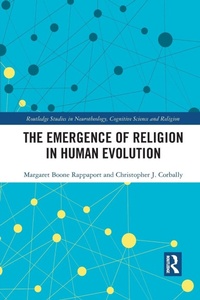
The Emergence of Religion in Human Evolution
1st Edition
Published on 30. June 2021
Book
Paperback/Softback
268 pages
978-1-032-08382-7 (ISBN)
Description
Religious capacity is a highly elaborate, neurocognitive human trait that has a solid evolutionary foundation. This book uses a multidisciplinary approach to describe millions of years of biological innovations that eventually give rise to the modern trait and its varied expression in humanity's many religions. The authors present a scientific model and a central thesis that the brain organs, networks, and capacities that allowed humans to survive physically also gave our species the ability to create theologies, find sustenance in religious practice, and use religion to support the social group. Yet, the trait of religious capacity remains non-obligatory, like reading and mathematics. The individual can choose not to use it.
The approach relies on research findings in nine disciplines, including the work of countless neuroscientists, paleoneurologists, archaeologists, cognitive scientists, and psychologists.
This is a cutting-edge examination of the evolutionary origins of humanity's interaction with the supernatural. It will be of keen interest to academics working in Religious Studies, Neuroscience, Cognitive Science, Anthropology, Evolutionary Biology, and Psychology.
The approach relies on research findings in nine disciplines, including the work of countless neuroscientists, paleoneurologists, archaeologists, cognitive scientists, and psychologists.
This is a cutting-edge examination of the evolutionary origins of humanity's interaction with the supernatural. It will be of keen interest to academics working in Religious Studies, Neuroscience, Cognitive Science, Anthropology, Evolutionary Biology, and Psychology.
More details
Series
Language
English
Place of publication
London
United Kingdom
Publishing group
Taylor & Francis Ltd
Target group
College/higher education
Professional and scholarly
Dimensions
Height: 234 mm
Width: 156 mm
Thickness: 15 mm
Weight
415 gr
ISBN-13
978-1-032-08382-7 (9781032083827)
Copyright in bibliographic data and cover images is held by Nielsen Book Services Limited or by the publishers or by their respective licensors: all rights reserved.
Schweitzer Classification
Other editions
Additional editions
Margaret Boone Rappaport | Christopher J. Corbally
The Emergence of Religion in Human Evolution
E-Book
12/2019
1st Edition
Routledge
€60.49
Available for download
Margaret Boone Rappaport | Christopher J. Corbally
The Emergence of Religion in Human Evolution
E-Book
12/2019
1st Edition
Routledge
€60.49
Available for download
Margaret Boone Rappaport | Christopher J. Corbally
The Emergence of Religion in Human Evolution
Book
12/2019
1st Edition
Routledge
€176.20
Shipment within 15-20 days
Persons
Margaret Boone Rappaport, Ph.D. is a cultural anthropologist and biologist who works in human cognitive evolution, and as a futurist, lecturer, and author in Tucson, Arizona. As President, Policy Research Methods, Incorporated, she conducted research for federal agencies for 30 years. She lectured at Georgetown and George Washington Universities. Dr. Rappaport is also a prize-winning short story and poetry writer, and the Co-Founder of The Human Sentience Project, LLC.
Christopher J. Corbally, S.J., Ph.D., is a Jesuit priest and an astronomer with the Vatican Observatory Research Group, for which he has served as Vice Director, and liaison to its headquarters at Castel Gandolfo, Italy. He is an Adjunct Associate Astronomer at the Department of Astronomy, University of Arizona, and ministers to a wide variety of Catholics, including Native Americans, in Tucson, Arizona. He is the Co-Founder of The Human Sentience Project, LLC.
Christopher J. Corbally, S.J., Ph.D., is a Jesuit priest and an astronomer with the Vatican Observatory Research Group, for which he has served as Vice Director, and liaison to its headquarters at Castel Gandolfo, Italy. He is an Adjunct Associate Astronomer at the Department of Astronomy, University of Arizona, and ministers to a wide variety of Catholics, including Native Americans, in Tucson, Arizona. He is the Co-Founder of The Human Sentience Project, LLC.
Content
Preface; Part I. Introduction to Theory; 1 New Sciences, New Findings, and a New Model; 2 Shifting Evolutionary Paradigms and the Study of Advanced Neurocognitive Traits; Part II. The Model; 3 The Human Hearth, the Circle of Light, and the Evolution of Morality; 4 Model for the Evolution of a Trait for Religious Capacity; Part III. The Implications; 5 The Neuroplastic Species; 6 Staying Alive, Becoming Religious; 7 Future Artificial Species: Will They Be Moral? Will They Be Religious?; Index