

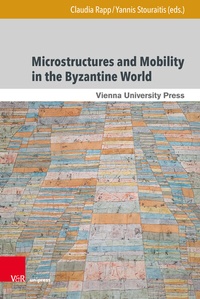
Microstructures and Mobility in the Byzantine World
1st Edition
Published on 22. January 2024
Book
Hardback
230 pages
978-3-8471-1497-0 (ISBN)
Description
The volume - whose chapters originated at panels at the International Byzantine Congress in Belgrade and at the IMC in Leeds - seeks to offer an introduction into various aspects of social and geographical mobility, and the intrinsic relationship between the two, as well as into the microstructures of social action in the Byzantine world during the high and late Middle Ages. Based on a balanced approach to the role of personal agency and social structure, the authors of the individual chapters seek to clarify how and why various kinds of people mobilized to either change place and/or social position, or to form groups whose actions shaped social reality both at the imperial centre and the provincial periphery.
More details
Persons
Editor
Dr. Claudia Rapp ist Professorin für Byzantinistik am Institut für Byzantinistik und Neogräzistik der Universität Wien.
Dr Yannis Stouraitis is a Senior Lecturer in Byzantine History at the University of Edinburgh. His research focuses on the social aspects of war, identity formation, migration and mnemohistory.
Contributions
Dr Ekaterini Mitsiou has held research positions at the National Hellenic Research Foundation (Athens), the Göttingen Academy, the Austrian Academy of Sciences and the University of Vienna where she is a member of the ENCHANT-Project ("Entangled Charters of Anatolia").
Dr. Claudia Rapp ist Professorin für Byzantinistik am Institut für Byzantinistik und Neogräzistik der Universität Wien.
Dr Yannis Stouraitis is a Senior Lecturer in Byzantine History at the University of Edinburgh. His research focuses on the social aspects of war, identity formation, migration and mnemohistory.