

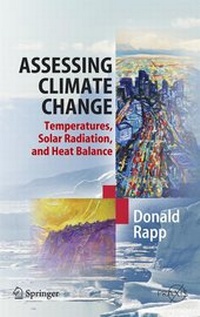
Assessing Climate Change
Temperatures, Solar Radiation and Heat Balance
1st Edition
Published on 22. November 2010
Book
Paperback/Softback
XXX, 374 pages
978-3-642-09533-7 (ISBN)
Description
Despite the inadequacies of the temperature measurement network, there is little doubt that much of the Earth has been undergoing a moderate warming since about the start of the 20th century, although this warming has been more pronounced in some areas, and it wavered in mid-century. A critical question facing mankind is: Has this global warming been primarily due to natural fluctuations (e.g. increases in total solar irradiance (TSI) coupled to positive feedback effects, changes in ocean heat transport flows, or other variations) or anthropogenic impacts (primarily greenhouse gas production)?
Global warming alarmists believe that the increases in 20th century temperatures are mainly due to increases in greenhouse gases and offer the "hockey stick" picture of global temperature history as evidence of the uniqueness of the 20th century. Nay-sayers dispute these predictions, claiming that the recent rise in temperature has significant regional exceptions, and is likely to be just another in a series of natural fluctuations in climate, not associated with greenhouse gases. They place little faith in climate models, and claim that the "hockey stick" picture of global temperature history is a "fraud" approaching the dimensions of cold fusion.
Published books on global warming and climate change tend to reflect the views of either the alarmists or the nay-sayers. They often start with the conclusion and then attempt to build the case by selecting or analyzing the data to support their thesis, e.g. global warming as a great threat or global warming as a fiction. In this book Donald Rapp attempts to assess the evidence in an objective way. Although he is not a climate scientist by profession, very few climate scientists have taken a broad systems view of the problem of global warming. Donald Rapp is a professional systems engineer, having taught in universities for 14 years and with over 25 years' experience managing various programs for NASA. His experience has required the ability to move into a highly technical field, assimilate the content, organize the knowledge base and succinctly describe the field, its content, its unresolved issues and achievements. This is precisely what Donald Rapp does in this book in relation to global climate change. As such his approach is refreshingly different.
Reviews / Votes
From the reviews:"Rapp . is a skeptic about climate change and the connection with human-induced increases in greenhouse gases. His book consists of nine chapters, a 20-page list of references, a 4-page index, and an appendix, which includes a critical review of Al Gore's film An Inconvenient Truth. . Summing Up: Recommended. Upper-division undergraduates through researchers/faculty." (J. T. Andrews, Choice, Vol. 46 (2), October, 2008)More details
Series
Edition
1., st Edition. Softcover version of original hardcover edition 2008
Language
English
Place of publication
Berlin
Germany
Target group
Professional and scholarly
Research
Edition type
New edition
Illustrations
130 s/w Abbildungen
130 black & white illustrations
Dimensions
Height: 23.5 cm
Width: 15.5 cm
Weight
631 gr
ISBN-13
978-3-642-09533-7 (9783642095337)
Schweitzer Classification
Other editions
Additional editions
Book
01/2008
Springer
€139.05
Article exhausted; check for reprint
Content
1. HISTORICAL VARIATIONS IN THE EARTH'S CLIMATE
2. EARTH SURFACE TEMPERATURES
3. TOTAL SOLAR IRRADIANCE
4. TEMPERATURE CHANGES DRIVEN BY CHANGES IN THE SUN
5. VOLCANIC ERUPTIONS
6. THE EARTH'S HEAT BALANCE AND THE GREENHOUSE EFFECT
7. FUTURE FOSSIL FUEL USAGE AND CO2 PRODUCTION
8. IMPACTS OF GLOBAL WARMING
9. GLOBAL CLIMATE CHANGE AND PUBLIC POLICY