

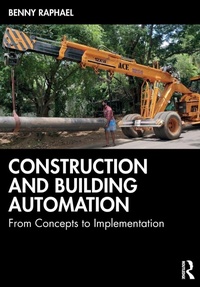
Construction and Building Automation
From Concepts to Implementation
1st Edition
Published on 26. July 2022
Book
Paperback/Softback
266 pages
978-0-367-76110-3 (ISBN)
Description
This book is intended to be used as a textbook in undergraduate civil engineering and construction courses to introduce cutting edge mechanical, electrical, and computer science topics that are needed for civil and construction engineers to collaborate in inter-disciplinary automation projects.
Part I introduces the basics of hardware and software technologies that are needed for implementing automation in buildings and construction. The content begins with the fundamental concepts and uses practical examples to bring out the benefits of automation through case studies that are easy to understand. No other book uniformly treats the subject of automation within the context of buildings and construction activities. While the technology needed for these two application domains are similar, the unifying principles are not well recognized. This book will bring out the fundamental principles that could form the basis of application to these two domains. For example, it will become clear that sensors, actuators, and controllers, along with smart control strategies could be used for automating tasks within buildings and on construction sites.
Part II of the book will introduce key advances in the areas of machine learning and artificial intelligence that are significant for the intelligent control of buildings and construction equipment. Control algorithms and techniques for data analytics are explained in a form that is appropriate for non-computer science students. Each chapter contains several hands-on exercises meant to apply the principles that are covered. These include numerical problems as well as design and analysis examples.
This new textbook:
* Introduces hardware and software needed for automating engineering tasks
* Presents examples of applications in the control of building systems
* Illustrates of the use of automation for improving construction processes
* Provides a lucid introduction to advanced computing concepts, machine learning, artificial intelligence, and control algorithms to construction and engineering students.
It is sure to be essential reading for a growing number of courses in smart construction, building automation, robotics, intelligent buildings, and construction 4.0.
Supplementary material including answers to exercises in the book will be provided on the author's website: https://bennyraphael.com/book2022/
Part I introduces the basics of hardware and software technologies that are needed for implementing automation in buildings and construction. The content begins with the fundamental concepts and uses practical examples to bring out the benefits of automation through case studies that are easy to understand. No other book uniformly treats the subject of automation within the context of buildings and construction activities. While the technology needed for these two application domains are similar, the unifying principles are not well recognized. This book will bring out the fundamental principles that could form the basis of application to these two domains. For example, it will become clear that sensors, actuators, and controllers, along with smart control strategies could be used for automating tasks within buildings and on construction sites.
Part II of the book will introduce key advances in the areas of machine learning and artificial intelligence that are significant for the intelligent control of buildings and construction equipment. Control algorithms and techniques for data analytics are explained in a form that is appropriate for non-computer science students. Each chapter contains several hands-on exercises meant to apply the principles that are covered. These include numerical problems as well as design and analysis examples.
This new textbook:
* Introduces hardware and software needed for automating engineering tasks
* Presents examples of applications in the control of building systems
* Illustrates of the use of automation for improving construction processes
* Provides a lucid introduction to advanced computing concepts, machine learning, artificial intelligence, and control algorithms to construction and engineering students.
It is sure to be essential reading for a growing number of courses in smart construction, building automation, robotics, intelligent buildings, and construction 4.0.
Supplementary material including answers to exercises in the book will be provided on the author's website: https://bennyraphael.com/book2022/
Reviews / Votes
"A comprehensive treaty on a growing area of knowledge" - Professor Abhijit Mukherjee, Curtin University, Australia "A comprehensive treaty on a growing area of knowledge." - Professor Abhijit Mukherjee, Curtin University, AustraliaMore details
Language
English
Place of publication
London
United Kingdom
Publishing group
Taylor & Francis Ltd
Target group
College/higher education
Undergraduate Advanced
Illustrations
112 s/w Abbildungen, 46 s/w Photographien bzw. Rasterbilder, 66 s/w Zeichnungen, 28 s/w Tabellen
28 Tables, black and white; 66 Line drawings, black and white; 46 Halftones, black and white; 112 Illustrations, black and white
Dimensions
Height: 244 mm
Width: 170 mm
Thickness: 15 mm
Weight
485 gr
ISBN-13
978-0-367-76110-3 (9780367761103)
Copyright in bibliographic data and cover images is held by Nielsen Book Services Limited or by the publishers or by their respective licensors: all rights reserved.
Schweitzer Classification
Other editions
Additional editions
E-Book
07/2022
1st Edition
Routledge
€69.99
Available for download
E-Book
07/2022
1st Edition
Routledge
€69.99
Available for download
Book
07/2022
1st Edition
Routledge
€206.60
Shipment within 15-20 days
Person
Benny Raphael is a professor in the Department of Civil Engineering at IIT Madras, India.
Content
1. Introduction to automation 2. Hardware for automation 3. Software for automation 4. Application: building Automation 5. Application: construction automation 6. Introduction to machine learning 7. Basic mathematics for machine learning 8. Regression 9. Classification task 10. Inductive learning - decision trees and random forests 11. Unsupervised learning algorithms Epilogue