

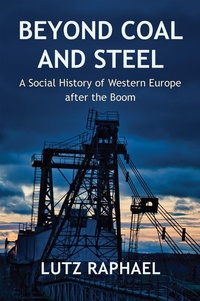
Beyond Coal and Steel
A Social History of Western Europe after the Boom
Published on 24. November 2023
Book
Hardback
404 pages
978-1-5095-5437-9 (ISBN)
Description
In the 1970s, the economic and social foundations of Western Europe underwent an unprecedented transformation. Old industries like coal and steel disappeared, millions of people lost their jobs and formerly flourishing towns and cities went into decline. Traditional political agendas gave way to new social problems and concerns. What happened to industrial citizens - their workplaces, their careers and their homes? How did social rights and political participation of workers change when markets became global, management lean and financial capital dominant? What ideas and ideologies framed these dramatic changes in society? How did companies change and how were personal skills and work tasks were re-invented under the impact of new technologies? How did workers - men and women - live through these decades of uncertainty and upheaval?
Lutz Raphael reconstructs the highly variegated story of deindustrialisation in Western Europe with a particular focus on Britain, France and West Germany. Extending over three decades, this transformation was accompanied by significant rises in productivity and consumerism, but it also came at a heavy cost, ushering in many low income jobs, growing inequality and a crisis of democratic representation. Its legacy is everywhere around us today - it is the transformation that has shaped our world.
In the 1970s, the economic and social foundations of Western Europe underwent an unprecedented transformation. Old industries like coal and steel disappeared, millions of people lost their jobs and formerly flourishing towns and cities went into decline. Traditional political agendas gave way to new social problems and concerns. What happened to industrial citizens - their workplaces, their careers and their homes? How did social rights and political participation of workers change when markets became global, management lean and financial capital dominant? What ideas and ideologies framed these dramatic changes in society? How did companies change and how were personal skills and work tasks were re-invented under the impact of new technologies? How did workers - men and women - live through these decades of uncertainty and upheaval?
Lutz Raphael reconstructs the highly variegated story of deindustrialisation in Western Europe with a particular focus on Britain, France and West Germany. Extending over three decades, this transformation was accompanied by significant rises in productivity and consumerism, but it also came at a heavy cost, ushering in many low income jobs, growing inequality and a crisis of democratic representation. Its legacy is everywhere around us today - it is the transformation that has shaped our world.
Lutz Raphael reconstructs the highly variegated story of deindustrialisation in Western Europe with a particular focus on Britain, France and West Germany. Extending over three decades, this transformation was accompanied by significant rises in productivity and consumerism, but it also came at a heavy cost, ushering in many low income jobs, growing inequality and a crisis of democratic representation. Its legacy is everywhere around us today - it is the transformation that has shaped our world.
In the 1970s, the economic and social foundations of Western Europe underwent an unprecedented transformation. Old industries like coal and steel disappeared, millions of people lost their jobs and formerly flourishing towns and cities went into decline. Traditional political agendas gave way to new social problems and concerns. What happened to industrial citizens - their workplaces, their careers and their homes? How did social rights and political participation of workers change when markets became global, management lean and financial capital dominant? What ideas and ideologies framed these dramatic changes in society? How did companies change and how were personal skills and work tasks were re-invented under the impact of new technologies? How did workers - men and women - live through these decades of uncertainty and upheaval?
Lutz Raphael reconstructs the highly variegated story of deindustrialisation in Western Europe with a particular focus on Britain, France and West Germany. Extending over three decades, this transformation was accompanied by significant rises in productivity and consumerism, but it also came at a heavy cost, ushering in many low income jobs, growing inequality and a crisis of democratic representation. Its legacy is everywhere around us today - it is the transformation that has shaped our world.
More details
Edition
1
Language
English
Place of publication
Oxford
United Kingdom
Publishing group
John Wiley and Sons Ltd
Target group
Professional and scholarly
Dimensions
Height: 235 mm
Width: 157 mm
Thickness: 29 mm
Weight
700 gr
ISBN-13
978-1-5095-5437-9 (9781509554379)
Copyright in bibliographic data and cover images is held by Nielsen Book Services Limited or by the publishers or by their respective licensors: all rights reserved.
Schweitzer Classification
Other editions
Additional editions
Book
11/2023
Polity Press
€27.50
Shipment within 15-20 days
E-Book
11/2023
1st Edition
Wiley
€20.99
Available for download
Persons
Lutz Raphael is Professor of Contemporary History at Trier University.
<b>Lutz Raphael</b> is Professor of Contemporary History at Trier University.
<b>Lutz Raphael</b> is Professor of Contemporary History at Trier University.
Content
Acknowledgements
Introduction
SECTION I. A BIRD'S EYE VIEW
Three National Labour Regimes in Transition
1. Industrial labour in Western Europe after the economic boom from the perspective of the political economy
2. Farewell to class struggle and fixed social structures
3. Political history from below: labour conflict and new social movements
4. Industrial citizens and wage earners: labour relations, social benefits and wages
5. Skilled work, production knowledge and educational capital: conflicts of interpretation and readjustments.
SECTION II. CLOSE-UPS
Fields of experience and horizons of expectation in times of upheaval
6. Life courses, work and unemployment in times of upheaval
7. Transformations in company regimes
8. Industrial districts, social spaces, 'problem neighbourhoods' and owner-occupier areas: social spaces and deindustrialization
Conclusion: The history of deindustrialization as a history of contemporary problems.
List of Illustrations
Sources and literature
Notes
Index
Introduction
SECTION I. A BIRD'S EYE VIEW
Three National Labour Regimes in Transition
1. Industrial labour in Western Europe after the economic boom from the perspective of the political economy
2. Farewell to class struggle and fixed social structures
3. Political history from below: labour conflict and new social movements
4. Industrial citizens and wage earners: labour relations, social benefits and wages
5. Skilled work, production knowledge and educational capital: conflicts of interpretation and readjustments.
SECTION II. CLOSE-UPS
Fields of experience and horizons of expectation in times of upheaval
6. Life courses, work and unemployment in times of upheaval
7. Transformations in company regimes
8. Industrial districts, social spaces, 'problem neighbourhoods' and owner-occupier areas: social spaces and deindustrialization
Conclusion: The history of deindustrialization as a history of contemporary problems.
List of Illustrations
Sources and literature
Notes
Index