

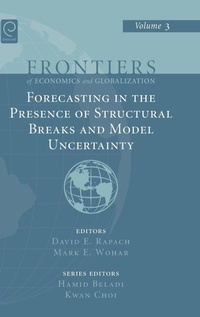
Forecasting in the Presence of Structural Breaks and Model Uncertainty
Will be published approx. on 29. February 2008
Book
Hardback
700 pages
978-0-444-52942-8 (ISBN)
Description
Forecasting in the presence of structural breaks and model uncertainty are active areas of recent research with crucial implications for practical problems in forecasting. "Forecasting in the Presence of Structural Breaks and Model Uncertainty" presents findings from the recent literature and new findings in a way that will be very useful to academic researchers and practitioners alike. Each chapter includes detailed empirical applications that demonstrate the usefulness (and limitations) of different methods for generating forecasts when structural breaks and model uncertainty are of significant concern. The authors describe in detail their methods and their results, and the data and programs are made available on a web site devoted to the book. The volume addresses forecasting variables from both Macroeconomics and Finance, and considers many different methods of dealing with model instability and model uncertainty when forming forecasts. Authors are leading experts in the topics they survey and extend. This book is supported by a website detailing the data and programs used.
More details
Series
Language
English
Place of publication
Kidlington
United Kingdom
Publishing group
Emerald Publishing Limited
Target group
Professional and scholarly
Dimensions
Height: 240 mm
Width: 161 mm
Thickness: 41 mm
Weight
1189 gr
ISBN-13
978-0-444-52942-8 (9780444529428)
Copyright in bibliographic data and cover images is held by Nielsen Book Services Limited or by the publishers or by their respective licensors: all rights reserved.
Schweitzer Classification
Other editions
Additional editions
David E. Rapach | Mark E. Wohar | Hamid Beladi
Forecasting in the Presence of Structural Breaks and Model Uncertainty
E-Book
02/2008
Emerald Publishing Limited
€172.99
Available for download
Content
Chapter 1 Forecasting Annual UK Inflation Using an Econometric Model over 1875-1991.
Chapter 2 Forecasting UK Inflation: The Roles of Structural Breaks and Time Disaggregation.
Chapter 3 Forecasting with Small Macroeconomic VARs in the Presence of Instabilities.
Chapter 4 Forecasting Macroeconomic Variables Using Diffusion Indexes in Short Samples with Structural Change.
Chapter 5 Predictive Inference under Model Misspecification.
Chapter 6 Forecasting Persistent Data with Possible Structural Breaks: Old School and New School Lessons Using OECD Unemployment Rates.
Chapter 7 What Can We Learn from Comprehensive Data Revisions for Forecasting Inflation? Some US Evidence.
Chapter 8 Estimating and Forecasting GARCH Models in the Presence of Structural Breaks and Regime Switches.
Chapter 9 A Source of Long Memory in Volatility.
Chapter 10 Forecasting Stock Return Volatility in the Presence of Structural Breaks.
Chapter 11 Financial Time Series and Volatility Prediction using NoVaS Transformations.
Chapter 12 Modeling Foreign Exchange Rates with Jumps.
Chapter 13 Bagging Binary and Quantile Predictors for Time Series: Further Issues.
Chapter 14 Forecasting Interest Rates: An Application of the Stochastic Unit Root and Stochastic Cointegration Frameworks.
Chapter 15 Bayesian Model Averaging in the Presence of Structural Breaks.
Chapter 16 The Economic and Statistical Value of Forecast Combinations Under Regime Switching: An Application to Predictable US Returns.
Editors' introduction.
List of Contributors (in alphabetical order).
Subject Index.
Contents.
Frontiers of economics and globalization.
Series Editors.
Volume Editors.
Copyright page.
Chapter 2 Forecasting UK Inflation: The Roles of Structural Breaks and Time Disaggregation.
Chapter 3 Forecasting with Small Macroeconomic VARs in the Presence of Instabilities.
Chapter 4 Forecasting Macroeconomic Variables Using Diffusion Indexes in Short Samples with Structural Change.
Chapter 5 Predictive Inference under Model Misspecification.
Chapter 6 Forecasting Persistent Data with Possible Structural Breaks: Old School and New School Lessons Using OECD Unemployment Rates.
Chapter 7 What Can We Learn from Comprehensive Data Revisions for Forecasting Inflation? Some US Evidence.
Chapter 8 Estimating and Forecasting GARCH Models in the Presence of Structural Breaks and Regime Switches.
Chapter 9 A Source of Long Memory in Volatility.
Chapter 10 Forecasting Stock Return Volatility in the Presence of Structural Breaks.
Chapter 11 Financial Time Series and Volatility Prediction using NoVaS Transformations.
Chapter 12 Modeling Foreign Exchange Rates with Jumps.
Chapter 13 Bagging Binary and Quantile Predictors for Time Series: Further Issues.
Chapter 14 Forecasting Interest Rates: An Application of the Stochastic Unit Root and Stochastic Cointegration Frameworks.
Chapter 15 Bayesian Model Averaging in the Presence of Structural Breaks.
Chapter 16 The Economic and Statistical Value of Forecast Combinations Under Regime Switching: An Application to Predictable US Returns.
Editors' introduction.
List of Contributors (in alphabetical order).
Subject Index.
Contents.
Frontiers of economics and globalization.
Series Editors.
Volume Editors.
Copyright page.