

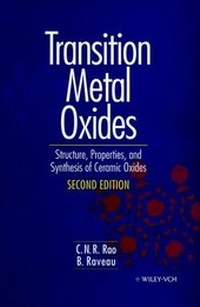
Transition Metal Oxides
Structure, Properties, and Synthesis of Ceramic Oxides
2nd Edition
Published on 24. March 1998
Book
Hardback
392 pages
978-0-471-18971-8 (ISBN)
Description
Praise for the First Edition:
"Very useful for researchers in solid-state chemistry and as a textbook of advanced inorganic chemistry for PhD students." -Advanced Materials.
This book provides unified coverage of the structure, properties, and synthesis of transition metal oxides. Written by two world-class scientists, it offers both an excellent window on modern solid-state chemistry and a gateway to understanding the behavior of inorganic solids.
Scientists and advanced students in inorganic and solid-state chemistry, materials science, ceramics, and condensed matter science will welcome this updated Second Edition, which features new or expanded material on:
* Oxyanion derivatives of cuprates, mercury cuprates, ladder compounds, and new oxide systems
* Giant magnetoresistance, superconductivity, and nonlinear materials
* Recently developed synthetic strategies and examples, including soft chemistry routes
Plus:
* Hundreds of illustrations
* Helpful references.
More details
Product info
GB
Edition
2., Auflage
Language
English
Place of publication
United States
Publishing group
John Wiley & Sons Inc
Target group
College/higher education
Professional and scholarly
Edition type
New edition
Product notice
sewn/stitched
Cloth over boards
Dimensions
Height: 240 mm
Width: 161 mm
Thickness: 25 mm
Weight
748 gr
ISBN-13
978-0-471-18971-8 (9780471189718)
Schweitzer Classification
Other editions
Previous edition

Persons
C. N. R. RAO is Albert Einstein Research Professor at the CSIR Centre of Excellence in Chemistry at the Indian Institute of Science and Jawaharlal Nehru Centre for Advanced Scientific Research in Bangalore, India.
B. RAVEAU is Professor at the Laboratoire CRISMAT, Centre des Matériaux Supraconducteurs in Caen, France.
Content
STRUCTURE.
Basic Background Material.
Mother Structures of Some Binary Transition Metal Oxides.
Perovskites and Relatives.
Octahedral Tunnel Structures: Bronzes and Bronzoids.
Octahedral Intersecting Tunnel Structures: Pyrochlores and Relatives.
Octahedral Lamellar Oxides.
Close-Packed Oxides: Spinels, Hexagonal Ferrites, and Relatives.
Three-Dimensional Mixed Frameworks Involving Tetrahedra and Octahedra.
Examples of Unusual Coordination: The Vanadium Oxides.
Sheer Structures.
The Highly Complex Structural Behavior of Transition Metal Oxides.
PROPERTIES AND PHENOMENA.
Electrons in Transition Metal Oxides.
Properties of Oxide Materials.
Electronic and Magnetic Properties of Oxides in Relation to Structure.
Mixed Valence.
Metal-Nonmetal Transitions.
Low-Dimensional Oxides.
Superconducting Oxides.
Ferroics.
Results from Empirical Theory.
Understanding Electronic Structures from Electron Spectroscopy Combined with Empirical Theory.
Giant Magnetoresistance and Related Aspects.
Nanomaterials.
Catalysts and Gas Sensors.
PREPARATION OF MATERIALS.
Typical Reactions.
Ceramic Preparations.
Use of Precursors.
Topochemical and Intercalation Reactions.
Ion Exchange Method.
Alkali Flux and Electrochemical Methods.
Sol-Gel Method.
Reactions at High Pressures.
Superconducting Cuprates.
Arc and Skull Techniques.
Soft Chemical Routes.
Crystal Growth.
Concluding Remarks.
References.
Index.