

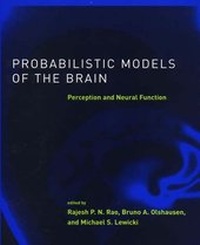
Probabilistic Models of the Brain
Perception and Neural Function
Published on 29. March 2002
Book
Hardback
334 pages
978-0-262-18224-9 (ISBN)
Description
Neurophysiological, neuroanatomical, and brain imaging studies have helped to shed
light on how the brain transforms raw sensory information into a form that is useful for
goal-directed behavior. A fundamental question that is seldom addressed by these studies, however,
is why the brain uses the types of representations it does and what evolutionary advantage, if any,
these representations confer. It is difficult to address such questions directly via animal
experiments. A promising alternative is to use probabilistic principles such as maximum likelihood
and Bayesian inference to derive models of brain function.
This book surveys some
of the current probabilistic approaches to modeling and understanding brain function. Although most
of the examples focus on vision, many of the models and techniques are applicable to other
modalities as well. The book presents top-down computational models as well as bottom-up neurally
motivated models of brain function. The topics covered include Bayesian and information-theoretic
models of perception, probabilistic theories of neural coding and spike timing, computational models
of lateral and cortico-cortical feedback connections, and the development of receptive field
properties from natural signals.
light on how the brain transforms raw sensory information into a form that is useful for
goal-directed behavior. A fundamental question that is seldom addressed by these studies, however,
is why the brain uses the types of representations it does and what evolutionary advantage, if any,
these representations confer. It is difficult to address such questions directly via animal
experiments. A promising alternative is to use probabilistic principles such as maximum likelihood
and Bayesian inference to derive models of brain function.
This book surveys some
of the current probabilistic approaches to modeling and understanding brain function. Although most
of the examples focus on vision, many of the models and techniques are applicable to other
modalities as well. The book presents top-down computational models as well as bottom-up neurally
motivated models of brain function. The topics covered include Bayesian and information-theoretic
models of perception, probabilistic theories of neural coding and spike timing, computational models
of lateral and cortico-cortical feedback connections, and the development of receptive field
properties from natural signals.
More details
Series
Language
English
Place of publication
Massachusetts
United States
Publishing group
MIT Press Ltd
Target group
Professional and scholarly
US School Grade: From College Freshman to College Graduate Student
Illustrations
Ill.
Dimensions
Height: 254 mm
Width: 203 mm
Thickness: 25 mm
Weight
907 gr
ISBN-13
978-0-262-18224-9 (9780262182249)
Copyright in bibliographic data and cover images is held by Nielsen Book Services Limited or by the publishers or by their respective licensors: all rights reserved.
Schweitzer Classification
Other editions
Additional editions
Rajesh P.N. Rao | Bruno A. Olshausen | Michael S. Lewicki
Probabilistic Models of the Brain
Perception and Neural Function
Book
03/2002
Bradford Books
€36.50
Article exhausted; check different version
Persons
Bruno A. Olshausen is Associate Professor in the Department of Psychology and the Center for Neuroscience at the University of California, Davis.
Michael S. Lewicki is Assistant Professor in the Department of Computer Science and the Center for the Neural Basis of Cognition at Carnegie Mellon University.
Michael S. Lewicki is Assistant Professor in the Department of Computer Science and the Center for the Neural Basis of Cognition at Carnegie Mellon University.