

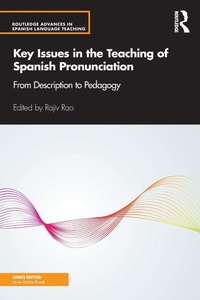
Key Issues in the Teaching of Spanish Pronunciation
From Description to Pedagogy
1st Edition
Published on 7. May 2019
Book
Paperback/Softback
356 pages
978-1-138-95461-8 (ISBN)
Description
Key Issues in the Teaching of Spanish Pronunciation: From Description to Pedagogy is a resource that encourages Spanish teachers and curriculum designers to increase their incorporation of pronunciation into the classroom. Combining theory and practical guidance, it will help language practitioners integrate the teaching of Spanish pronunciation with confidence and effectiveness. The international group of scholars across its 15 chapters is made up of individuals with well-established research records and training in best pedagogical practices.
Key features:
A range of topics including vowels, various classes of consonants, prosody, the use of technology, the role of orthography, the importance of both perception and production, individual learner differences, and teacher training;
Overviews of descriptive, empirical, and acquisition-based research associated with each aspect of the Spanish sound system;
Guidance on the difficulties that teachers face when incorporating the teaching of pronunciation into the classroom;
Clear explanations of concepts, accompanied by an abundance of concrete examples and references;
Multiple sample activities and lesson plans tailored to different levels and backgrounds of students;
A bilingual glossary of terms to help the content reach the widest audience possible.
Written in a clear and accessible manner, Key Issues in the Teaching of Spanish Pronunciation is an essential resource for teachers of Spanish at all levels. It is also an excellent reference book for researchers and both undergraduate and graduate university students interested in Spanish phonetics and language acquisition.
Key features:
A range of topics including vowels, various classes of consonants, prosody, the use of technology, the role of orthography, the importance of both perception and production, individual learner differences, and teacher training;
Overviews of descriptive, empirical, and acquisition-based research associated with each aspect of the Spanish sound system;
Guidance on the difficulties that teachers face when incorporating the teaching of pronunciation into the classroom;
Clear explanations of concepts, accompanied by an abundance of concrete examples and references;
Multiple sample activities and lesson plans tailored to different levels and backgrounds of students;
A bilingual glossary of terms to help the content reach the widest audience possible.
Written in a clear and accessible manner, Key Issues in the Teaching of Spanish Pronunciation is an essential resource for teachers of Spanish at all levels. It is also an excellent reference book for researchers and both undergraduate and graduate university students interested in Spanish phonetics and language acquisition.
More details
Series
Language
English
Place of publication
London
United Kingdom
Publishing group
Taylor & Francis Ltd
Target group
College/higher education
Professional and scholarly
Academic and Professional Practice & Development
Illustrations
35 s/w Tabellen, 18 s/w Photographien bzw. Rasterbilder, 44 s/w Zeichnungen
35 Tables, black and white; 44 Line drawings, black and white; 18 Halftones, black and white
Dimensions
Height: 234 mm
Width: 156 mm
Thickness: 20 mm
Weight
570 gr
ISBN-13
978-1-138-95461-8 (9781138954618)
Copyright in bibliographic data and cover images is held by Nielsen Book Services Limited or by the publishers or by their respective licensors: all rights reserved.
Schweitzer Classification
Other editions
Additional editions
Book
05/2019
1st Edition
Routledge
€207.30
Shipment within 10-20 days

E-Book
04/2019
1st Edition
Routledge
€68.49
Available for download

E-Book
04/2019
Routledge
€68.49
Available for download
Person
Rajiv Rao is Associate Professor of Spanish in the Department of Spanish and Portuguese at the University of Wisconsin-Madison.
Content
Introduction
Rajiv Rao
Part I
The Sound System of Spanish
1 Description of Spanish Vowels and Guidelines for Teaching Them
Eugenio Martinez Celdran and Wendy Elvira-Garcia
2 Pronunciation in the L2 Spanish Classroom: The Voiceless Stops /p, t, k/
Mary L. Zampini
3 Suggestions for Teaching Spanish Voiced Stops /b, d, ?/ and Their Lenited Allophones [??, ??, ??]
Manuela Gonzalez-Bueno
4 A Theoretical Framework in the Acquisition and Teaching of Fricatives to L2 Learners of Spanish
A. Raymond Elliott
5 Issues in the Teaching of Spanish Liquid Consonants
Benjamin Schmeiser
6 The Polymorphism of Spanish Nasal Stops
Carlos-Eduardo Pineros
7 Incorporating Syllable Structure into the Teaching of Spanish Pronunciation
Sonia Colina
8 Improving Non-Native Pronunciation: Teaching Prosody to Learners of Spanish as a Second/Foreign Language
Carme de-la-Mota
Part II
Pedagogical Challenges and Suggestions for the Classroom
9 Spanish Pronunciation and Teaching Dialectal Variation
German Zarate-Sandez
10 Incorporating Technology into the Teaching of Spanish Pronunciation
Gillian Lord
11 Navigating Orthographic Issues in the Teaching of Spanish Pronunciation
Yasaman Rafat and Scott James Perry
12 The Role of Perception in Learning Spanish Pronunciation
C. Elizabeth Goodin-Mayeda
13 An Analytical Approach to Teaching Spanish Pronunciation to Native Speakers of German: First Language and Age of First Exposure as Crucial Factors
Conxita Lleo and Marta Ulloa
14 Teaching Pronunciation to Spanish Heritage Speakers
Amanda Boomershine and Rebecca Ronquest
15 Spanish Pronunciation and Teacher Training: Challenges and Suggestions
Manuel Delicado Cantero, William Steed, and Alfredo Herrero de Haro
Glossary
Rajiv Rao
Part I
The Sound System of Spanish
1 Description of Spanish Vowels and Guidelines for Teaching Them
Eugenio Martinez Celdran and Wendy Elvira-Garcia
2 Pronunciation in the L2 Spanish Classroom: The Voiceless Stops /p, t, k/
Mary L. Zampini
3 Suggestions for Teaching Spanish Voiced Stops /b, d, ?/ and Their Lenited Allophones [??, ??, ??]
Manuela Gonzalez-Bueno
4 A Theoretical Framework in the Acquisition and Teaching of Fricatives to L2 Learners of Spanish
A. Raymond Elliott
5 Issues in the Teaching of Spanish Liquid Consonants
Benjamin Schmeiser
6 The Polymorphism of Spanish Nasal Stops
Carlos-Eduardo Pineros
7 Incorporating Syllable Structure into the Teaching of Spanish Pronunciation
Sonia Colina
8 Improving Non-Native Pronunciation: Teaching Prosody to Learners of Spanish as a Second/Foreign Language
Carme de-la-Mota
Part II
Pedagogical Challenges and Suggestions for the Classroom
9 Spanish Pronunciation and Teaching Dialectal Variation
German Zarate-Sandez
10 Incorporating Technology into the Teaching of Spanish Pronunciation
Gillian Lord
11 Navigating Orthographic Issues in the Teaching of Spanish Pronunciation
Yasaman Rafat and Scott James Perry
12 The Role of Perception in Learning Spanish Pronunciation
C. Elizabeth Goodin-Mayeda
13 An Analytical Approach to Teaching Spanish Pronunciation to Native Speakers of German: First Language and Age of First Exposure as Crucial Factors
Conxita Lleo and Marta Ulloa
14 Teaching Pronunciation to Spanish Heritage Speakers
Amanda Boomershine and Rebecca Ronquest
15 Spanish Pronunciation and Teacher Training: Challenges and Suggestions
Manuel Delicado Cantero, William Steed, and Alfredo Herrero de Haro
Glossary