

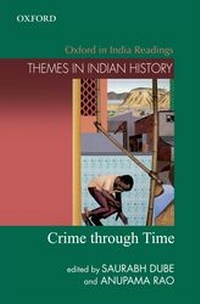
Crime Through Time
1st Edition
Published in December 2013
Book
Hardback
424 pages
978-0-19-807761-9 (ISBN)
Description
Part of the prestigious Themes in Indian History series, this book deals with notions, ideas, and concepts of crime and justice from the eighteenth to the twentieth century. Divided into four sections, the first deals with the pre-colonial period with its decentralized law and justice system. The second addresses the colonial period and cites the administrative and legal changes during that period like legal codifications, policing, tattooing and other technologies identification. The section on subaltern legalities studies customary laws and their negotiations with colonial laws. The final section studies the nature of crimes in post-independence India, and discusses issues like violence on Dalits and minorities.
This book will be of great interest to scholars and students of modern Indian history, sociology, and cultural studies.
This book will be of great interest to scholars and students of modern Indian history, sociology, and cultural studies.
More details
Series
Language
English
Place of publication
New Delhi
India
Target group
College/higher education
This book will be of great interest to scholars and students of modern Indian history, sociology, and cultural studies.
Dimensions
Height: 223 mm
Width: 149 mm
Thickness: 31 mm
Weight
590 gr
ISBN-13
978-0-19-807761-9 (9780198077619)
Copyright in bibliographic data and cover images is held by Nielsen Book Services Limited or by the publishers or by their respective licensors: all rights reserved.
Schweitzer Classification
Persons
Anupama Rao is Associate Professor of History, Barnard College, Columbia University, New York. She is also Fellow of Center for Advanced Study in Behavioral Sciences, Stanford University.
Saurabh Dube is Professor of History, Center of Asian and African Studies, El Colegio de Mexico, Mexico City.
Saurabh Dube is Professor of History, Center of Asian and African Studies, El Colegio de Mexico, Mexico City.
Content
SERIES NOTE ; PREFACE ; ACKNOWLEDGEMENTS ; INTRODUCTION ; PART I. PRECOLONIAL PREMONITIONS: ; 1. WRONGS AND RIGHTS IN THE MARATHA COUNTRY: ANTIQUITY, CUSTOM AND POWER IN EIGHTEENTH-CENTURY INDIA BY SUMIT GUHA ; 2. THE BANDIT AS KING BY MALAVIKA KASTURI; ; PART II. COLONIAL CONCERNS: ; 3. FRAMED, BLAMED AND RENAMED: THE RECASTING OF ISLAMIC JURISPRUDENCE IN MODERN ASIAN STUDIES BY SCOTT ALAN KUGLE ; 4. DISCIPLINING AND POLICING THE 'CRIMINALS BY BIRTH': DEVELOPMENT OF A DISCIPLINARY SYSTEM, 1871-1900 BY SANJAY NIGAM ; 5. CRIMINAL COMMUNITIES BY RADHIKA SINGHA ; 6. POLICE AND PUBLIC ORDER BY RAJNARAYAN CHANDAVARKAR ; 7. DISCIPLINING 'NATIVES': PRISONS AND PRISONERS IN EARLY NINETEENTH CENTURY INDIA BY ANAND A. YANG ; 8. THE SELF AND THE CELL: INDIAN PRISON NARRATIVES AS LIFE HISTORIES BY DAVID ARNOLD ; PART III. LEGALITIES AND ILLEGALITIES: ; 9. AMBIGUITY BY RANAJIT GUHA ; 10. THE EMERGENCE OF FEMINISM IN INDIA, 1850-1920 BY PADMA ANAGOL ; 11. TELLING TALES BY SAURABH DUBE ; PART IV. POSTCOLONIAL PREDILECTIONS ; 12. OUTLAW WOMAN: THE POLITICS OF PHOOLAN DEVI BY RAJESWARI SUNDER RAJAN ; 13. DEATH OF A KOTWAL: THE INJURIOUS POLITICS OF RECOGNITION BY ANUPAMA RAO ; 14. SEMIOTICS OF TERROR: MUSLIM CHILDREN AND WOMEN IN HINDU RASHTRA BY TANIKA SARKAR ; ANNOTATED BIBLIOGRAPHY ; NOTES ON CONTRIBUTORS