

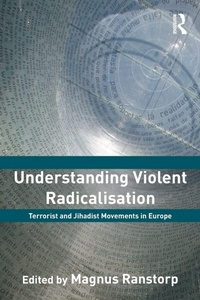
Understanding Violent Radicalisation
Terrorist and Jihadist Movements in Europe
1st Edition
Published on 10. December 2009
Book
Paperback/Softback
268 pages
978-0-415-55630-9 (ISBN)
Description
This is the first book to address in depth the interplay between radicalisation and political violence in Europe, as well as the effectiveness of counter-measures.
As evidenced from the multitude of intercepted plots across several European cities since 2001, the threat level and the intensity of the desire to perpetrate mass-casualty attacks within Europe is not diminishing. While violent radicalization has gradually moved to the top of the EU counterterrorism agenda, it has been accompanied by a relatively embryonic understanding about the processes and interplay of factors that contribute to radicalization, which are played out differently in cities like Paris, Rome, London and Copenhagen. Undoubtedly, there are common factors at the global and regional levels that facilitate radicalization, but it is also clear that radicalization is very context dependent. This book provides crucial insights into different ways to understand violent radicalization within national contexts and the challenges addressing the many pathways into terrorism inspired by al-Qaeda and other forms of Islamic extremism.
This book will be of great interest to students of terrorism studies and political violence, counter-terrorism, EU politics, security studies and IR in general.
Magnus Ranstorp is Research Director of the Center for Asymmetric Threat Studies at the Swedish National Defence College and a Member of EU Expert Groups on (Violent) Radicalisation. He has twenty years of experience in research on counterterrorism issues and testified at the 9/11 Commission Hearing.
As evidenced from the multitude of intercepted plots across several European cities since 2001, the threat level and the intensity of the desire to perpetrate mass-casualty attacks within Europe is not diminishing. While violent radicalization has gradually moved to the top of the EU counterterrorism agenda, it has been accompanied by a relatively embryonic understanding about the processes and interplay of factors that contribute to radicalization, which are played out differently in cities like Paris, Rome, London and Copenhagen. Undoubtedly, there are common factors at the global and regional levels that facilitate radicalization, but it is also clear that radicalization is very context dependent. This book provides crucial insights into different ways to understand violent radicalization within national contexts and the challenges addressing the many pathways into terrorism inspired by al-Qaeda and other forms of Islamic extremism.
This book will be of great interest to students of terrorism studies and political violence, counter-terrorism, EU politics, security studies and IR in general.
Magnus Ranstorp is Research Director of the Center for Asymmetric Threat Studies at the Swedish National Defence College and a Member of EU Expert Groups on (Violent) Radicalisation. He has twenty years of experience in research on counterterrorism issues and testified at the 9/11 Commission Hearing.
More details
Series
Language
English
Place of publication
London
United Kingdom
Publishing group
Taylor & Francis Ltd
Target group
College/higher education
Professional and scholarly
Product notice
Paperback (UK-B)
Illustrations
2 s/w Zeichnungen, 1 s/w Tabelle
1 Tables, black and white; 2 Line drawings, black and white
Dimensions
Height: 234 mm
Width: 156 mm
Thickness: 15 mm
Weight
430 gr
ISBN-13
978-0-415-55630-9 (9780415556309)
Copyright in bibliographic data and cover images is held by Nielsen Book Services Limited or by the publishers or by their respective licensors: all rights reserved.
Schweitzer Classification
Other editions
Additional editions
E-Book
01/2010
Routledge
€64.49
Available for download
E-Book
01/2010
Routledge
€64.49
Available for download
Book
12/2009
1st Edition
Routledge
€232.00
Shipment within 15-20 days
Person
Magnus Ranstorp is Research Director of the Center for Asymmetric Threat Studies at the Swedish National Defence College and a Member of EU Expert Groups on (Violent) Radicalisation. He has twenty years of experience in research on counterterrorism issues and testified at the 9/11 Commission Hearing.
Content
Introduction Magnus Ranstorp Part 1: Understanding Radicalization as a Process 1. Background Contributing Factors to Terrorism: Radicalisation and Recruitment Rem Kortweg with Sajjan Gohel, Francois Heisbourg, Magnus Ranstorp and Rob de Wijk 2. Where does the Radicalisation Process Lead? Radical Community, Radical Networks and Radical Subcultures Peter Waldmann, Matenia Sirseloudi and Stefan Malthaner 3. The Physiology of Al-Qaeda: From Ideology to Participation Christina Hellmich 4. Joining Jihadi Terrorist Cells in Europe - Exploring Motivational Aspects of Recruitment and Radicalization Petter Nesser Part 2: Understanding Radicalization in Context 5. Radicalization and Recruitment in Europe: The UK Case Mark Huband 6. An Overview of Violent Jihad in the UK: Radicalisation and the State Response Lindsay Clutterbuck 7. Islamism, Radicalisation and Jihadism in the Netherlands: Main Developments and Counter Measures Edwin Bakker 8. The Jihadists and Anti-Terrorist Challenges in France: An Overview Jean-Luc Marret 9. Radicalization and Recruitment Among Jihadist Terrorists in Spain: Main Patterns and Subsequent Counterterrorist Measures Rogelio Alonso 10. Salafi-Jihadi Terrorism in Italy Carl Bjoerkman