

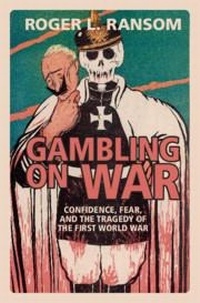
Gambling on War
Confidence, Fear, and the Tragedy of the First World War
Will be published approx. on 28. June 2018
Book
Hardback
346 pages
978-1-108-48502-9 (ISBN)
Description
The First World War left a legacy of chaos that is still with us a century later. Why did European leaders resort to war and why did they not end it sooner? Roger L. Ransom sheds new light on this enduring puzzle by employing insights from prospect theory and notions of risk and uncertainty. He reveals how the interplay of confidence, fear, and a propensity to gamble encouraged aggressive behavior by leaders who pursued risky military strategies in hopes of winning the war. The result was a series of military disasters and a war of attrition which gradually exhausted the belligerents without producing any hope of ending the war. Ultimately, he shows that the outcome of the war rested as much on the ability of the Allied powers to muster their superior economic resources to continue the fight as it did on success on the battlefield.
Reviews / Votes
'World War I became a tragedy when victory became an end in itself rather than a means of achieving some prewar objective. In his lucid and insightful Gambling on War, Roger L. Ransom draws on history and economics to explain why that happened, why World War I upended the world's institutions, and why its tragic effects persist even today.' Philip T. Hoffman, author of Why Did Europe Conquer the World? 'The First World War remains with us. Ransom, an economic historian, places it within an age of extremes that ran from Bismarck to Clemenceau. The war resolved no rivalries. It led to no new normalcy. The book jars the reader into that reality. It shocks. It angers. It is a must-read.' Holger H. Herwig, author of The First World War: Germany and Austria-Hungary 1914-1918 'Economists think of people as rational but this is belied by experience. From that perspective, economic historian Roger L. Ransom shows persuasively how over-confidence, fear and reckless gambles make sense of a sequence of bad decisions that led to the First World War, and to catastrophic outcomes that nobody planned for.' Avner Offer, author of The First World War: An Agrarian Interpretation 'The general interest reader learns a lot, and about many things. ... a great read for general interest readers with a standard background in economics ... It should also have its place as a core reading for an undergraduate course on the economics of war.' Victor Gay, EH.Net 'The great strength of the book is the application of behavioral economic theories to decision-making in the First World War. It offers a variation on the argument that the war swept away the restrained political mores of the late nineteenth century. Once one power 'speculated' by initiating aggression, others had to react, and this changed expectations of future behavior, creating a path dependency toward the Second World War.' William Mulligan, H-DiploMore details
Language
English
Place of publication
Cambridge
United Kingdom
Target group
Professional and scholarly
Product notice
sewn/stitched
Cloth over boards
Illustrations
Worked examples or Exercises; 5 Tables, black and white; 24 Maps; 12 Halftones, black and white
Dimensions
Height: 233 mm
Width: 156 mm
Thickness: 22 mm
Weight
674 gr
ISBN-13
978-1-108-48502-9 (9781108485029)
Copyright in bibliographic data and cover images is held by Nielsen Book Services Limited or by the publishers or by their respective licensors: all rights reserved.
Schweitzer Classification
Other editions
Additional editions
Book
06/2018
Cambridge University Press
€40.20
Shipment within 15-20 days
E-Book
06/2018
Cambridge University Press
€19.49
Available for download
E-Book
05/2018
Cambridge University Press
€23.49
Available for download
Person
Roger L. Ransom is Distinguished Professor of History and Economics, Emeritus at the University of California, Riverside. He is best known for his work with Richard Sutch on the American Civil War and his many publications include the books One Kind of Freedom (co-authored with Richard Sutch Cambridge, 2001), Conflict and Compromise (Cambridge, 1990) and The Confederate States of America: What Might Have Been (2005). He was the president of the Economic History Association in 2005, and was awarded a Guggenheim Fellowship, and the distinguished teaching award from the University of California, Riverside. He also won the Arthur H. Cole Prize from the Economic History Association and the Clio Can Award from the Cliometric Society.
Content
Prologue; 1. Confidence, fear, and a propensity to gamble; 2. Otto von Bismarck and the changing paradigm of war; 3. Schlieffen's gamble; 4. A war of attrition; 5. Economies at war; 6. War and revolution; 7. The last gamble; 8. The chaos of victory; Epilogue: the tragedy of a world war.