

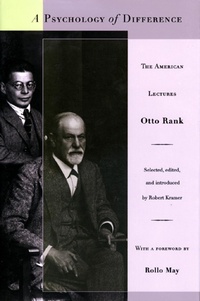
A Psychology of Difference
The American Lectures
Published on 28. July 1996
Book
Hardback
320 pages
978-0-691-04470-5 (ISBN)
Description
A leading disciple and confidant of Freud, Otto Rank revolutionized the field of psychoanalytic theory in The Trauma of Birth (1924). In this book, Rank proposed that the child's pre-Oedipal relationship to the mother was the prototype of the therapeutic relationship between analyst and patient. Although Rank is now widely acknowledged as the most important precursor of humanistic and existential psychotherapy--influencing such well-known writers as Carl Rogers, Rollo May, and Ernest Becker--Rank's knotty prose has long frustrated readers. In this volume of Rank's lectures, Robert Kramer has brought together for the first time the innovator's clearest explanations of his most influential theories. The lectures were delivered in English to receptive audiences of social workers, therapists, and clinical psychologists throughout the United States from 1924 to 1938, the year before Rank's untimely death. The topics covered include separation and individuation, projection and identification, love and will, relationship therapy, and neurosis as a failure in creativity.
The lectures reveal that Rank, much maligned by orthodox analysts, invented the modern object-relations approach to psychotherapy in the 1920s. In his introduction, based on private correspondence between Rank, Freud, and others in the inner circle, Robert Kramer tells the full story of why Rank parted ways with Freud. The collection of lectures constitutes a "readable Rank," filled with insights still relevant today, for those interested in the humanistic, existential, or object- relational aspects of psychotherapy, or in the development of the psychoanalytic movement.
The lectures reveal that Rank, much maligned by orthodox analysts, invented the modern object-relations approach to psychotherapy in the 1920s. In his introduction, based on private correspondence between Rank, Freud, and others in the inner circle, Robert Kramer tells the full story of why Rank parted ways with Freud. The collection of lectures constitutes a "readable Rank," filled with insights still relevant today, for those interested in the humanistic, existential, or object- relational aspects of psychotherapy, or in the development of the psychoanalytic movement.
Reviews / Votes
"Dr. Kramer ... is fast becoming one of the most productive and consistently insightful rnak scholars on the scene today. His major Rankian essays include treatments of Rank's place in the history of psychoanalysis, specific aspects of Rankian theory, Rank's influence on later major figures such as Carl Rogers, and the application of Rank's ideas to management theory."--The Ernest Becker FoundationMore details
Language
English
Place of publication
New Jersey
United States
Target group
Professional and scholarly
College/higher education
Product notice
Trade binding
Dimensions
Height: 235 mm
Width: 157 mm
Thickness: 23 mm
Weight
666 gr
ISBN-13
978-0-691-04470-5 (9780691044705)
Copyright in bibliographic data and cover images is held by Nielsen Book Services Limited or by the publishers or by their respective licensors: all rights reserved.
Schweitzer Classification
Other editions
Additional editions
E-Book
03/2021
1st Edition
Princeton University Press
€155.99
Available for download
Persons
Otto Rank (1884-1939) was the author of many works, including Will Therapy, Truth and Reality, Art and Artist, and Beyond Psychology. He emigrated from Vienna to Paris in 1926, and moved permanently to the United States in 1935. Robert Kramer is the author of articles and reviews on organizational behavior and the history of psychoanalytic thought.
Content
ForewordChronology of Rank's Life (1884-1939)Editor's Notes to the ReaderIntroduction. Insight and Blindness: Visions of Rank3Pt. 1The Trauma of Birth: "A Much Stronger Repression Than Even Infantile Sexuality"1Psychoanalysis as General Psychology (1924)512The Therapeutic Application of Psychoanalysis (1924)663The Trauma of Birth and Its Importance for Psychoanalytic Therapy (1924)784Psychoanalysis as a Cultural Factor (1924)85Pt. 2Exploring the Dark Continent of Maternal Power: "The 'Bad Mother' Freud Has Never Seen"5Foundations of a Genetic Psychology (1926)996Development of the Ego (1926)1077The Problem of the Etiology of the Neurosis (1926)1128The Anxiety Problem (1926)1169The Genesis of the Guilt-Feeling (1926)13110The Genesis of the Object Relation (1926)140Pt. 3From Projection and Identification to Self-Determination: "Emotions Are the Center and Real Sphere of Psychology"11Love, Guilt, and the Denial of Feelings (1927)15312Emotional Suffering and Therapy (1927)16613The Significance of the Love Life (1927)17714Social Adaptation and Creativity (1927)18915The Prometheus Complex (1927)20116Parental Attitudes and the Child's Reactions (1927)211Pt. 4Toward a Theory of Relationship and Relativity: "I Am No Longer Trying to Prove Freud was Wrong and I Right"17Speech at First International Congress on Mental Hygiene (1930)22118Beyond Psychoanalysis (1928)22819The Yale Lecture (1929)24020Neurosis as a Failure in Creativity (1935)25121Active and Passive Therapy (1935)26022Modern Psychology and Social Change (1938)264Prior Publication of Lectures277References279Index285