

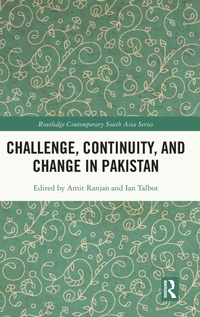
Challenge, Continuity, and Change in Pakistan
1st Edition
Published on 30. September 2025
Book
Hardback
306 pages
978-1-032-99364-5 (ISBN)
Description
This book brings a multi-disciplinary approach to studying Pakistan's contemporary political, social and environmental challenges. It offers insights from various disciplines to show the interconnectedness of many of Pakistan's problems and their historical roots.
The analysis includes issues of political alienation and exclusion, vulnerability to climate change-induced disasters and how such challenges might be mitigated. The case studies in the book reveal that reality is complex and that demographic, social, and technological change is moving apace in Pakistan. This dynamism points to another aspect of Pakistan and its resilience in the face of manmade and natural disasters. An increasingly youthful and urbanised population is challenging social inequalities and power structures whilst the state attempts to respond in old ways to maintain order and stability. The emergence of overseas Pakistani communities and their connectedness with the homeland is another growing development with ramifications for politics and society.
A significant contribution on critical affairs in Pakistan, this book investigates if the country is moving towards a critical crossroads in its development. It will be of interest to historians and political scientists of Modern South Asia, as well as geographers interested in examining impact of climate change.
The analysis includes issues of political alienation and exclusion, vulnerability to climate change-induced disasters and how such challenges might be mitigated. The case studies in the book reveal that reality is complex and that demographic, social, and technological change is moving apace in Pakistan. This dynamism points to another aspect of Pakistan and its resilience in the face of manmade and natural disasters. An increasingly youthful and urbanised population is challenging social inequalities and power structures whilst the state attempts to respond in old ways to maintain order and stability. The emergence of overseas Pakistani communities and their connectedness with the homeland is another growing development with ramifications for politics and society.
A significant contribution on critical affairs in Pakistan, this book investigates if the country is moving towards a critical crossroads in its development. It will be of interest to historians and political scientists of Modern South Asia, as well as geographers interested in examining impact of climate change.
More details
Series
Language
English
Place of publication
London
United Kingdom
Publishing group
Taylor & Francis Ltd
Target group
College/higher education
Postgraduate
Illustrations
20 s/w Abbildungen, 12 s/w Photographien bzw. Rasterbilder, 8 s/w Zeichnungen, 10 s/w Tabellen
10 Tables, black and white; 8 Line drawings, black and white; 12 Halftones, black and white; 20 Illustrations, black and white
Dimensions
Height: 240 mm
Width: 161 mm
Thickness: 22 mm
Weight
643 gr
ISBN-13
978-1-032-99364-5 (9781032993645)
Copyright in bibliographic data and cover images is held by Nielsen Book Services Limited or by the publishers or by their respective licensors: all rights reserved.
Schweitzer Classification
Other editions
Additional editions
Amit Ranjan | Ian Talbot
Challenge, Continuity, and Change in Pakistan
E-Book
10/2025
Routledge
€60.49
Available for download
Amit Ranjan | Ian Talbot
Challenge, Continuity, and Change in Pakistan
E-Book
10/2025
Routledge
€60.49
Available for download
Persons
Amit Ranjan is a Research Fellow at the Institute of South Asian Studies, National University of Singapore. His latest book is The Aftermath of the Bangladesh Liberation War of 1971: Enduring Impacts (edited with Taj Hashmi and Mazhar Abbas, Routledge, 2025). He has also edited Migration, Memories and "Unfinished" Partition (TISS-Routledge series on Migration Studies, 2024) and is the author of Federalism and Inter-State River Water Disputes in India (Routledge, London and New Delhi, 2023), and Contested Waters: India's Transboundary River Water Disputes in South Asia (Routledge, Oxon and New Delhi, 2021).
Ian Talbot is a Professor Emeritus in the History of Modern South Asia at the University of Southampton. He holds a BA at Royal Holloway College, an MA from Oxford University and a PhD from Royal Holloway College. He is a Fellow of the Royal Asiatic Society and a Fellow of the Royal Historical Society and was formerly the Head of History at the University of Southampton.
Ian Talbot is a Professor Emeritus in the History of Modern South Asia at the University of Southampton. He holds a BA at Royal Holloway College, an MA from Oxford University and a PhD from Royal Holloway College. He is a Fellow of the Royal Asiatic Society and a Fellow of the Royal Historical Society and was formerly the Head of History at the University of Southampton.
Content
Introduction
Part One: The Political Landscape: Continuity and Change
Chapter 1 The Military at a Political Crossroad? Pakistan 2018-present
Chapter 2 Hybrid Regime Management in Pakistan 1947-2022
Chapter 3 Mapping Federalism in Pakistan
Chapter 4 Governance and Resistance in Pakistan's Peripheries: The Cases of Pakistan-Administered Kashmir, Balochistan, and Gilgit-Baltistan
Chapter 5 Politics of Extremism and the Emergence of the Tehreek-e-Labbaik Pakistan
Chapter 6 Geopolitics, Security, and Imbalance in Pakistan's Foreign Policy: A historical perspective
Chapter 7 Political Economy of Crisis
Part Two: The Changing Social Landscape
Chapter 8 Navigating through the Black Hole of Crises in the post-truth Era: A Curious Case of Pakistan's middle-class Youth
Chapter 9 Media and Election in Pakistan
Chapter 10 New Social Movements in Pakistan: Dynamics and Politics of Aurat March
Chapter 11 Homo-Islamicus: piety, populism, and post-feminism in Pakistan
Chapter12 Pakistan and its diaspora(s): An exploration of Economic and Political Mobilization for the homeland
Chapter 13 Finding Contemporary Pakistan on Screen: The Case of The Legend of Maula Jatt and Joyland
Chapter 14 Sport in Pakistan: Highs and Lows Amidst Structural Decline
Part Three: Environmental Challenges and Responses
Chapter 15 Pakistan's Water Resources: Availability Concerns, Disputes and Sub-Nationalism
Chapter 16 Forests, Climate Change and Politics in Pakistan: The PTI Tree Tsunami in North-West Pakistan
Chapter 17 Pakistan in the face of Climate Change: Current state of Risks, Resilience and Sustainability
Part One: The Political Landscape: Continuity and Change
Chapter 1 The Military at a Political Crossroad? Pakistan 2018-present
Chapter 2 Hybrid Regime Management in Pakistan 1947-2022
Chapter 3 Mapping Federalism in Pakistan
Chapter 4 Governance and Resistance in Pakistan's Peripheries: The Cases of Pakistan-Administered Kashmir, Balochistan, and Gilgit-Baltistan
Chapter 5 Politics of Extremism and the Emergence of the Tehreek-e-Labbaik Pakistan
Chapter 6 Geopolitics, Security, and Imbalance in Pakistan's Foreign Policy: A historical perspective
Chapter 7 Political Economy of Crisis
Part Two: The Changing Social Landscape
Chapter 8 Navigating through the Black Hole of Crises in the post-truth Era: A Curious Case of Pakistan's middle-class Youth
Chapter 9 Media and Election in Pakistan
Chapter 10 New Social Movements in Pakistan: Dynamics and Politics of Aurat March
Chapter 11 Homo-Islamicus: piety, populism, and post-feminism in Pakistan
Chapter12 Pakistan and its diaspora(s): An exploration of Economic and Political Mobilization for the homeland
Chapter 13 Finding Contemporary Pakistan on Screen: The Case of The Legend of Maula Jatt and Joyland
Chapter 14 Sport in Pakistan: Highs and Lows Amidst Structural Decline
Part Three: Environmental Challenges and Responses
Chapter 15 Pakistan's Water Resources: Availability Concerns, Disputes and Sub-Nationalism
Chapter 16 Forests, Climate Change and Politics in Pakistan: The PTI Tree Tsunami in North-West Pakistan
Chapter 17 Pakistan in the face of Climate Change: Current state of Risks, Resilience and Sustainability