

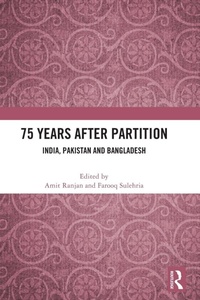
75 Years After Partition
India, Pakistan and Bangladesh
1st Edition
Published on 24. July 2025
Book
Hardback
192 pages
978-1-041-03590-9 (ISBN)
Description
This book explores how the 1947 Partition of British India not only divided people and territories but also deepened cultural rifts in postcolonial India, Pakistan and Bangladesh, especially between Hindus and Muslims. The colonial "divide and rule" strategy, which intensified religious divides, laid the foundation for ongoing tensions. Even as the 75th anniversary of Partition approached in 2022, this cultural segregation remains prevalent. Over the years, mass media such as films, press and television have significantly evolved in India, Bangladesh, and Pakistan, playing a pivotal role in manufacturing, disseminating and perpetuating the narrative of cultural differences based on religion. These cultural platforms have gained even more influence with the rise of majoritarian nationalism in both India and Pakistan.
The chapters in this volume analyse how language, cinema, and textbooks contributed to the divide instead of bridging gaps, and why unresolved questions from the Partition continue to affect the region. The chapters cover the communalization of Hindi and Urdu, how textbooks in India, Bangladesh, and Pakistan narrate Partition, the role of mass media in India and Pakistan in presenting Partition, and the portrayal of Partition in films across India, Bangladesh, and Pakistan. This book is aimed at students, researchers and scholars interested in postcolonial studies, South Asian history, cultural studies, and media analysis.
The chapters in this book were originally published as a special issue of India Review.
The chapters in this volume analyse how language, cinema, and textbooks contributed to the divide instead of bridging gaps, and why unresolved questions from the Partition continue to affect the region. The chapters cover the communalization of Hindi and Urdu, how textbooks in India, Bangladesh, and Pakistan narrate Partition, the role of mass media in India and Pakistan in presenting Partition, and the portrayal of Partition in films across India, Bangladesh, and Pakistan. This book is aimed at students, researchers and scholars interested in postcolonial studies, South Asian history, cultural studies, and media analysis.
The chapters in this book were originally published as a special issue of India Review.
Reviews / Votes
The edited volume provides a valuable guide for understanding how narratives and representations of the division of British India have contributed to majoritarian nationalism in South Asia. As such it is a timely contribution to the field of study on the 1947 Partition and is deserving of a wide readership.Ian Talbot, Emeritus Professor of Modern South Asian History,
University of Southampton
More details
Language
English
Place of publication
London
United Kingdom
Publishing group
Taylor & Francis Ltd
Target group
College/higher education
Postgraduate, Undergraduate Advanced, and Undergraduate Core
Dimensions
Height: 260 mm
Width: 183 mm
Thickness: 16 mm
Weight
600 gr
ISBN-13
978-1-041-03590-9 (9781041035909)
Copyright in bibliographic data and cover images is held by Nielsen Book Services Limited or by the publishers or by their respective licensors: all rights reserved.
Schweitzer Classification
Other editions
Additional editions
E-Book
07/2025
Routledge
€73.99
Available for download
E-Book
07/2025
Routledge
€73.99
Available for download
Persons
Amit Ranjan is Research Fellow at the Institute of South Asian Studies, National University of Singapore. His latest book is India and China in Southeast Asia (edited with Diotima Chattoraj and AKM Ahsan Ullah) and The Aftermath of the Bangladesh Liberation War of 1971: Enduring Impacts (edited with Taj Hashmi and Mazhar Abbas, Routledge, 2025). His papers, review essays and book reviews have been widely published in several journals, including Asian Affairs, Economic & Political Weekly. Journal of Asian Security and International Affairs, amongst many others.
Farooq Sulehria teaches at Beaconhouse National University (BNU), Lahore. He is the author of Media Imperialism in India and Pakistan (Routledge, 2018) and has co-edited From Terrorism to Television: Dynamics of Media, State, and Society in Pakistan (Routledge, 2020). He has a PhD in Development Studies (SOAS) and an MA in Global Media and Post-national Communication (SOAS). He has published over twenty book chapters and peer-reviewed articles in international journals. He has previously worked as a journalist in Pakistan and Sweden. He also edits, Jeddojehad.com, a multimedia site.
Farooq Sulehria teaches at Beaconhouse National University (BNU), Lahore. He is the author of Media Imperialism in India and Pakistan (Routledge, 2018) and has co-edited From Terrorism to Television: Dynamics of Media, State, and Society in Pakistan (Routledge, 2020). He has a PhD in Development Studies (SOAS) and an MA in Global Media and Post-national Communication (SOAS). He has published over twenty book chapters and peer-reviewed articles in international journals. He has previously worked as a journalist in Pakistan and Sweden. He also edits, Jeddojehad.com, a multimedia site.
Content
Preface. Introduction: 75 Years After Partition: India, Pakistan and Bangladesh 1. Language, religion, and identity: Hindi and Urdu in colonial and post-colonial India 2. Ideological positioning in the representation of borders: an analysis of recent Hindi films 3. Narrativizing partition and producing stigmatized identities: an analysis of the representation of Muslims in two Indian history textbooks 4. Building an ideological nation-state: migrancy and patriarchy in Khadija Mastoor's novel, Zameen 5. Lollywood on partition: surprise departures, anticipated arrivals 6. Reimagining and reproducing the partitions (of 1947 and 1971) in textbooks in Pakistan: a comparative analysis of the Zia and Musharraf regimes 7. Cinema of Bangladesh: Absence of 1947 and abundance of 1971 8. 1947, 1971: history, facts, and fictions