

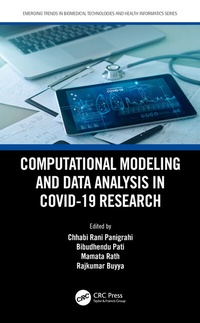
Computational Modeling and Data Analysis in COVID-19 Research
1st Edition
Published on 10. May 2021
Book
Hardback
256 pages
978-0-367-68036-7 (ISBN)
Description
This book covers recent research on the COVID-19 pandemic. It includes the analysis, implementation, usage, and proposed ideas and models with architecture to handle the COVID-19 outbreak. Using advanced technologies such as artificial intelligence (AI) and machine learning (ML), techniques for data analysis, this book will be helpful to mitigate exposure and ensure public health. We know prevention is better than cure, so by using several ML techniques, researchers can try to predict the disease in its early stage and develop more effective medications and treatments. Computational technologies in areas like AI, ML, Internet of Things (IoT), and drone technologies underlie a range of applications that can be developed and utilized for this purpose. Because in most cases there is no one solution to stop the spreading of pandemic diseases, and the integration of several tools and tactics are needed. Many successful applications of AI, ML, IoT, and drone technologies already exist, including systems that analyze past data to predict and conclude some useful information for controlling the spread of COVID-19 infections using minimum resources. The AI and ML approach can be helpful to design different models to give a predictive solution for mitigating infection and preventing larger outbreaks. This book:
Examines the use of artificial intelligence (AI), machine learning (ML), Internet of Things (IoT), and drone technologies as a helpful predictive solution for controlling infection of COVID-19
Covers recent research related to the COVID-19 pandemic and includes the analysis, implementation, usage, and proposed ideas and models with architecture to handle a pandemic outbreak
Examines the performance, implementation, architecture, and techniques of different analytical and statistical models related to COVID-19
Includes different case studies on COVID-19
Dr. Chhabi Rani Panigrahi is Assistant Professor in the Department of Computer Science at Rama Devi Women's University, Bhubaneswar, India.
Dr. Bibudhendu Pati is Associate Professor and Head of the Department of Computer Science at Rama Devi Women's University, Bhubaneswar, India.
Dr. Mamata Rath is Assistant Professor in the School of Management (Information Technology) at Birla Global University, Bhubaneswar, India.
Prof. Rajkumar Buyya is a Redmond Barry Distinguished Professor and Director of the Cloud Computing and Distributed Systems (CLOUDS) Laboratory at the University of Melbourne, Australia.
Examines the use of artificial intelligence (AI), machine learning (ML), Internet of Things (IoT), and drone technologies as a helpful predictive solution for controlling infection of COVID-19
Covers recent research related to the COVID-19 pandemic and includes the analysis, implementation, usage, and proposed ideas and models with architecture to handle a pandemic outbreak
Examines the performance, implementation, architecture, and techniques of different analytical and statistical models related to COVID-19
Includes different case studies on COVID-19
Dr. Chhabi Rani Panigrahi is Assistant Professor in the Department of Computer Science at Rama Devi Women's University, Bhubaneswar, India.
Dr. Bibudhendu Pati is Associate Professor and Head of the Department of Computer Science at Rama Devi Women's University, Bhubaneswar, India.
Dr. Mamata Rath is Assistant Professor in the School of Management (Information Technology) at Birla Global University, Bhubaneswar, India.
Prof. Rajkumar Buyya is a Redmond Barry Distinguished Professor and Director of the Cloud Computing and Distributed Systems (CLOUDS) Laboratory at the University of Melbourne, Australia.
More details
Series
Language
English
Place of publication
London
United Kingdom
Publishing group
Taylor & Francis Ltd
Target group
College/higher education
Illustrations
98 s/w Abbildungen, 30 s/w Photographien bzw. Rasterbilder, 68 s/w Zeichnungen, 22 s/w Tabellen
22 Tables, black and white; 68 Line drawings, black and white; 30 Halftones, black and white; 98 Illustrations, black and white
Dimensions
Height: 234 mm
Width: 156 mm
Weight
700 gr
ISBN-13
978-0-367-68036-7 (9780367680367)
Copyright in bibliographic data and cover images is held by Nielsen Book Services Limited or by the publishers or by their respective licensors: all rights reserved.
Schweitzer Classification
Other editions
Additional editions
Chhabi Rani Panigrahi | Bibudhendu Pati | Mamata Rath
Computational Modeling and Data Analysis in COVID-19 Research
Book
09/2023
1st Edition
CRC Press
€76.40
Shipment within 15-20 days
Chhabi Rani Panigrahi | Bibudhendu Pati | Mamata Rath
Computational Modeling and Data Analysis in COVID-19 Research
E-Book
05/2021
1st Edition
CRC Press
€69.99
Available for download
Chhabi Rani Panigrahi | Bibudhendu Pati | Mamata Rath
Computational Modeling and Data Analysis in COVID-19 Research
E-Book
05/2021
1st Edition
CRC Press
€69.99
Available for download
Persons
Dr. Chhabi Rani Panigrahi is Assistant Professor in the Department of Computer Science at Rama Devi Women's University, Bhubaneswar, India.
Dr. Bibudhendu Pati is Associate Professor and Head in the Department of Computer Science at Rama Devi Women's University, Bhubaneswar, India.
Dr. Mamata Rath is Assistant Professor in School of Management (Information Technology) at Birla Global University, Bhubaneswar, India.
Prof. Rajkumar Buyya is a Redmond Barry Distinguished Professor and Director of the Cloud Computing and Distributed Systems (CLOUDS) Laboratory at the University of Melbourne, Australia.
Dr. Bibudhendu Pati is Associate Professor and Head in the Department of Computer Science at Rama Devi Women's University, Bhubaneswar, India.
Dr. Mamata Rath is Assistant Professor in School of Management (Information Technology) at Birla Global University, Bhubaneswar, India.
Prof. Rajkumar Buyya is a Redmond Barry Distinguished Professor and Director of the Cloud Computing and Distributed Systems (CLOUDS) Laboratory at the University of Melbourne, Australia.
Content
Chapter 1 Machine Learning Implementations in COVID-19 Chapter 2 Analysis of COVID-19 Data Using Consensus Clustering Technique Chapter 3 MoBMGAN: Modified GAN-Based Transfer Learning for Automatic Detection of COVID-19 Cases Using Chest X-ray Images Chapter 4 Application and Progress of Drone Technology in the COVID-19 Pandemic: A Comprehensive Review Chapter 5 Smart War on COVID-19 and Global Pandemics: Integrated AI and Blockchain Ecosystem Chapter 6 Machine Learning-Based Text Mining in Social Media for COVID-19 Chapter 7 Containing the Spread of COVID-19 with IoT: A Visual Tracing Approach Chapter 8 Crowd-Sourced Centralized Thermal Imaging for Isolation and Quarantine Chapter 9 Blockchain Technology for Limiting the Impact of Pandemic: Challenges and Prospects Chapter 10 A Study on Mathematical and Computational Models in the Context of COVID-19 Chapter 11 A Detailed Study on AI-Based Diagnosis of Novel Coronavirus from Radiograph Images Chapter 12 Data Analytics for COVID-19