

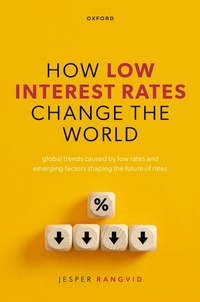
How Low Interest Rates Change the World
Global Trends Caused by Low Rates and Emerging Factors Shaping the Future of Rates
Published on 1. April 2025
Book
Hardback
284 pages
978-0-19-894638-0 (ISBN)
Description
How Low Interest Rates Change the World explores the societal impact of changing interest rates. Taking its starting point in the remarkable four-decade decline in global interest rates from 1980 to 2020, the book examines five global trends it caused, the underlying factors that drove interest rates lower, and emerging trends likely to shape the future path of interest rates.
The book contends that the steady decline in interest rates around the world from 1980 to 2020 played a pivotal role in shaping five significant global trends during the same period: soaring debt levels, escalating housing prices, surging stock markets, widening economic inequality, and increased financial risk-taking.
The book also explores emerging factors likely to shape the future trajectory of interest rates. While demographic trends may keep rates low, other forces, such as rising public debt, can push them higher. The book offers its perspective on the interaction of these opposing trends, and presents its view on the future evolution of interest rates.
How Low Interest Rates Change the World is a no-nonsense fact-based book written in plain language. A key feature of the book is its empirical approach and reliance on data. Figures and tables richly illustrate and support the arguments presented, thereby inviting a broad audience to follow its fascinating journey into the evolution of interest rates and their impact.
The book contends that the steady decline in interest rates around the world from 1980 to 2020 played a pivotal role in shaping five significant global trends during the same period: soaring debt levels, escalating housing prices, surging stock markets, widening economic inequality, and increased financial risk-taking.
The book also explores emerging factors likely to shape the future trajectory of interest rates. While demographic trends may keep rates low, other forces, such as rising public debt, can push them higher. The book offers its perspective on the interaction of these opposing trends, and presents its view on the future evolution of interest rates.
How Low Interest Rates Change the World is a no-nonsense fact-based book written in plain language. A key feature of the book is its empirical approach and reliance on data. Figures and tables richly illustrate and support the arguments presented, thereby inviting a broad audience to follow its fascinating journey into the evolution of interest rates and their impact.
More details
Language
English
Place of publication
Oxford
United Kingdom
Target group
College/higher education
Product notice
sewn/stitched
Cloth over boards
With dust jacket
Dimensions
Height: 236 mm
Width: 162 mm
Thickness: 25 mm
Weight
550 gr
ISBN-13
978-0-19-894638-0 (9780198946380)
Copyright in bibliographic data and cover images is held by Nielsen Book Services Limited or by the publishers or by their respective licensors: all rights reserved.
Schweitzer Classification
Person
Jesper Rangvid is a Professor of Finance and the Director of the Pension Research Centre (PeRCent) at Copenhagen Business School. His research focuses on asset return determination and forecasting, financial crises, financial institutions, and household finance. Rangvid holds positions on various committees and boards of private and public firms. Notably, he led the government-appointed committee that investigated the causes and consequences of Denmark's 2008 financial crisis. His book, From Main Street to Wall Street, was published by Oxford University Press in 2021. Jesper also authors Rangvid's Blog, where he shares insights on finance and economics.
Content
List of Figures
Introduction
Part I. Falling Rates
1: The Level of Interest Rates: Today and Historically
2: Inflation and Real Interest Rates
Part II. Consequences of Falling and Low Interest Rates
3: Debt and Low Interest Rates
4: House Prices and Low Interest Rates
5: Stock Markets and Low Interest Rates
6: Inequality and Low Interest Rates
7: Financial Risk-Taking and Low Interest Rates
Part III. What Caused a Four-Decade Fall in Interest Rates?
8: What Caused a Four-Decade Fall in Inflation?
9: What Caused a Four-Decade Fall in Real Interest Rates?
10: What Caused the Rise in Inflation and Interest Rates after the Covid-19 Pandemic?
Part IV. What Does the Future Hold?
11: Trends That Could Keep Rates Low
12: Trends That Could Elevate Rates
13: Putting It All Together: What Is the Outlook for Rates?
14: Debt, Inequality, and House and Stock Prices Considering Interest Rate Scenarios
References
Index
Introduction
Part I. Falling Rates
1: The Level of Interest Rates: Today and Historically
2: Inflation and Real Interest Rates
Part II. Consequences of Falling and Low Interest Rates
3: Debt and Low Interest Rates
4: House Prices and Low Interest Rates
5: Stock Markets and Low Interest Rates
6: Inequality and Low Interest Rates
7: Financial Risk-Taking and Low Interest Rates
Part III. What Caused a Four-Decade Fall in Interest Rates?
8: What Caused a Four-Decade Fall in Inflation?
9: What Caused a Four-Decade Fall in Real Interest Rates?
10: What Caused the Rise in Inflation and Interest Rates after the Covid-19 Pandemic?
Part IV. What Does the Future Hold?
11: Trends That Could Keep Rates Low
12: Trends That Could Elevate Rates
13: Putting It All Together: What Is the Outlook for Rates?
14: Debt, Inequality, and House and Stock Prices Considering Interest Rate Scenarios
References
Index