

Playing Place
Board Games, Popular Culture, Space
Published on 15. August 2023
Book
Hardback
280 pages
978-0-262-04783-8 (ISBN)
Description
An essay collection exploring the board game's relationship to the built environment, revealing the unexpected ways that play reflects perceptions of space.
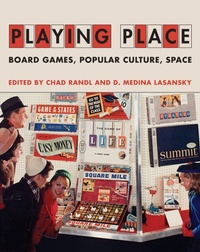
Board games harness the creation of entirely new worlds. From the medieval warlord to the modern urban planner, players are permitted to inhabit a staggering variety of roles and are prompted to incorporate preexisting notions of placemaking into their decisions. To what extent do board games represent the social context of their production? How might they reinforce or subvert normative ideas of community and fulfillment? In Playing Place, Chad Randl and D. Medina Lasansky have curated a collection of thirty-seven fascinating essays, supplemented by a rich trove of photo illustrations, that unpack these questions with breadth and care.
Although board games are often recreational objects, their mythologies and infrastructure do not exist in a vacuum-rather, they echo and reproduce prevalent cultural landscapes. This thesis forms the throughline of pieces reflecting on subjects as diverse as the rigidly gendered fantasies of classic mass-market games; the imperial convictions embedded in games that position player-protagonists as conquerors establishing dominion over their "discoveries"; and even the uncanny prescience of games that have players responding to a global pandemic. Representing a thrilling convergence of historiography, architectural history, and media studies scholarship, Playing Place suggests not only that tabletop games should be taken seriously but also that the medium itself is uniquely capable of facilitating our critical consideration of structures that are often taken for granted.
Board games harness the creation of entirely new worlds. From the medieval warlord to the modern urban planner, players are permitted to inhabit a staggering variety of roles and are prompted to incorporate preexisting notions of placemaking into their decisions. To what extent do board games represent the social context of their production? How might they reinforce or subvert normative ideas of community and fulfillment? In Playing Place, Chad Randl and D. Medina Lasansky have curated a collection of thirty-seven fascinating essays, supplemented by a rich trove of photo illustrations, that unpack these questions with breadth and care.
Although board games are often recreational objects, their mythologies and infrastructure do not exist in a vacuum-rather, they echo and reproduce prevalent cultural landscapes. This thesis forms the throughline of pieces reflecting on subjects as diverse as the rigidly gendered fantasies of classic mass-market games; the imperial convictions embedded in games that position player-protagonists as conquerors establishing dominion over their "discoveries"; and even the uncanny prescience of games that have players responding to a global pandemic. Representing a thrilling convergence of historiography, architectural history, and media studies scholarship, Playing Place suggests not only that tabletop games should be taken seriously but also that the medium itself is uniquely capable of facilitating our critical consideration of structures that are often taken for granted.
More details
Language
English
Place of publication
Cambridge (Massachusetts)
United States
Publishing group
MIT Press Ltd
Product notice
sewn/stitched
Cloth over boards
Illustrations
154 COLOR ILLUS.
Dimensions
Height: 260 mm
Width: 208 mm
Thickness: 23 mm
Weight
952 gr
ISBN-13
978-0-262-04783-8 (9780262047838)
Copyright in bibliographic data and cover images is held by Nielsen Book Services Limited or by the publishers or by their respective licensors: all rights reserved.
Schweitzer Classification
Other editions
Additional editions
E-Book
08/2023
MIT Press
€38.99
Available for download
Persons
Chad Randl is the author of A-Frame and Revolving Architecture: A History of Buildings That Rotate, Swivel, and Pivot.
D. Medina Lasansky is Professor in the Department of Architecture at Cornell University, where her research and teaching focus on the intersection of the built environment, politics, and popular culture.
D. Medina Lasansky is Professor in the Department of Architecture at Cornell University, where her research and teaching focus on the intersection of the built environment, politics, and popular culture.
Content
Introduction xi
Chad Randl and D. Medina Lasansky
1 Aspirational Ideals 1
2 Contesting Designed and Planned Space 21
3 Landscapes (Real and Imagined) 39
4 Icons 67
5 Consuming Place 87
6 Conquest and Control 105
7 Identity, Community, Disparity 131
8 Beyond the Game Table 159
Conclusion 177
Acknowledgments 185
Figure Credits 187
Notes 191
Selected Bibliography 207
Contributor Biographies 217
Index 223
Chad Randl and D. Medina Lasansky
1 Aspirational Ideals 1
2 Contesting Designed and Planned Space 21
3 Landscapes (Real and Imagined) 39
4 Icons 67
5 Consuming Place 87
6 Conquest and Control 105
7 Identity, Community, Disparity 131
8 Beyond the Game Table 159
Conclusion 177
Acknowledgments 185
Figure Credits 187
Notes 191
Selected Bibliography 207
Contributor Biographies 217
Index 223