

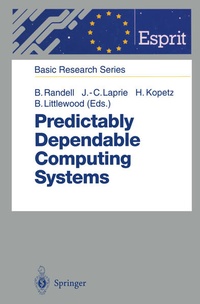
Predictably Dependable Computing Systems
Published on 8. December 2011
Book
Paperback/Softback
XIX, 588 pages
978-3-642-79791-0 (ISBN)
Description
This ESPRIT Basic Research volume provides an overview of two projects intended "to contribute to making the process of designing and constructing dependable computing systems much more predictable and cost-effective". Papers on fault prevention, fault tolerance, fault removal, and fault forecasting are included.
More details
Series
Edition
Softcover reprint of the original 1st ed. 1995
Language
English
Place of publication
Berlin
Germany
Publishing group
Springer Berlin
Target group
Professional and scholarly
Research
Illustrations
XIX, 588 p.
Dimensions
Height: 235 mm
Width: 155 mm
Thickness: 33 mm
Weight
914 gr
ISBN-13
978-3-642-79791-0 (9783642797910)
DOI
10.1007/978-3-642-79789-7
Schweitzer Classification
Other editions
Additional editions
Brian Randell | Jean-Claude Laprie | Hermann Kopetz
Predictably Dependable Computing Systems
Book
06/1995
Springer
€139.09
Article exhausted; check different version
Content
I. Basic Concepts.- A. Dependability - Its Attributes, Impairments and Means.- References for Chapter 1.- II. Fault Prevention.- A. Analysis of Safety Requirements for Process Control Systems.- B. Real-Time System Scheduling.- C. The Time-Triggered Approach to Real-Time System Design.- D. Software Measurement: A Necessary Scientific Basis.- References for Chapter II.- III. Fault Tolerance.- A. From Recovery Blocks to Concurrent Atomic Actions.- B. Definition and Analysis of Hardware-and-Software Fault-Tolerant Architectures.- C. Failure Mode Assumptions and Assumption Coverage.- D. Rational Design of Multiple-Redundant Systems: Adjudication and Fault Treatment.- E. Dynamic Adjustment of Dependability and Efficiency in Fault-Tolerant Software.- F. Designing Secure and Reliable Applications using FragmentationRedundancy-Scattering: an Object Oriented Approach.- G. Implementing Fault Tolerant Applications Using Reflective Object-Oriented Programming.- H. The PDCS Implementation of MARS Hardware and Software.- References for Chapter III.- IV. Fault Removal.- A. Advantages and Limits of Formal Approaches for Ultra-High Dependability.- B. Software Statistical Testing.- C. An Experimental Evaluation of Formal Testing and Statistical Testing.- D. Testing Distributed Real-Time Systems: An Overview.- References for Chapter IV.- V. Fault Forecasting - Fault Injection.- A. Integration and Comparison of Three Physical Fault Injection Techniques.- B. Fault Injection into VHDL Models: The MEFISTO Tool.- C. Estimators for Fault Tolerance Coverage Evaluation.- References for Chapter V.- VI. Fault Forecasting - Software Reliability.- A. Software Reliability Trend Analyses: From Theoretical to Practical Considerations.- B. The Transformation Approach to the Modeling and Evaluationof Reliability and Availability Growth.- C. New Ways to Get Accurate Reliability Measures.- D. Combination of Predictions Obtained from Different Software Reliability Growth Models.- E. Dependability Modelling and Evaluation of Software Fault-Tolerant Systems.- F. Dependability Analysis of Iterative Fault-Tolerant Software Considering Correlation.- G. Validation of Ultra-High Dependability for Software-based Systems.- References for Chapter VI.- VII. Fault Forecasting - Large State Space Modelling.- A. Computable Dependability Bounds for Large Markov Chains.- B. Fast Numerical Solution for a Class of Markov Models.- References for Chapter VII.- VIII. Fault Forecasting - Security Modelling.- A. Towards Operational Measures of Computer Security: Concepts.- B. Towards Operational Measures of Computer Security: Experimentation and Modelling.- References for Chapter VIII.- Pdcs Publications.