

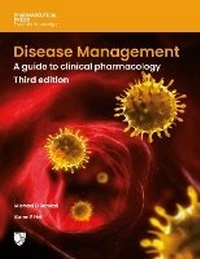
Disease Management
A Guide to Clinical Pharmacology
3rd Edition
Will be published approx. on 1. August 2016
Book
Paperback/Softback
978-0-85711-209-5 (ISBN)
Description
Disease Management is a comprehensive introduction to the management of diseases which are commonly encountered in primary care. Pharmacology is considered in the context of clinical practice and a holistic approach is taken to patient care to include lifestyle issues, concurrent disease and treatment, and the use of alternative remedies and complementary medicine.
Reviews / Votes
A useful book for students and preregistration trainees...Common diseases - such as diabetes, hypertension, asthma, depression and peptic ulceration - are described, followed by brief summaries of the pharmacology of the drugs used to manage these conditions. There is a strong focus on drug choice so that the reader can appreciate the rationale behind logical prescribing....
...drug interactions represent an important therapeutic challenge and attempts have been made to highlight important examples and how they may be overcome.
The book will be of greatest value to pharmacy students in the latter part of their courses and to preregistration graduates undertaking their clinical practice.
Laurence A. Goldberg, The Pharmaceutical Journal, 12 October 2016 -- Laurence A. Goldberg * The Pharmaceutical Journal *
More details
Edition
3rd Revised edition
Language
English
Place of publication
London
United Kingdom
Target group
Professional and scholarly
Illustrations
Illus
Dimensions
Height: 246 mm
Width: 189 mm
ISBN-13
978-0-85711-209-5 (9780857112095)
Copyright in bibliographic data and cover images is held by Nielsen Book Services Limited or by the publishers or by their respective licensors: all rights reserved.
Schweitzer Classification
Other editions
Previous edition
Book
01/2009
2nd Edition
Pharmaceutical Press
€69.59
Article exhausted; check for reprint
Persons
Content
Part A The patient
1 Signs and symptoms
2 Clinical laboratory tests
3 Lifestyle
4 Herbal medicine and alternative remedies
Part B Treatment
5 Drug Choice and prescribing
6 Adverse drug reactions and interactions
7 Clinical pharmacokinetics
Part C Gastrointestinal diseases
8 Dyspepsia and peptic ulcer disease
9 Nausea and vomiting
10 Lower gastrointestinal problems
11 The liver patient
Part D Cardiovascular diseases
12 Hypertension
13 Lipids and cardiovascular risk
14 Obesity
15 Ischaemic heart disease
16 Heart failure
17 Thromboembolic prophylaxis
18 Anaemias
19 The renal patient
Part E Respiratory diseases
20 Coughs and colds
21 Allergy
22 Respiratory diseases: asthma and chronic obstructive pulmonary disease
Part F Central nervous system disorders
23 Migraine
24 Epilepsy
25 Affective disorders
26 Anxiety disorders
27 Insomnia
28 Schizophrenia
29 Parkinson's disease
Part G Pain
30 Pain management
31 Musculoskeletal pain
Part H Cancer
32 The cancer patient and chemotherapy
33 The cancer patient and palliative care; Part I Infections
34 Bacterial infections
35 Non-bacterial infections
Part J Dermatology
36 Dermatology
Part K Endocrine disorders
37 Diabetes mellitus
38 Thyroid disorders; Feedback on self-assessments
Appendices
1 Formulary of some important classes of drugs, commonly used examples, mechanisms of action and uses
2 Some important clinical measurements and therapeutic drug monitoring.
1 Signs and symptoms
2 Clinical laboratory tests
3 Lifestyle
4 Herbal medicine and alternative remedies
Part B Treatment
5 Drug Choice and prescribing
6 Adverse drug reactions and interactions
7 Clinical pharmacokinetics
Part C Gastrointestinal diseases
8 Dyspepsia and peptic ulcer disease
9 Nausea and vomiting
10 Lower gastrointestinal problems
11 The liver patient
Part D Cardiovascular diseases
12 Hypertension
13 Lipids and cardiovascular risk
14 Obesity
15 Ischaemic heart disease
16 Heart failure
17 Thromboembolic prophylaxis
18 Anaemias
19 The renal patient
Part E Respiratory diseases
20 Coughs and colds
21 Allergy
22 Respiratory diseases: asthma and chronic obstructive pulmonary disease
Part F Central nervous system disorders
23 Migraine
24 Epilepsy
25 Affective disorders
26 Anxiety disorders
27 Insomnia
28 Schizophrenia
29 Parkinson's disease
Part G Pain
30 Pain management
31 Musculoskeletal pain
Part H Cancer
32 The cancer patient and chemotherapy
33 The cancer patient and palliative care; Part I Infections
34 Bacterial infections
35 Non-bacterial infections
Part J Dermatology
36 Dermatology
Part K Endocrine disorders
37 Diabetes mellitus
38 Thyroid disorders; Feedback on self-assessments
Appendices
1 Formulary of some important classes of drugs, commonly used examples, mechanisms of action and uses
2 Some important clinical measurements and therapeutic drug monitoring.