

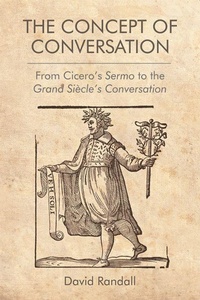
The Concept of Conversation
From Cicero's Sermo to the Grand Siecle's Conversation
Published on 9. February 2018
Book
Hardback
272 pages
978-1-4744-3010-4 (ISBN)
Description
The first history of early modern conversation in English
In the classical period, conversation referred to real conversations, conducted in the leisure time of noble men, and concerned with indefinite philosophical topics. Christianity inflected conversation with universal aspirations during the medieval centuries and the ars dictaminis, the art of letter writing, increased the importance of this written analogue of conversation. The Renaissance humanists from Petrarch onward further transformed conversation, and its genre analogues of dialogue and letter, by transforming it into a metaphor of increasing scope. This expanded realm of humanist conversation bifurcated in Renaissance and early modern Europe. The Concept of Conversation traces the way the rise of conversation spread out from the history of rhetoric to include the histories of friendship, the court and the salon, the Republic of Letters, periodical press and women. It revises Juergen Habermas' history of the emergence of the rational speech of the public sphere as the history of the emergence of rational conversation and puts the emergence of women's speech at the centre of the intellectual history of early modern Europe.
Key Features
The first book-length history of early modern conversation in EnglishSynthesizes early modern intellectual history within the frameworks of rhetoric and conversationPlaces the history of women's speech at the heart of the history of early modern rhetoricFuses Habermas' historical-theoretical framework to the history of rhetoric and revises both
In the classical period, conversation referred to real conversations, conducted in the leisure time of noble men, and concerned with indefinite philosophical topics. Christianity inflected conversation with universal aspirations during the medieval centuries and the ars dictaminis, the art of letter writing, increased the importance of this written analogue of conversation. The Renaissance humanists from Petrarch onward further transformed conversation, and its genre analogues of dialogue and letter, by transforming it into a metaphor of increasing scope. This expanded realm of humanist conversation bifurcated in Renaissance and early modern Europe. The Concept of Conversation traces the way the rise of conversation spread out from the history of rhetoric to include the histories of friendship, the court and the salon, the Republic of Letters, periodical press and women. It revises Juergen Habermas' history of the emergence of the rational speech of the public sphere as the history of the emergence of rational conversation and puts the emergence of women's speech at the centre of the intellectual history of early modern Europe.
Key Features
The first book-length history of early modern conversation in EnglishSynthesizes early modern intellectual history within the frameworks of rhetoric and conversationPlaces the history of women's speech at the heart of the history of early modern rhetoricFuses Habermas' historical-theoretical framework to the history of rhetoric and revises both
Reviews / Votes
This ambitious, wide-ranging, thoughtful and highly readable book offers a fresh approach to a form of communication that is attracting increasing interest, focusing on the changing idea of conversation over the centuries. * Peter Burke, Emmanuel College Cambridge * The sheer amount of material [this book covers] is at least half the appeal. Randall weaves a thick, elaborate, and mostly seamless tapestry from sometimes disparate threads. He prefers to let the texts speak for themselves, drawing his conclusions following lengthy quotations in English, French, and Italian. The other half of the [book's] appeal, then, is in Randall's nimble analyses. For instance, he finds persuasive geographical, temporal, and conceptual continuities to demonstrate the significance of natural law jurisprudence's emphasis on self-preservation, an emphasis that runs from Hugo Grotius, Thomas Hobbes, and Samuel Pufendorf through to the link between sociability, on theone hand, and behavior and manners, on the other. -- James Donathan Garner, University of Texas at Austin * Rhetorica *More details
Language
English
Place of publication
Edinburgh
United Kingdom
Target group
Professional and scholarly
College/higher education
Product notice
sewn/stitched
Cloth over boards
Dimensions
Height: 239 mm
Width: 155 mm
Thickness: 23 mm
Weight
522 gr
ISBN-13
978-1-4744-3010-4 (9781474430104)
Copyright in bibliographic data and cover images is held by Nielsen Book Services Limited or by the publishers or by their respective licensors: all rights reserved.
Schweitzer Classification
Other editions
Additional editions
E-Book
01/2018
1st Edition
Edinburgh University Press
€29.49
Available for download
Person
David Randall is Director of Research at the National Association of Scholars. His publications include Credibility in Elizabethan and Early Stuart Military News (2008) and English Military News Pamphlets, 1513-1637 (2011).
Content
Introduction; 1. The Classic Origins of Conversation; 2. The Medieval Reformulations of Conversation; 3. The Renaissance of Conversation; 4. Intimate Friendship; 5. Court, Salon, and Republic of Letters; 6. Letters; 7. Sociabilitas; Conclusion.