

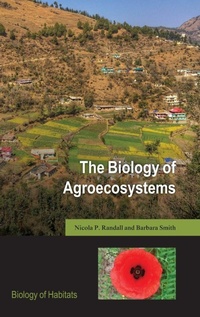
The Biology of Agroecosystems
Published on 27. November 2019
Book
Hardback
208 pages
978-0-19-873752-0 (ISBN)
Description
Since the advent of agriculture approximately 12,000 years ago, human activity has created a unique set of ecosystems. However, the recent development of world markets, rapid technological advances, and other changes to farming practices have led to hugely increased pressures on farm habitats and organisms. Global human populations are rising and diets are becoming ever more complicated, leading to unrelenting requirements for increased levels of food production. Natural biotopes are becoming increasingly fragmented as agricultural activities expand around them.
"Agroecosystems" now occur from the tropics to subarctic environments and comprise systems as varied as annual crops, perennial grasslands, orchards, and agroforestry systems. They presently cover almost 40% of the terrestrial land surface and significantly shape landscapes at a global scale. This key addition to the OUP Biology of Habitats Series provides a novel perspective on agroecosystems, summarising our current understanding of the basic and applied aspects of these important and complex habitats, whilst focusing on environmental concerns in the context of global change.
The Biology of Agroecosystemsis is for both senior undergraduate and graduate students taking courses in agroecology, farmland ecology, conservation, and agriculture as well as the many professional ecologists, conservation biologists, and land managers requiring a concise overview of agroecology.
"Agroecosystems" now occur from the tropics to subarctic environments and comprise systems as varied as annual crops, perennial grasslands, orchards, and agroforestry systems. They presently cover almost 40% of the terrestrial land surface and significantly shape landscapes at a global scale. This key addition to the OUP Biology of Habitats Series provides a novel perspective on agroecosystems, summarising our current understanding of the basic and applied aspects of these important and complex habitats, whilst focusing on environmental concerns in the context of global change.
The Biology of Agroecosystemsis is for both senior undergraduate and graduate students taking courses in agroecology, farmland ecology, conservation, and agriculture as well as the many professional ecologists, conservation biologists, and land managers requiring a concise overview of agroecology.
Reviews / Votes
The authors accomplished their goal for this book by providing readers with a thorough yet succinct background on agroecosystems, including the biological pressures and issues that must be considered in successful management of these complex systems. The Biology of Agroecosystems would be beneficial to students, land managers, and researchers with an interest in balancing agricultural production and natural resource conservation. * Andrew R. Little, Journal of Wildlife Management *More details
Series
Language
English
Place of publication
Oxford
United Kingdom
Target group
College/higher education
Dimensions
Height: 240 mm
Width: 161 mm
Thickness: 16 mm
Weight
485 gr
ISBN-13
978-0-19-873752-0 (9780198737520)
Copyright in bibliographic data and cover images is held by Nielsen Book Services Limited or by the publishers or by their respective licensors: all rights reserved.
Schweitzer Classification
Other editions
Additional editions
Nicola Randall | Barbara Smith
The Biology of Agroecosystems
Book
11/2019
Oxford University Press
€69.80
Shipment within 15-20 days
Nicola Randall | Barbara Smith
The Biology of Agroecosystems
E-Book
11/2019
1st Edition
OUP eBook
€47.49
Available for download
Persons
Dr Nicola Randall is Director of the Centre for Evidence Based Agriculture (CEBA) at Harper Adams University, UK, a reviewing, training and co-ordinating hub for the collation and synthesis of agri-food evidence and part of the UK Collaboration for Environmental Evidence Centre. Her main research interests are in the fields of agricultural ecology and sustainable food production, and in the use of scientific evidence in order to support and underpin policy and management decision making. She is Course Leader for the Agroecology MSc at Harper Adams University.
Dr Barbara Smith is a Senior Research Fellow in Agricultural Ecology and Public Science at the Centre for Agroecology, Water and Resilience, Coventry University, UK. She is an Associate Director of the Centre for Pollination Studies at Calcutta University and is Chair of the Agricultural Ecology Special Interest Group of the British Ecological Society. She previously worked as a Senior Scientist in the Farmland Ecology Unit at the Game and Wildlife Conservation Trust (2002-2015) developing and evaluating agri-environment scheme options.
Dr Barbara Smith is a Senior Research Fellow in Agricultural Ecology and Public Science at the Centre for Agroecology, Water and Resilience, Coventry University, UK. She is an Associate Director of the Centre for Pollination Studies at Calcutta University and is Chair of the Agricultural Ecology Special Interest Group of the British Ecological Society. She previously worked as a Senior Scientist in the Farmland Ecology Unit at the Game and Wildlife Conservation Trust (2002-2015) developing and evaluating agri-environment scheme options.
Content
1: Introduction
2: Agricultural environments
3: Biodiversity
4: Biotic interactions and ecosystem functioning
5: Soils
6: Water (hydrology)
7: The Biological Impacts of Globalization of Agriculture
8: Conservation and sustainable management of agroecosystems
9: Future perspectives
2: Agricultural environments
3: Biodiversity
4: Biotic interactions and ecosystem functioning
5: Soils
6: Water (hydrology)
7: The Biological Impacts of Globalization of Agriculture
8: Conservation and sustainable management of agroecosystems
9: Future perspectives