

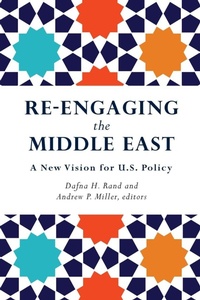
Re-Engaging the Middle East
A New Vision for U.S. Policy
Published on 22. September 2020
Book
Paperback/Softback
332 pages
978-0-8157-3740-7 (ISBN)
Description
It's time for new policies based on changing U.S. interests
U.S. policy in the Middle East has had very few successes in recent years, so maybe it's time for a different approach. But is the new approach of the Trump administration?military disengagement coupled with unquestioning support for key allies--Israel, Egypt, and Saudi Arabia?the way forward?
In this edited volume, noted experts on the region lay out a better long-term strategy for protecting U.S. interests in the Middle East. The authors articulate a vision that is both self-interested and carefully tailored to the unique dynamics of the increasingly divergent sub-regions in the Middle East, including North Africa, the Sunni Arab bloc of Egypt and Persian Gulf states, and the increasingly chaotic Levant.
The book argues that the most effective way to pursue and protect U.S. interests is unlikely to involve the same alliance-centric approach that has been the basis of Washington's policy since the 1990s. Instead, the United States should adopt a nimbler and less military-dominant strategy that relies on a diversified set of partners and a determination to establish priorities for American interests and the use of resources, both financial and military.
In essence, the book calls for a new post-Obama and post-Trump approach to the region that reflects the fact that U.S. interests are changing and likely will continue to change. The book offers a fresh perspective in advance of the 2020 presidential election.
U.S. policy in the Middle East has had very few successes in recent years, so maybe it's time for a different approach. But is the new approach of the Trump administration?military disengagement coupled with unquestioning support for key allies--Israel, Egypt, and Saudi Arabia?the way forward?
In this edited volume, noted experts on the region lay out a better long-term strategy for protecting U.S. interests in the Middle East. The authors articulate a vision that is both self-interested and carefully tailored to the unique dynamics of the increasingly divergent sub-regions in the Middle East, including North Africa, the Sunni Arab bloc of Egypt and Persian Gulf states, and the increasingly chaotic Levant.
The book argues that the most effective way to pursue and protect U.S. interests is unlikely to involve the same alliance-centric approach that has been the basis of Washington's policy since the 1990s. Instead, the United States should adopt a nimbler and less military-dominant strategy that relies on a diversified set of partners and a determination to establish priorities for American interests and the use of resources, both financial and military.
In essence, the book calls for a new post-Obama and post-Trump approach to the region that reflects the fact that U.S. interests are changing and likely will continue to change. The book offers a fresh perspective in advance of the 2020 presidential election.
More details
Language
English
Place of publication
United States
Publishing group
Bloomsbury Publishing Plc
Target group
Professional and scholarly
Dimensions
Height: 229 mm
Width: 152 mm
Thickness: 20 mm
Weight
540 gr
ISBN-13
978-0-8157-3740-7 (9780815737407)
Copyright in bibliographic data and cover images is held by Nielsen Book Services Limited or by the publishers or by their respective licensors: all rights reserved.
Schweitzer Classification
Other editions
Additional editions
E-Book
09/2020
1st Edition
Brookings Institution
€41.49
Available for download
E-Book
09/2020
1st Edition
Brookings Institution
€41.49
Available for download
Persons
Dafna H. Rand most recently served as Deputy Assistant Secretary in the State Department's Bureau of Democracy, Human Rights and Labor, on Secretary Hillary Clinton's Policy Planning Staff, and on the staff of the National Security Council. She is the author of Roots of the Arab Spring: Contested Authority and Political Change in the Middle East.Andrew P. Miller is the deputy director for policy at the Project on Middle East Democracy and a nonresident scholar in the Carnegie Endowment for International Peace's Middle East Program. Miller served on President Obama's National Security Council from 2014 to 2017, and previously worked in the Department of State.
Content
Contents:
Preface
Acknowledgments
1. Between Retreat and Overinvestment in the Middle East and North Africa
Andrew P. Miller and Dafna H. Rand
Part I: Defusing Regional Conflicts and Rebuilding Diplomatic Influence
2. The Syrian Crucible and Future U.S. Options
Wa'el Alzayat
3. Moving from Partisan to Peacemaker in Yemen
Christopher J. Le Mon
4. Toward a Stable Libya
Megan Doherty
Part II: Re-Imagining Key U.S. Security Partnerships
5. The U.S.-Israel Relationship and the Israeli-Palestinian Arena
Daniel B. Shapiro
6. Why Iraq Matters
Jon Finer
7. The United States and Egypt Updating an Obsolete Relationship
Amy Hawthorne and Andrew P. Miller
8. Recalibrating the Terms of U.S.-Saudi Relations
Daniel Benaim
Part III: Regional Challenges for the United States
9. A New Cold War in the Middle East?
Alexander Bick
10. Iran: Leading with Diplomacy
Sahar Nowrouzzadeh and Jane Rhee
11. Adapting U.S. Defense Posture in the Middle East for New Priorities
Melissa Dalton and Mara Karlin
12. The Use and Misuse of Security Assistance in the Middle East and North Africa
Stephen Tankel
13. Toward Strategic Investments in Foreign Assistance: The Tunisia Experiment
Dafna H. Rand
Conclusion: Looking to the Future
Dafna H. Rand and Andrew P. Miller
Contributors
Index
Preface
Acknowledgments
1. Between Retreat and Overinvestment in the Middle East and North Africa
Andrew P. Miller and Dafna H. Rand
Part I: Defusing Regional Conflicts and Rebuilding Diplomatic Influence
2. The Syrian Crucible and Future U.S. Options
Wa'el Alzayat
3. Moving from Partisan to Peacemaker in Yemen
Christopher J. Le Mon
4. Toward a Stable Libya
Megan Doherty
Part II: Re-Imagining Key U.S. Security Partnerships
5. The U.S.-Israel Relationship and the Israeli-Palestinian Arena
Daniel B. Shapiro
6. Why Iraq Matters
Jon Finer
7. The United States and Egypt Updating an Obsolete Relationship
Amy Hawthorne and Andrew P. Miller
8. Recalibrating the Terms of U.S.-Saudi Relations
Daniel Benaim
Part III: Regional Challenges for the United States
9. A New Cold War in the Middle East?
Alexander Bick
10. Iran: Leading with Diplomacy
Sahar Nowrouzzadeh and Jane Rhee
11. Adapting U.S. Defense Posture in the Middle East for New Priorities
Melissa Dalton and Mara Karlin
12. The Use and Misuse of Security Assistance in the Middle East and North Africa
Stephen Tankel
13. Toward Strategic Investments in Foreign Assistance: The Tunisia Experiment
Dafna H. Rand
Conclusion: Looking to the Future
Dafna H. Rand and Andrew P. Miller
Contributors
Index