

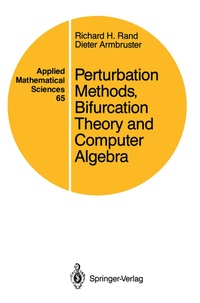
Perturbation Methods, Bifurcation Theory and Computer Algebra
Published on 5. October 1987
Book
Paperback/Softback
IX, 251 pages
978-0-387-96589-5 (ISBN)
Description
Perturbation methods have always been an important tool for treating nonlinear differential equations. Now the drudgery associated with them has been eliminated! This book offers computer algebra (MACSYMA) programs which implement the most popular perturbation methods. Not only does this avoid the errors associated with hand computation, but the increase in efficiency permits more complicated problems to be tackled. This book is useful both for the beginner learning perturbation methods for the first time, as well as for the researcher. Methods covered include: Lindstedt's method, center manifolds, normal forms, two variable expansion method (method of multiple scales), averaging, Lie transforms and Liapunov-Schmidt reduction. For each method the book includes an introduction and some example problems solved both by hand and by machine. The examples feature common bifurcations such as the pitchfork and the Hopf. The MACSYMA code for each method is given and suggested exercises are provided at the end of each Chapter. An Appendix offers a brief introduction to MACSYMA.
More details
Series
Edition
Softcover reprint of the original 1st ed. 1987
Language
English
Place of publication
New York
United States
Target group
Professional and scholarly
Research
Illustrations
1 s/w Abbildung
IX, 251 p. 1 illus.
Dimensions
Height: 235 mm
Width: 155 mm
Thickness: 15 mm
Weight
400 gr
ISBN-13
978-0-387-96589-5 (9780387965895)
DOI
10.1007/978-1-4612-1060-3
Schweitzer Classification
Content
1 Lindstedt's Method.- 2 Center Manifolds.- 3 Normal Forms.- 4 Two Variable Expansion Method.- 5 Averaging.- 6 Lie Transforms.- 7 Liapunov-Schmidt Reduction.- Appendix Introduction to MACSYMA.- References.