

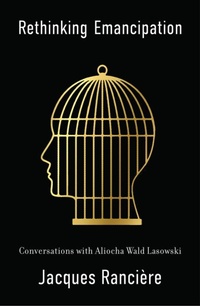
Rethinking Emancipation
Conversations with Aliocha Wald Lasowski
1st Edition
Published on 6. September 2024
Book
Paperback/Softback
140 pages
978-1-5095-5923-7 (ISBN)
Description
Faced with growing inequalities and new forms of domination and exploitation, can the movement of emancipation take on a new life today, or has it been arrested by the powers of repression and normalization?
In order to address this question, Jacques Ranciere pays close attention to the sociopolitical rhythms of our time, listening for the figures of trembling and oscillation that are often drowned out by the deafening hubbub of the media. He questions the relationship between democracies and the very concept of democracy, and questions what, in the social movements and protests taking place today, offers a possibility of emancipation. Emancipation means breaking out of the established hierarchies, proposing a ludic attitude of free-floating distance and bringing into it a space of equality to replace the dominant order of inequalities.
In five conversations on politics, art, literature, philosophy and cinema, Jacques Ranciere and Aliocha Wald Lasowski consider the form, experience and collectives which characterise emancipation. In so doing, they imagine the world of tomorrow and the radical utopias that will bring it closer to us.
In order to address this question, Jacques Ranciere pays close attention to the sociopolitical rhythms of our time, listening for the figures of trembling and oscillation that are often drowned out by the deafening hubbub of the media. He questions the relationship between democracies and the very concept of democracy, and questions what, in the social movements and protests taking place today, offers a possibility of emancipation. Emancipation means breaking out of the established hierarchies, proposing a ludic attitude of free-floating distance and bringing into it a space of equality to replace the dominant order of inequalities.
In five conversations on politics, art, literature, philosophy and cinema, Jacques Ranciere and Aliocha Wald Lasowski consider the form, experience and collectives which characterise emancipation. In so doing, they imagine the world of tomorrow and the radical utopias that will bring it closer to us.
Reviews / Votes
"Open-ended, informative, reflecting with acumen and care on the stakes of politics and aesthetics, Aliocha Wald Lasowski's conversation with Jacques Ranciere tells us how and why we need dialogue and dissensus to contend with the glaring social inequalities in our midst. Clear and concise on every page, Rethinking Emancipation mobilizes Ranciere's writing from Althusser's Lesson (1974) to Aisthesis (2011) and beyond. A practical work of the highest ethical order."Tom Conley, Harvard University
"For readers seeking not only to understand why freedom matters, but how it can be made real, Ranciere's book - especially in dialogue with these leading radical theorists - is essential reading."
Capital & Class
More details
Language
English
Place of publication
Oxford
United Kingdom
Publishing group
John Wiley and Sons Ltd
Target group
College/higher education
Product notice
Paperback (trade)
Unsewn / adhesive bound
Dimensions
Height: 185 mm
Width: 120 mm
Thickness: 12 mm
Weight
164 gr
ISBN-13
978-1-5095-5923-7 (9781509559237)
Copyright in bibliographic data and cover images is held by Nielsen Book Services Limited or by the publishers or by their respective licensors: all rights reserved.
Schweitzer Classification
Other editions
Additional editions
Book
09/2024
1st Edition
Polity Press
€42.00
Shipment within 15-20 days
E-Book
08/2024
1st Edition
Wiley
€10.99
Available for download
E-Book
08/2024
1st Edition
Wiley-Spektrum
€10.99
Available for download
Persons
Jacques Ranciere is a leading French philosopher and Professor Emeritus of Philosophy at the University of Paris-St. Denis. He is the author of many books on politics and aesthetics including Hatred of Democracy, The Emancipated Spectator, The Politics of Literature and The Edges of Fiction.
Content
Foreword by Aliocha Wald Lasowski
Chapter 1. Politics: The democratic paradox
Chapter 2. Aesthetics: Aesthetic democracy and social emancipation
Chapter 3. Literature: the politics of writers and the revolution in literature
Chapter 4. Philosophy: Althusser, the theoretical weapon of a revival of Marxism
Chapter 5. Cinema: the sensible fabric of the new life
Notes
Chapter 1. Politics: The democratic paradox
Chapter 2. Aesthetics: Aesthetic democracy and social emancipation
Chapter 3. Literature: the politics of writers and the revolution in literature
Chapter 4. Philosophy: Althusser, the theoretical weapon of a revival of Marxism
Chapter 5. Cinema: the sensible fabric of the new life
Notes