

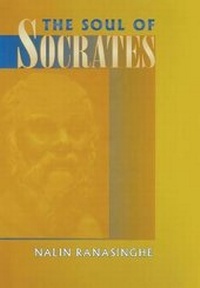
The Soul of Socrates
Published on 15. June 2000
Book
Hardback
224 pages
978-0-8014-3746-5 (ISBN)
Description
Nalin Ranasinghe has a strong affection for the Socrates he finds in four of Plato's most influential dialogues. This engagingly humane book traces Plato's struggle to simultaneously understand and convey the erotic presence of Socrates. Most commentators suppose that Plato assumes an ironic distance from Socrates. Ranasinghe claims, rather, that the dialogues reflect Plato's awe and frustration before the enigmatic figure whose conduct fascinated and bewildered Classical Athens.
In original readings of the Republic, the Protagoras, the Phaedo, and the Symposium, Ranasinghe uncovers the profound literary and thematic unity of each work and shows new connections among the dialogues. From this re-reading, Ranasinghe proposes new answers to such perennial problems as the invalidity of the four proofs of the soul's immortality in the Phaedo, the draconian nature of the perfect regime described in the Republic, and the nature of Socrates' dalliance with Alcibiades in the Symposium.
The book begins with an exegesis of the Republic that defends Socrates against the charge that he offers the blueprint for a totalitarian state-this slander must be refuted, Ranasinghe argues, before Plato can be understood as a liberal humanist. The chapter on the Protagoras examines the roots of sophistry and explicates a startling similarity between Protagoras and the nihilistic intellectual of the present day. The chapter on the Phaedo attacks the depiction of Plato as an otherworldly mystic who despised human existence. Two final chapters on the Symposium reveal the true Socrates. He is, Ranasinghe finds, an exemplary citizen and a human being passionately devoted to his mission of reconciling the mind to the desires.
Ranasinghe's readings bring the distant and inscrutable figure of Socrates to life. They offer a vivid account of philosophical virtue that resonates over the centuries: how to live with integrity and grace in a world of uncertainty.
In original readings of the Republic, the Protagoras, the Phaedo, and the Symposium, Ranasinghe uncovers the profound literary and thematic unity of each work and shows new connections among the dialogues. From this re-reading, Ranasinghe proposes new answers to such perennial problems as the invalidity of the four proofs of the soul's immortality in the Phaedo, the draconian nature of the perfect regime described in the Republic, and the nature of Socrates' dalliance with Alcibiades in the Symposium.
The book begins with an exegesis of the Republic that defends Socrates against the charge that he offers the blueprint for a totalitarian state-this slander must be refuted, Ranasinghe argues, before Plato can be understood as a liberal humanist. The chapter on the Protagoras examines the roots of sophistry and explicates a startling similarity between Protagoras and the nihilistic intellectual of the present day. The chapter on the Phaedo attacks the depiction of Plato as an otherworldly mystic who despised human existence. Two final chapters on the Symposium reveal the true Socrates. He is, Ranasinghe finds, an exemplary citizen and a human being passionately devoted to his mission of reconciling the mind to the desires.
Ranasinghe's readings bring the distant and inscrutable figure of Socrates to life. They offer a vivid account of philosophical virtue that resonates over the centuries: how to live with integrity and grace in a world of uncertainty.
More details
Language
English
Place of publication
Ithaca
United States
Target group
College/higher education
Professional and scholarly
Product notice
Paper over boards
Dimensions
Height: 229 mm
Width: 152 mm
Thickness: 22 mm
Weight
907 gr
ISBN-13
978-0-8014-3746-5 (9780801437465)
Copyright in bibliographic data and cover images is held by Nielsen Book Services Limited or by the publishers or by their respective licensors: all rights reserved.
Schweitzer Classification
Person
Nalin Ranasinghe is Assistant Professor of Philosophy at Assumption College.