

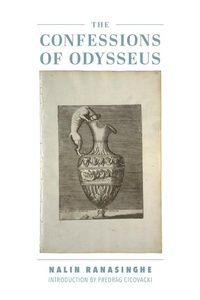
The Confessions of Odysseus
Will be published approx. on 14. May 2021
Book
Hardback
240 pages
978-1-58731-137-6 (ISBN)
Description
Nalin Ranasinghe undertakes the monumentally brash assignment of accusing man and then offering his defense, precisely as Homer does of Odysseus in the Iliad. Odysseus is portrayed as a human being deserving of both. For this reason and Homer's perceptive descriptions, Ranasinghe claims Homer's epic is the cornerstone of Western civilization. The central insights herein compel Ranasinghe to admit the necessity of heeding its lessons today, of minding its characters and seeing them in action off the page and in our own world.
Predrag Cicovacki in his indispensable preface to the book, elucidates: "In Ranasinghe's view, Odysseus is both the first recognizable human being and a model of curious and concupiscent human rationality that constantly strives toward the virtues of self-knowledge and moderation. Homer leads us to believe that the cosmos leans toward virtue, although its fundamental truths may be inherently unspeakable. This is the line of thought that Ranasinghe believes was further developed by Socrates, Plato, and Jesus, while being obscured by Aristotle, Augustine, and their followers. Homer's later epic and his central insights are, according to Ranasinghe, the most fertile soil on which a humane civilization can grow and flourish."
Yet Ranasinghe ultimately says it best. "Homer must be read as the wisest Greeks did, not for fantastic tales of the Olympians but because his myths reveal eternal constants of the human state: the soul's ruling passions and the possibility of knowing and educating these false gods. Wrestled with thus the Iliad becomes a cautionary tale, not one urging literal reading or mindless mimesis. It may always be that for the few who grasp Homer, many more will obey his gods or imitate his antiheroes; but the Odyssey hints that while its poet sees this potential for misuse, he is willing to take a noble risk and hope that eros can listen to and educate thumos. This faith is implicit in his tale of Achilles and the Trojan War. It is vital today that we see how the West's end resembles its angry origins, as depicted in the Iliad. This is why Homer is said to be as fresh as the morning newspaper. His wisdom may outlive our literacy."
Predrag Cicovacki in his indispensable preface to the book, elucidates: "In Ranasinghe's view, Odysseus is both the first recognizable human being and a model of curious and concupiscent human rationality that constantly strives toward the virtues of self-knowledge and moderation. Homer leads us to believe that the cosmos leans toward virtue, although its fundamental truths may be inherently unspeakable. This is the line of thought that Ranasinghe believes was further developed by Socrates, Plato, and Jesus, while being obscured by Aristotle, Augustine, and their followers. Homer's later epic and his central insights are, according to Ranasinghe, the most fertile soil on which a humane civilization can grow and flourish."
Yet Ranasinghe ultimately says it best. "Homer must be read as the wisest Greeks did, not for fantastic tales of the Olympians but because his myths reveal eternal constants of the human state: the soul's ruling passions and the possibility of knowing and educating these false gods. Wrestled with thus the Iliad becomes a cautionary tale, not one urging literal reading or mindless mimesis. It may always be that for the few who grasp Homer, many more will obey his gods or imitate his antiheroes; but the Odyssey hints that while its poet sees this potential for misuse, he is willing to take a noble risk and hope that eros can listen to and educate thumos. This faith is implicit in his tale of Achilles and the Trojan War. It is vital today that we see how the West's end resembles its angry origins, as depicted in the Iliad. This is why Homer is said to be as fresh as the morning newspaper. His wisdom may outlive our literacy."
More details
Language
English
Place of publication
Indiana
United States
Target group
Professional and scholarly
Product notice
sewn/stitched
Cloth over boards
Dimensions
Height: 231 mm
Width: 155 mm
Thickness: 18 mm
Weight
431 gr
ISBN-13
978-1-58731-137-6 (9781587311376)
Copyright in bibliographic data and cover images is held by Nielsen Book Services Limited or by the publishers or by their respective licensors: all rights reserved.
Schweitzer Classification
Other editions
Additional editions
Ranasinghe Nalin Ranasinghe
Confessions of Odysseus
E-Book
05/2021
St Augustine's Press
€24.49
Available for download
Persons
Nalin Ranasinghe was professor of philosophy at Assumption University, and author of The Soul of Socrates, Socrates in the Underworld: On Plato's Gorgias, and Socrates and the Gods: How to Read Plato's Euthyphro, Apology, and Crito.